A magnetic needle suspended parallel to a magnetic field requires $\sqrt 3\,J $ of work to turn it through $60^o$. The torque needed to maintain the needle in this position will be
Medium
Download our app for free and get started
$\mathrm{W}=\mathrm{MB}\left(\cos \theta_{1}-\cos \theta_{2}\right)$
$\sqrt{3}=\mathrm{MB}\left(\cos 0^{\circ}-\cos 60^{\circ}\right)$
$\mathrm{MB}=2 \sqrt{3}$
$\tau=M B \sin \theta=2 \sqrt{3} \times \sin 60^{\circ}=3\, \mathrm{J}$

Download our appand get started for free
Experience the future of education. Simply download our apps or reach out to us for more information. Let's shape the future of learning together!No signup needed.*
Similar Questions
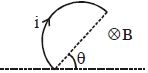
- 1An electron is accelerated by a potential difference of $12000\, volts$. It then enters a uniform magnetic field of ${10^{ - 3}}\,T$ applied perpendicular to the path of electron. Find the radius of path. Given mass of electron $ = 9 \times {10^{ - 31}}\,kg$ and charge on electron $ = 1.6 \times {10^{ - 19}}\,C$View Solution
- 2View SolutionMagnetic dipole moment of a rectangular loop is
- 3In the hydrogen atom, the electron is making $6.6 \times {10^{15}}\,r.p.s.$ If the radius of the orbit is $0.53 \times {10^{ - 10}}\,metre,$ then magnetic field produced at the centre of the orbit is......$Tesla$View Solution
- 4A galvanometer having a coil resistance of $30\,\Omega $ shows full scale deflection when a current of $2\,A$ passes through it. It can be converted into an ammeter to read currents upto $10\,A$ byView Solution
- 5In a toroid the number of turns per unit length is $1000$ and current through it is $\frac{1}{4 \pi}$ ampere. The magnetic field produced inside (in $weber / m ^2$ ) will beView Solution
- 6View SolutionIf the radius of a coil is halved and the number of turns doubled, then the magnetic field at the centre of the coil, for the same current will
- 7A thin ring of $10\, cm$ radius carries a uniformly distributed charge. The ring rotates at a constant angular speed of $40\,\pi \,rad\,{s^{ - 1}}$ about its axis, perpendicular to its plane. If the magnetic field at its centre is $3.8 \times {10^{ - 9}}\,T$, then the charge carried by the ring is close to $\left( {{\mu _0} = 4\pi \times {{10}^{ - 7}}\,N/{A^2}} \right)$View Solution
- 8A particle of mass $m$ and charge $q$ moves with a constant velocity $v$ along the positive $x$ direction. It enters a region containing a uniform magnetic field $B$ directed along the negative $z$ direction, extending from $x = a$ to $x = b$. The minimum value of $v$ required so that the particle can just enter the region $x > b$ isView Solution
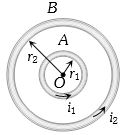
- 9$A$ and $B$ are two concentric circular conductors of centre $O$ and carrying currents ${i_1}$ and ${i_2}$ as shown in the adjacent figure. If ratio of their radii is $1 : 2$ and ratio of the flux densities at $O$ due to $A$ and $B$ is $1 : 3$, then the value of ${i_1}/{i_2}$ isView Solution
- 10A semicircular ring of radius $R$ carrying current $i$ is placed in a magnetic field of intensity $B$ so that plane of wire is perpendicular to magnetic field as shown. Net force acting on the ring isView Solution