MCQ
A man is looking at a small object placed at his near point. Without altering the position of his eye or the object, he puts a simple microscope of magnifying power 5X before his eyes. The angular magnification achieved is:
  • A
    5
  • B
    2.5
  • 1
  • D
    0.2

Answer

Correct option: C.
1
We have,

h = Object height
u = Object distance = 25cm
D = Near point = 25cm
Now,
$\text{m}=\frac{\frac{\text{h}}{\text{u}}}{\frac{\text{h}}{\text{D}}}$
$\Rightarrow\text{m}=\frac{\frac{\text{h}}{25}}{\frac{\text{h}}{25}}$
$\Rightarrow \text{m}=1$

Need a full question paper?

Generate a complete, print-ready paper with questions like this in minutes — across 16+ boards, with answer keys.

Start Generating Free

Similar questions

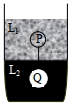
Two spheres $P$ and $Q$ of equal radii have densities $\rho_1$ and $\rho_2$, respectively. The spheres are connected by a massless string and placed in liquids $L_1$ and $L_2$ of densities $\sigma_1$ and $\sigma_2$ and viscosities $\eta_1$ and $\eta_2$, respectively. They float in equilibrium with the sphere $P$ in $L_1$ and sphere $Q$ in $L _2$ and the string being taut (see figure). If sphere $P$ alone in $L _2$ has terminal velocity $\overrightarrow{ V }_{ P }$ and $Q$ alone in $L _1$ has terminal velocity $\overrightarrow{ V }_{ Q }$, then

$(A)$ $\frac{\left|\overrightarrow{ V }_{ P }\right|}{\left|\overrightarrow{ V }_{ Q }\right|}=\frac{\eta_1}{\eta_2}$ $(B)$ $\frac{\left|\overrightarrow{ V }_{ P }\right|}{\left|\overrightarrow{ V }_{ Q }\right|}=\frac{\eta_2}{\eta_1}$

$(C)$ $\overrightarrow{ V }_{ P } \cdot \overrightarrow{ V }_{ Q } > 0$ $(D)$ $\overrightarrow{ V }_{ P } \cdot \overrightarrow{ V }_{ Q } < 0$
Two trains travelling on the same track are approaching each other with equal speeds of $40\, m/s$. The drivers of the trains begin to decelerate simultaneously when they are just $2.0\, km$ apart. Assuming the decelerations to be uniform and equal, the value of the deceleration to barely avoid collision should be.........$m/{s^2}$
In a certain thermodynamical process, the pressure of a gas depends on its volume as $kV ^{3}$. The work done when the temperature changes from $100^{\circ} C$ to $300^{\circ} C$ will be .......... $nR$, where $n$ denotes number of moles of a gas.
A rubber ball is taken to a $100\, m$ deep lake and its volume changes by $0.1\%$. The bulk modulus of rubber is nearly
A mass $m$ attached to free end of a spring executes SHM with a period of $1\; s$. If the mass is increased by $3\; kg$ the period of oscillation increases by one second, the value of mass $m$ is $..............kg$.
A pipe $17\, cm$ long is closed at one end. Which harmonic mode of the pipe resonates  a $1.5\, kHz$ source ? 
(Speed of sound in air $= 340\, m\, s^{-1}$)
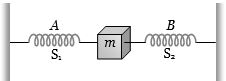
In the figure, ${S_1}$ and ${S_2}$ are identical springs. The oscillation frequency of the mass $m$ is $f$. If one spring is removed, the frequency will become
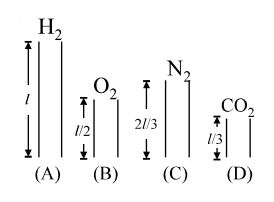
Four open organ pipes of different lengths and different gases at same temperature as shown in figure. Let $f_A$, $f_B$, $f_C$ and $f_D$ be their fundamental frequencies then :[Take ${\gamma _{c{o_2}}} = 7/5$]
In which of the following situations, the heavier of the two particles has smaller de Broglie wavelength? The two particles:
A gun is aimed at a target in a line of its barrel. The target is released and allowed to fall under gravity at the same instant the gun is fired. The bullet will