MCQ
A man sets his watch by a whistle that is $2\, km$ away. How much will his watch be in error. (speed of sound in air $330\, m/sec$)
  • A
    $3$ seconds fast
  • B
    $3$ seconds slow
  • C
    $6$ seconds fast
  • $6$ seconds slow

Answer

Correct option: D.
$6$ seconds slow
d
(d) Time lost in covering the distance of $2\, km$ by the sound waves

$t = \frac{d}{v} = \frac{{2000}}{{330}} = 6.06\,sec \approx 6\, sec$

Need a full question paper?

Generate a complete, print-ready paper with questions like this in minutes — across 16+ boards, with answer keys.
Start Generating Free

Similar questions

A unitless quantity?
The layers of atmosphere are heated through
The position vector of a particle changes with time according to the relation $\vec r\left( t \right) = 15{t^2}\hat i + \left( {4 - 20{t^2}} \right)\hat j$. What is the magnitude of the acceleration at $t = 1$ ?
The dimensional formula for $r.m.s.$ (root mean square) velocity is
For nuclei with $A > 100:$
  1. The binding energy of the nucleus decreases on an average as $A$ increases.
  2. The binding energy per nucleon decreases on an average as $A$ increases.
  3. If the nucleus breaks into two roughly equal parts, energy is released.
  4. If two nuclei fuse to form a bigger nucleus, energy is released.
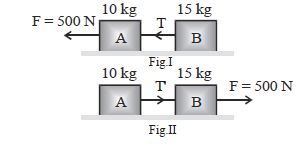
Two bodies $A$ and $B$ of masses $10\,\, kg$ and $15\, kg$ respectively kept on a smooth, horizontal surface are tied to the ends of a light string. If $T$ represents the tension in the string when a horizontal force $F = 500\, N$ is applied to $A$ (as shown in figure $1$) and $T'$ be the tension when it is applied to $B$ (figure $2$), then which of the following is true
Water rises upto $10\, cm$ height in a long capillary tube. If this tube is immersed in water so that the height above the water surface is only $8 \,cm,$  then
A truck of mass $10,000\, kg$ moves up an inclined plane rising $1$ in $50$ with a speed of $36\, km/h$. Find the power of engine .................. $\mathrm{kW}$  $(g = 10\, m/s^2$)
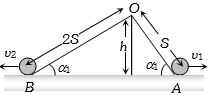
Two uniform similar discs roll down two inclined planes of length $S$ and $2S$ respectively as shown is the fig. The velocities of two discs at the points $A$ and $B$ of the inclined planes are related as
A force $F = Be^{-Ct}$ acts on a particle whose mass is $m$ and whose velocity is $0$ at $t = 0$. It’s terminal velocity is :