MCQ
Vapour is injected at a uniform rate in a closed vessel which was initially evacuated. The pressure in the vessel
  • A
    Increase continuously
  • B
    Decreases continuously
  • First increases and then decreases
  • D
    First increase and then becomes constant

Answer

Correct option: C.
First increases and then decreases
c
When the number of moles increases, the pressure increases, and at a certain pressure the vapor condenses, so now the pressure decreases

Need a full question paper?

Generate a complete, print-ready paper with questions like this in minutes — across 16+ boards, with answer keys.
Start Generating Free

Similar questions

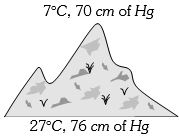
At the top of a mountain a thermometer reads $7°C$ and a barometer reads $70\, cm$ of $Hg.$ At the bottom of the mountain these read $27°C$ and $76 \,cm$ of $Hg$ respectively. Comparison of density of air at the top with that of bottom is
A simple pendulum of length $1 \mathrm{~m}$ has a wooden bob of mass $1 \mathrm{~kg}$. It is struck by a bullet of mass $10^{-2} \mathrm{~kg}$ moving with a speed of $2 \times 10^2 \mathrm{~ms}^{-1}$. The bullet gets embedded into the bob. The height to which the bob rises before swinging back is. (use $\mathrm{g}=10 \mathrm{~m} / \mathrm{s}^2$ )
Masses $m$ and $3m$ are attached to the two ends of a spring of constant $k.$ If the system vibrates freely, the period of oscillation will be:
The two interfering waves have intensities in the ratio $9 : 4$. The ratio of intensities of maxima and minima in the interference pattern will be
Two identical beakers $A$ and $B$ contain equal volumes of two different liquids at $60\,^oC$ each and left to cool down. Liquid in $A$ has density of $8 \times10^2\, kg / m^3$ and specific heat of $2000\, Jkg^{-1}\,K^{-1}$ while liquid in $B$ has density of $10^3\,kgm^{-3}$ and specific heat of $4000\,JKg^{-1}\,K^{-1}$ . Which of the following best describes their temperature versus time graph schematically? (assume the emissivity of both the beakers to be the same)
Water flows out of the hole on the side of a bucket and follows a parabolic path. If the bucket falls freely under gravity, ignoring air resistance, the water flow
A stone is projected from ground at $t = 0$. At the time of projection horizontal and vertical component of velocity are $10\, m/s$ and $20\, m/s$ respectively. Then time at which tangential and normal acceleration magnitude will be equal $(g = 10\, m/s^2)$ [neglect air friction]    ......... $\sec$
A plane is revolving around the earth with a speed of $100\, km/hr $ at a constant height from the surface of earth. The change in the velocity as it travels half circle is.........$km/hr$
The escape velocity of a sphere of mass $m$ is given by $(G=$ Universal gravitational constant; $M_e=$ Mass of the earth and $R_e=$ Radius of the earth)
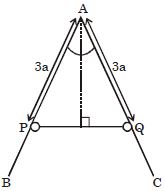
In the diagram, $BAC$ is a rigid fixed rough wire and angle $BAC$ is $60^o$. $P$ and $Q$ are two identical rings of mass $m$ connected by a light elastic string of natural length $2a$ and elastic constant $\frac{mg}{a}$. If $P$ and $Q$ are in equilibrium when $PA = AQ = 3a$ then the least coefficient of friction between the ring and the wire is $\mu$. Then value of $\mu + \sqrt 3 $ is :-