Two thin blankets keep more hotness than one blanket of thickness equal to these two. The reason is
Easy
Download our app for free and get started
(b) Two thin blankets usually warmer than one thick blanket because air is trapped between them. And the air is bad conductor of heat. It does not pass heat from our body to the surroundings.

Download our appand get started for free
Experience the future of education. Simply download our apps or reach out to us for more information. Let's shape the future of learning together!No signup needed.*
Similar Questions
- 1The heat is flowing through two cylindrical rods of same material. The diameters of the rods are in the ratio $1 : 2$ and their lengths are in the ratio $2 : 1$ . If the temperature difference between their ends is the same, the ratio of rate of flow of heat through them will beView Solution
- 2The power radiated by a black body is $P$ and it radiates maximum energy at wavelength,$\lambda_0.$ If the temperature of the black body is now changed so that it radiates maximum energy at wavelength $\frac{3}{4}\lambda_0$, the power radiated by it becomes $nP$. The value of $n$ isView Solution
- 3View SolutionHeat current is maximum in which of the following (rods are of identical dimension)
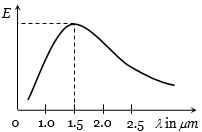
- 4View SolutionA body, which emits radiations of all possible wavelengths, is known as
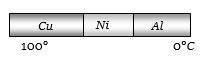
- 5A composite metal bar of uniform section is made up of length $25 cm$ of copper, $10 cm$ of nickel and $15 cm$ of aluminium. Each part being in perfect thermal contact with the adjoining part. The copper end of the composite rod is maintained at ${100^o}C$ and the aluminium end at ${0^o}C$. The whole rod is covered with belt so that there is no heat loss occurs at the sides. If ${K_{{\rm{Cu}}}} = 2{K_{Al}}$ and ${K_{Al}} = 3{K_{{\rm{Ni}}}}$, then what will be the temperatures of $Cu - Ni$ and $Ni - Al$ junctions respectivelyView Solution
- 6A black body radiates energy at the rate of $1 \times 10^5 J / s \times m^2$ at temperature of $227^o C$. The temperature to which it must be heated so that it radiates energy at rate of $1 \times 10^9J/s m^2$, isView Solution
- 7View SolutionFor cooking the food, which of the following type of utensil is most suitable
- 8Three large identical plates are kept parallel to each other. The outer two plates are maintained at temperatures $T$ and $2 T$, respectively. The temperature of the middle plate in steady state will be close to ........... $T$View Solution
- 9At temperature $T$ , the power radiated by a body is $Q$ watts. At the temperature $3T$ the power radiated by it will beView Solution
- 10In the figure, the distribution of energy density of the radiation emitted by a black body at a given temperature is shown. The possible temperature of the black body is ....... $K$View Solution