Question
A metallic ring of mass m and radius l (ring being horizontal) is falling under gravity in a region having a magnetic field. If z is the vertical direction, the z-component of magnetic field is $\text{B}_\text{z}=\text{B}_0(1+\lambda\text{z})$. If R is the resistance of the ring and if the ring falls with a velocity v, find the energy lost in the resistance. If the ring has reached a constant velocity, use the conservation of energy to determine v in terms of $\text{m},\text{B},\lambda$ and acceleration due to gravity g.
Answer

In this problem a relation is established between induced current, power lost and velocity acquired by freely falling ring.
The magnetic flux linked with the metallic ring of mass m and radius l ring being horizontal falling under gravity in a region having a magnetic field whose z-component of magnetic field is $\text{B}_\text{z}=\text{B}_0(1+\lambda\text{z})$ is,
$\phi_\text{m}=\text{B}_\text{z}(\pi\text{l}^2)=\text{B}_0(1+\lambda\text{z})(\pi\text{l})$
Applying Faraday's law of EML, we have emf induced given by $\frac{\text{d}\phi}{\text{dt}}$ = rate of change of flux. Also, by Ohm's law
$\text{B}_0(\pi\text{l}^2)\lambda\frac{\text{dz}}{\text{dt}}=\text{IR}$
We have $\text{I}=\frac{\pi\text{l}^2\text{B}_0\lambda}{\text{R}}\text{v}$
Energy lost/second $=\text{I}^2\text{R}=\frac{(\pi\text{l}^2\lambda)^2\text{B}_0^2\text{v}^2}{\text{R}}$
Rate of change of $\text{PE}=\text{mg}\frac{\text{dz}}{\text{dt}}=\text{mgv}$ [as kinetic energy is constant for v = constant]
According to the law of conservation of energy
Thus, $\text{mgv}=\frac{(\pi\text{l}^2\lambda\text{B}_0)^2\text{v}^2}{\text{R}}\text{ or v}=\frac{\text{mgR}}{(\pi\text{l}^2\lambda\text{B}_0)^2}$
This is the required exspression of velocity.

Need a full question paper?

Generate a complete, print-ready paper with questions like this in minutes — across 16+ boards, with answer keys.

Start Generating Free

Similar questions

A bulb with rating 250V, 100W is connected to a power supply of 220V situated 10m away using a copper wire of area of cross-section 5mm2. How much power will be consumed by the connecting wires? Resistivity of copper $1.7\times10^{-8}\Omega-\text{m}$.
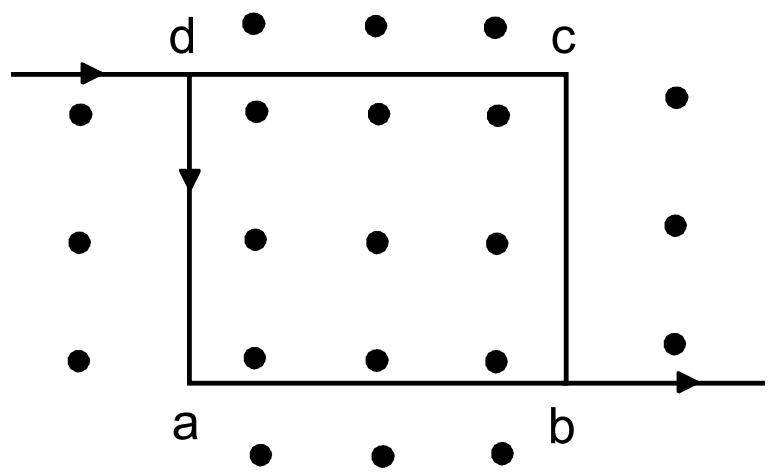
A current of 2A enters at the corner d of a square frame abcd of side 20cm and leaves at the opposite corner b. A magnetic field B = 0.1 T exists in the space in a direction perpendicular to the plane of the frame, as shown in the figure. Find the magnitude and direction of the magnetic forces on the four sides of the frame.

A hydrogen atom moving at speed υ collides with another hydrogen atom kept at rest. Find the minimum value of υ for which one of the atoms may get ionized. The mass of a hydrogen atom = 1.67 × 10⁻²⁷kg.
What are the values of the self-induced emf in the circuit of the previous problem at the times indicated therein?
A vessel of volume 125cm3 contains tritium $\big(\text{ }^3\text{H,t}_{\frac{1}{2}}=12.3\text{y}\big)$ at 500 kPa and 300K. Calculate the activity of the gas.
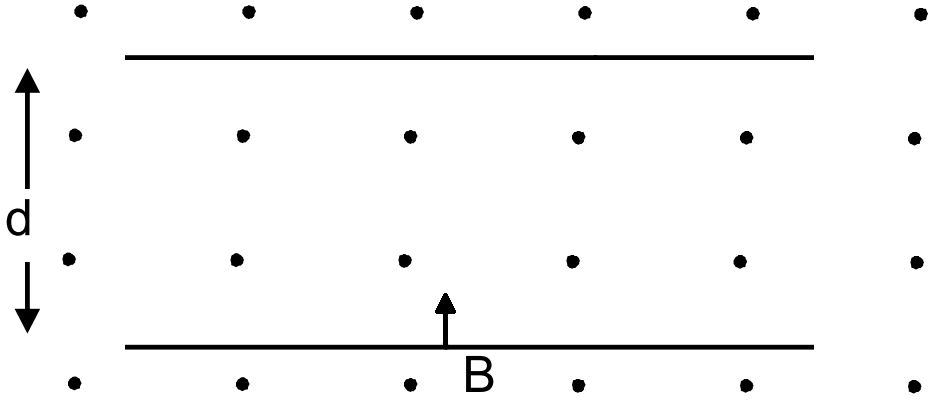
An electron is emitted with negligible speed from the negative plate of a parallel-plate capacitor charged to a potential difference V. The separation between the plates is d and a magnetic field Bexists in the space, as shown in the figure. Show that the electron will fail to strike the upper plates if $\text{d}>\Big(\frac{2\text{m}_\text{e}\text{v}}{\text{eB}^2}\Big)^{\frac{1}{2}}.$

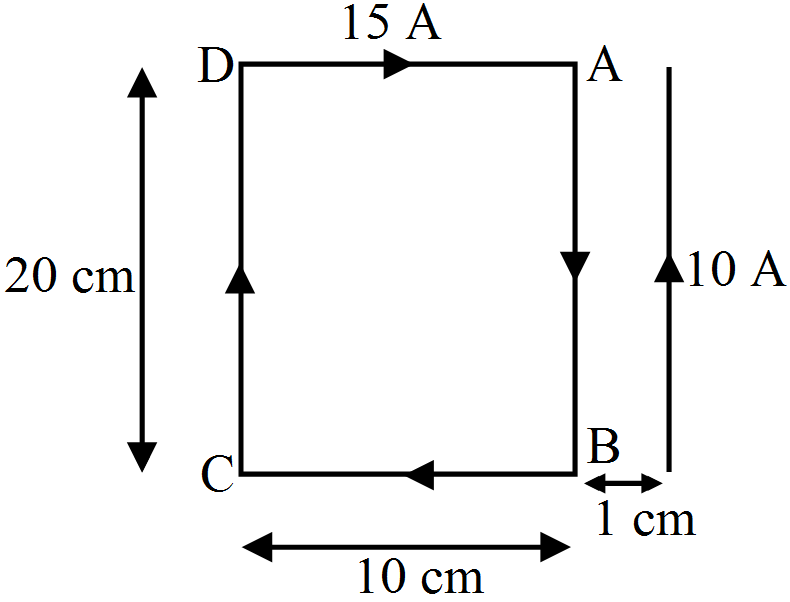
A rectangular current carrying loop is placed 1cm away from a long straight current-carrying conductor as shown.

  1. Will the net force acting on the loop due to straight conductor be attractive or repulsive in nature? Justify your answer. Calculate the magnitude of this force.
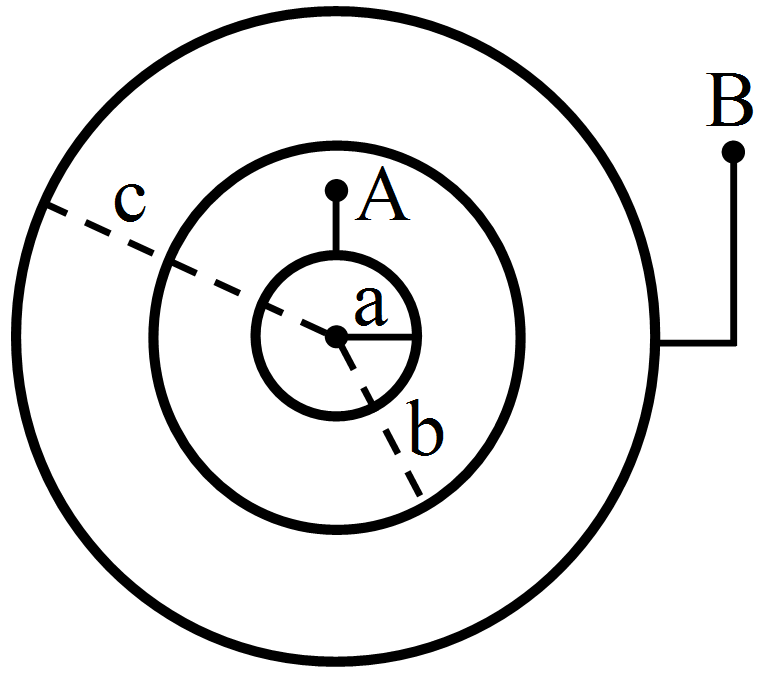
Consider an assembly of three conducting concentric spherical shells of radii a, b and c as shown in figure. Find the capecitance of the assembly between the poima A and B

  1. For a ray of light travelling from a denser medium of refractive index n1 to a rarer medium of refractive index nprove that  $\frac{\text{n}_{2}}{\text{n}_{1}} = \sin \text{i}_{c} ,$ where ic is the critical angle of incidence for the media.
  2. Explain with the help of a diagram, how the above principle is used for transmission of video signals using optical fibres.

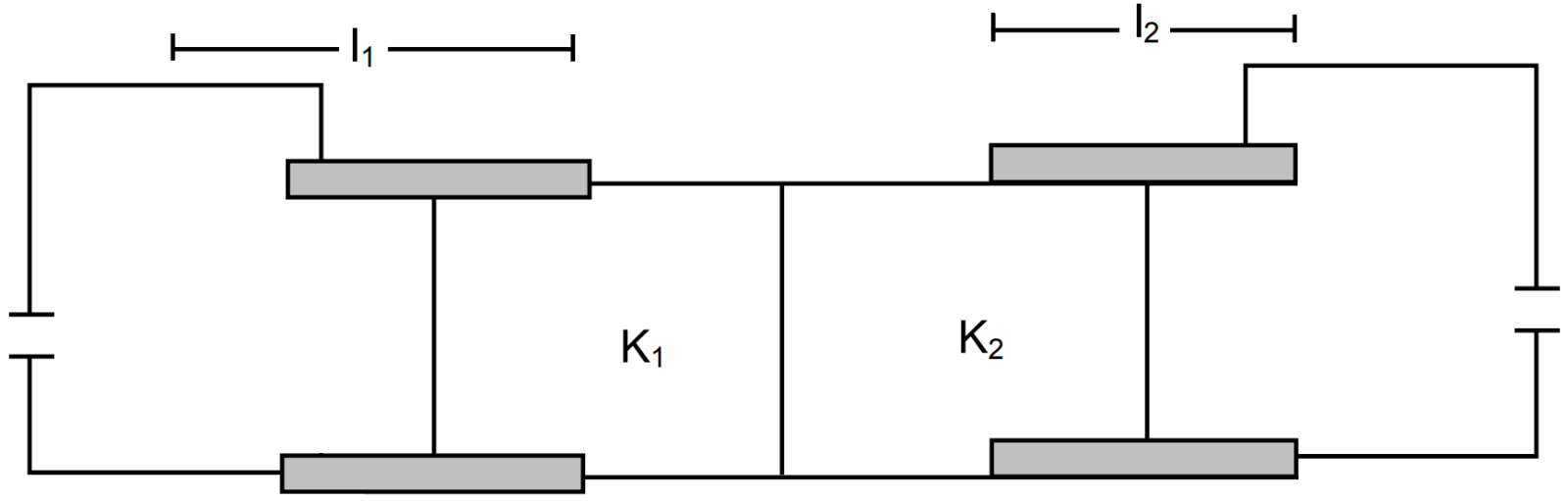
Figure shows two parallel plate capacitors with fixed plates and connected to two batteries. The separation between the plates is the same for the two capacitors. The plates are rectangular in shape with width b and lengths l1 and l2 The left half of the dielectric slab has a dielectric constant K1 and the right half K2. Neglecting any friction, find the ratio of the emf of the left. battery to that of the right battery for which the dielectric slab may remain in equilibrium.