Question
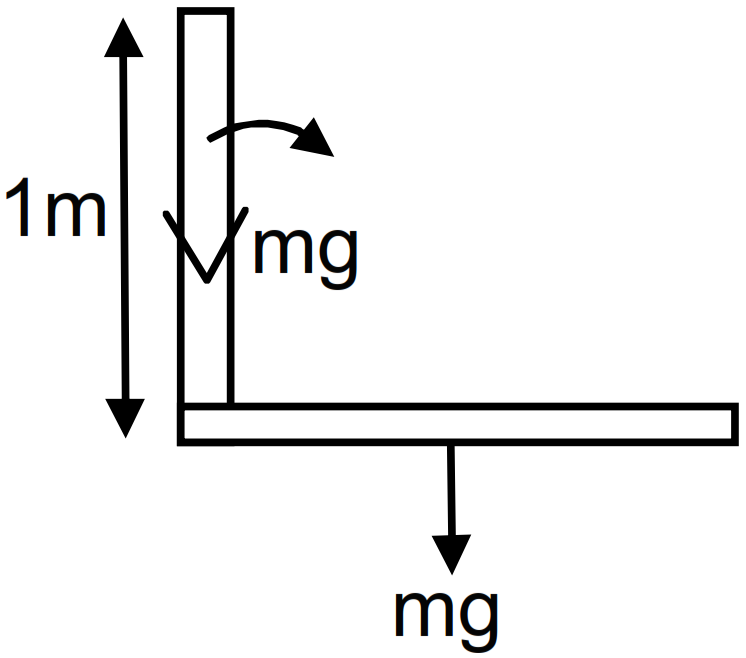
A metre stick is held vertically with one end on a rough horizontal floor. It is gently allowed to fall on the floor. Assuming that the end at the floor does not slip, find the angular speed of the rod when it hits the floor.
Answer

Let the mass of the rod = m Therefore applying laws of conservation of energy$\frac{1}{2}\text{l}\omega^2=\text{mg}\frac{\text{l}}2{}$
$\Rightarrow\frac{1}{2}\times\text{M}\frac{\text{l}^2}{3}\times\omega^2=\text{mg}\frac{1}{2}$
$\Rightarrow\omega^2=\frac{\text{3g}}{\text{l}}$
$\Rightarrow\omega=\sqrt{\frac{\text{3g}}{\text{l}}}=5.42\text{rad/s.}$

Need a full question paper?

Generate a complete, print-ready paper with questions like this in minutes — across 16+ boards, with answer keys.
Start Generating Free

Similar questions

A resistor of $200 \Omega$ and a capacitor of $15.0 \mu F$ are connected in series to a $220 V , 50 Hz$ ac source.$ (a)$ Calculate the current in the circuit; $(b) $ Calculate the voltage $(rms)$ across the resistor and the capacitor. Is the algebraic sum of these voltages more than the source voltage? If yes, resolve the paradox.
A molecule. of hydrogen contains two protons and two electrons. The nuclear force between these two protons is always neglected while discussing the behaviour of a hydrogen molecule. Why?
A solenoid has a core of a material with relative permeability 400 . The windings of the solenoid are insulated from the core and carry a current of 2A. If the number of turns is 1000 per metre, calculate (a) $H$, (b) $M$, (c) $B$ and (d) the magnetising current $I_m$.
The gravitational potential energy of a two particle system is derived in this chapter as $\text{U}=-\frac{\text{Gm}_1\text{m}_2}{\text{r}}.$ Does it follow from this equation that the potential energy for $\text{r}=\infty$ must be zero? Can we choose the potential energy for $\text{r}=\infty.$ to be 20J and still use this formula? If no, what formula should be used to calculate the gravitational potential energy at separation r?
Both alternating current and direct current are measured in amperes. But how is the ampere defined for an alternating current?
A piece of wire carrying a current of 6.00A is bent in the form of a circular arc of radius 10.0cm, and it subtends an angle of 120° at the centre. Find the magnetic field B due to this piece of wire at the centre.
  1. Six lead-acid type of secondary cells each of emf 2.0 V and internal resistance $0.015\Omega$ are joined in series to provide a supply to a resistance of $8.5\ \Omega.$ What are the current drawn from the supply and its terminal voltage?
  2. A secondary cell after long use has an emf of 1.9 V and a large internal resistance of $380\ \Omega$ What maximum current can be drawn from the cell? Could the cell drive the starting motor of a car?
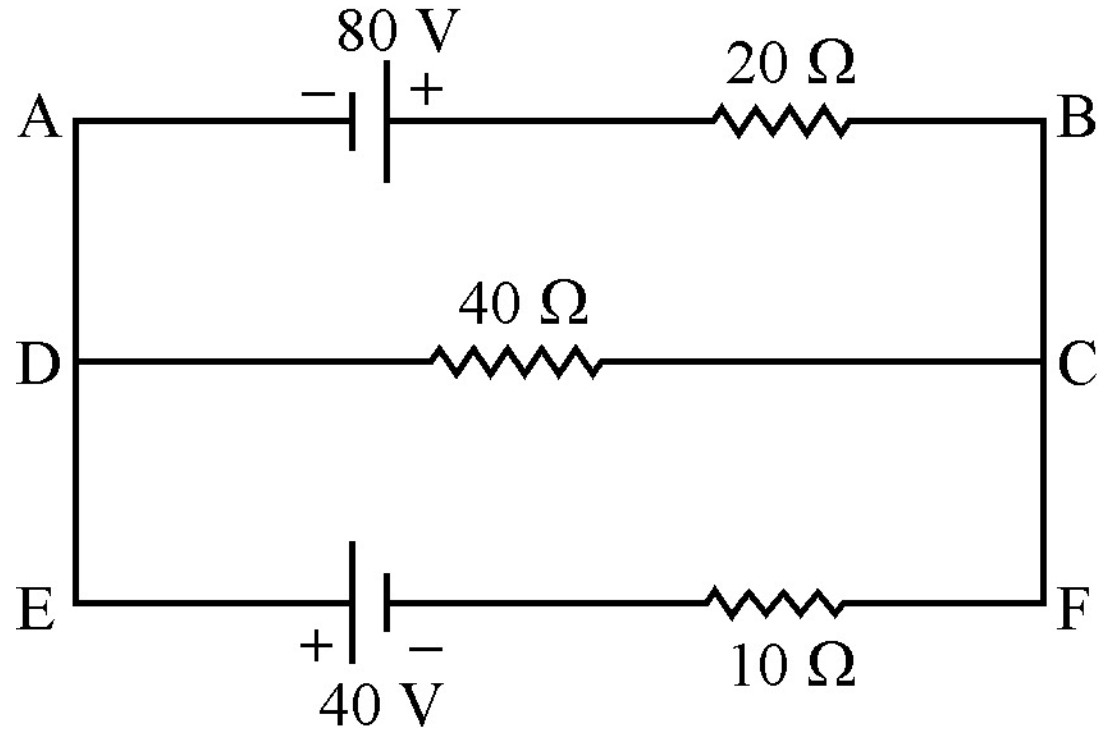
Using Kirchhoff’s rules, calculate the current through the $40\Omega$ and $20\Omega$ resistors in the following circuit:
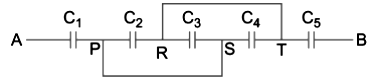
  1. Find equivalent capacitance between A and B in the combination given below. Each capacitor is of 2 μF capacitance.

  1. If a dc source of 7 V is connected across AB, how much charge is drawn from the source and what is the energy stored in the network?
In defining the ideal gas temperature scale, it is assumed that the pressure of the gas at constant volume is proportional to the temperature T. How can we verify whether this is true or not? Are we using the kinetic theory of gases? Are we using the experimental result that the pressure is proportional to temperature?