- Six lead-acid type of secondary cells each of emf 2.0 V and internal resistance $0.015\Omega$ are joined in series to provide a supply to a resistance of $8.5\ \Omega.$ What are the current drawn from the supply and its terminal voltage?
- A secondary cell after long use has an emf of 1.9 V and a large internal resistance of $380\ \Omega$ What maximum current can be drawn from the cell? Could the cell drive the starting motor of a car?
Exercise
Download our app for free and get started
- Number of secondary cells, n = 6
Internal resistance of each cell, $\text{r}=0.015\ \Omega$
series resistor is connected to the combination of cells.
Resistance of the resistor, $\text{R}=8.5\ \Omega$
Current drawn from the supply = I, which is given by the relation,
$\text{I}=\frac{\text{nE}}{\text{R}+\text{nr}}$
$=\frac{6\times2}{8.5+6\times0.015}$
$=\frac{12}{8.59}=1.39\ \text{A}$
Terminal voltage, V = IR = 1.39 × 8.5 = 11.87 A
Therefore, the current drawn from the supply is 1.39 A and terminal voltage is 11.87 A.
- After a long use, emf of the secondary cell, E = 1.9 V
Hence, maximum current $=\frac{\text{E}}{\text{r}}=\frac{1.9}{380}=0.005\ \text{A}$
Therefore, the maximum current drawn from the cell is 0.005 A. Since a large current is required to start the motor of a car, the cell cannot be used to start a motor.

Download our appand get started for free
Experience the future of education. Simply download our apps or reach out to us for more information. Let's shape the future of learning together!No signup needed.*
Similar Questions
- 1A wire $AB$ is carrying a steady current of $12 A$ and is lying on the table. Another wire $CD$ carrying $5A$ is held directly above $AB$ at a height of $1 mm.$ Find the mass per unit length of the wire $CD$ so that it remains suspended at its position when left free. Give the direction of the current flowing in $CD$ with respect to that in $AB.$ $[$Take the value of $g = 10 ms^{–2}]$View Solution
- 2View SolutionIs the motion of a charge across junction momentum conserving? Why or why not?
- 3View SolutionThe specification on a heater coil is 250V, 500W. Calculate the resistance of the coil. What will be the resistance of a coil of 1000W to operate at the same voltage?
- 4View SolutionTwo electric bulbs have the following specifications.
- 100W at 220V.
- 1000W at 220V.
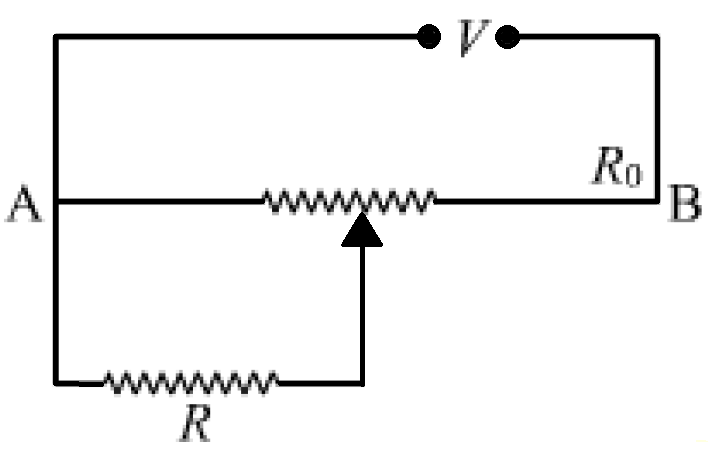
- 5A resistance of $R$ draws current from a potentiometer. The potentiometer wire, $AB,$ has a total resistance of $R_o$. A voltage $V$ is supplied to the potentiometer. Derive an expression for the voltage across $R$ when the sliding contact is in the middle of potentiometer wire.View Solution
- 6The four arms of a Wheatstone bridge $($Fig. $3.19)$ have the following resistances:View Solution
$AB =100 \Omega, BC =10 \Omega, CD =5 \Omega \text {, and } DA =60 \Omega \text {. }$
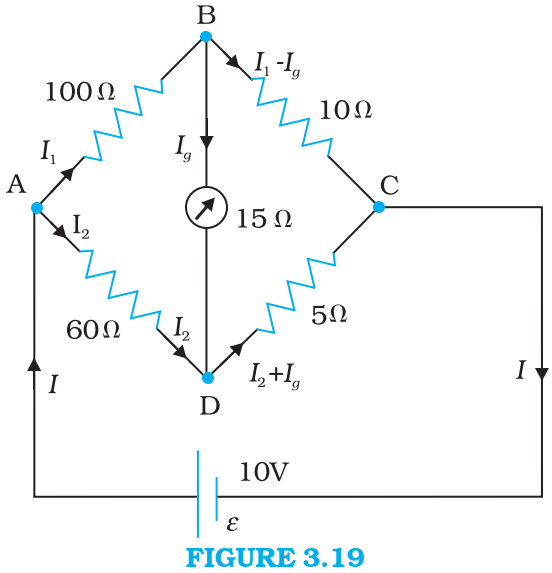
A galvanometer of $15 \Omega$ resistance is connected across $BD$. Calculate the current through the galvanometer when a potential difference of $10 V$ is maintained across $AC$. - 7A cell of emf 'E' and internal resistance 'r' is connected across a variable load resistor R. Draw the plots of the terminal voltage V versus (i) R and (ii) the current I.View Solution
It is found that when R = 4$\Omega$, the current is 1 A and when R is increased to 9$\Omega$, the current reduces to 0.5 A. Find the values of the emf E and internal resistance r. - 8View SolutionA cylindrical metallic wire is stretched to increase its length by 10%. Calculate the percentage increase in its resistance.
- 9View Solution
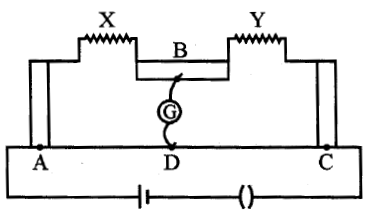
 The figure shows experimental set up of a meter bridge. When the two unknown resistances X and Y are inserted, the null point D is obtained 40 cm from the end A. When a resistance of 10 Ω is connected in series with X, the null point shifts by 10 cm. Find the position of the null point when the 10 Ω resistance is instead connected in series with resistance ‘Y’. Determine the values of the resistances X and Y.
 - 10View SolutionDo all the thermocouples have a neutral temperature?