$A$ microammeter has a resistance of $100\,\Omega$ and $a$ full scale range of $50\,\mu$ $A$. It can be used as a voltmeter or a higher range ammeter provided a resistance is added to it. Pick the correct range and resistance combination $(s)$.
Diffcult
Download our app for free and get started
To increase the range of ammeter a parallel resistance (called shunt) is required which is given by $S=\left(\frac{i_{g}}{i-i_{g}}\right) G$
$ S=\left(\frac{50 \times 10^{-6}}{95 \times 10^{-50} \times 10^{-60}}\right)(100) \approx 1 \Omega$
To change it in voltmeter a high resistance $R$ is put in series, where $R$ is given by $R=\frac{V}{i_{g}}-G$
$R=\frac{10}{50 \times 10^{-6}}-100 \approx 200 k \Omega$

Download our appand get started for free
Experience the future of education. Simply download our apps or reach out to us for more information. Let's shape the future of learning together!No signup needed.*
Similar Questions
- 1An $\alpha - $ particle travels in a circular path of radius $0.45\, m$ in a magnetic field $B = 1.2\,Wb/{m^2}$ with a speed of $2.6 \times {10^7}\,m/\sec $. The period of revolution of the $\alpha - $ particle isView Solution
- 2Two infinitely long parallel wires carry currents of magnitude $I_1$ and $I_2$ are at a distance $4 cm$ apart. The magnitude of the net magnetic field is found to reach a non-zero minimum value between the two wires and $1 \,cm$ away from the first wire. The ratio of the two currents and their mutual direction isView Solution
- 3An $\alpha -$ particle of $1\,MeV$ energy moves on circular path in uniform magnetic field. Then kinetic energy of proton in same magnetic field for circular path of double radius is......$MeV$View Solution
- 4Two wires each carrying a steady current $I$ are shown in four configurations in Column $I$. Some of the resulting effects are described in Column $II$. Match the statements in Column $I$ with the statements in Column $II$ and indicate your answer by darkening appropriate bubbles in the $4 \times 4$ matrix given in the $ORS$.View Solution
Column $I$ Column $II$ $(A)$ Point $P$ is situated midway between the wires. $Image$ $(p)$ The magnetic fields $(B)$ at $P$ due to the currents in the wires are in the same direction. $(B)$ Point $P$ is situated at the mid-point of the line joining the centers of the circular wires, which have same radii. $Image$ $(q)$ The magnetic fields $(B)$ at $P$ due to the currents in the wires are in opposite directions. $(C)$ Point $P$ is situated at the mid-point of the line joining the centers of the circular wires, which have same radii. $Image$ $(r)$ There is no magnetic field at $P$. $(D)$ Point $P$ is situated at the common center of the wires. $Image$ $(s)$ The wires repel each other. 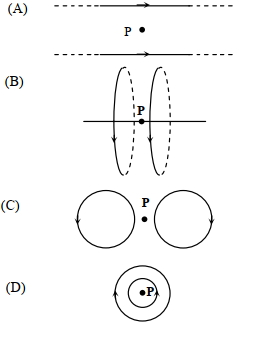
- 5View SolutionTwo free parallel wires carrying currents in opposite direction
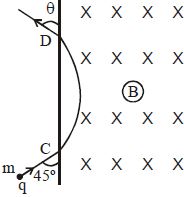
- 6A particle of mass $m = 1.67 \times 10^{-27}\, kg$ and charge $q = 1.6 \times 10^{-19} \, C$ enters a region of uniform magnetic field of strength $1$ $tesla$ along the direction shown in the figure. the particle leaves the magnetic field at point $D,$ then the distance $CD$ is :-View Solution
- 7The magnetic field $B$ with in the solenoid having $n$ $turns$ per $metre$ length and carrying a current of $i$ $ampere$ is given byView Solution
- 8Two particles $\mathrm{X}$ and $\mathrm{Y}$ having equal charges are being accelerated through the same potential difference. Thereafter they enter normally in a region of uniform magnetic field and describes circular paths of radii $R_1$ and $R_2$ respectively. The mass ratio of $\mathrm{X}$ and $\mathrm{Y}$ is :View Solution
- 9View SolutionIn a co-axial straight cable, the central conductor and the outer conductor carry equal currents in opposite directions. The magnetic field is zero.
- 10$AB$ and $CD$ are smooth parallel rails, separated by a distance $l$, and inclined to the horizontal at an angle $\theta$ . $A$ uniform magnetic field of magnitude $B$, directed vertically upwards, exists in the region. $EF$ is a conductor of mass $m$, carrying a current $i$, if $B$ is normal to the plane of the railsView Solution