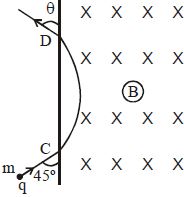
A particle of mass $m = 1.67 \times 10^{-27}\, kg$ and charge $q = 1.6 \times 10^{-19} \, C$ enters a region of uniform magnetic field of strength $1$ $tesla$ along the direction shown in the figure. the particle leaves the magnetic field at point $D,$ then the distance $CD$ is :-
Diffcult
Download our app for free and get started

Download our appand get started for free
Experience the future of education. Simply download our apps or reach out to us for more information. Let's shape the future of learning together!No signup needed.*
Similar Questions
- 1If an electron is going in the direction of magnetic field $\overrightarrow B $ with the velocity of $\overrightarrow {v\,} $ then the force on electron isView Solution
- 2In a mass spectrometer used for measuring the masses of ions, the ions are initially accelerated by an electric potential $V$ and then made to describe semicircular paths of radius $R$ using a magnetic field $B$. If $V$ and $B$ are kept constant, the ratio $\left( {\frac{{{\text{charge on the ion}}}}{{{\text{mass of the ion}}}}} \right)$ will be proportional toView Solution
- 3A cylindrical conductor of radius $'R'$ carries a current $'i'$. The value of magnetic field at a point which is $R/4$ distance inside from the surface is $10\,T$. Find the value of magnetic field at point which is $4R$ distance outside from the surfaceView Solution
- 4Statement $-1$ : Path of the charge particle may be straight line in uniform magnetic field.View Solution
Statement $-2$ : Path of the charge particle is decided by the angle between its velocity and the magnetic force working on it - 5An electron is revolving round a proton, producing a magnetic field of $16\, weber/m^2$ in a circular orbit of radius $1\,\mathop A\limits^o $. It’s angular velocity will beView Solution
- 6View SolutionA cell is connected between two points of a uniformly thick circular conductor. The magnetic field at the centre of the loop will be
- 7View SolutionThe following statement is false for Helmholtz coils
- 8When a proton is released from rest in a room, it starts with an initial acceleration $a_0$ towards west. When it is projected towards north with a speed $v_0$ it moves with an initial acceleration $3a_0$ toward west. The electric and magnetic fields in the room areView Solution
- 9In a hydrogen atom, an electron moves in a circular orbit of radius $5.2 \times {10^{ - 11}}\,m$ and produces a magnetic induction of $12.56\, T$ at its nucleus. The current produced by the motion of the electron will be (Given ${\mu _0} = 4\pi \times {10^{ - 7}}\,Wb/A - m)$View Solution
- 10Five very long, straight wires are bound together to form a small cable. Currents carried by the wires are ${I_1} = 20\,A,$ ${I_2} = - \,6\,A,$ ${I_3} = 12\,A,\,{I_4} = - 7\,A,\,{I_5} = 18\,A.$ The magnetic induction at a distance of $10\, cm$ from the cable isView Solution