A milliammeter of range $10\, mA$ has a coil of resistance $1 \,\Omega$. To use it as voltmeter of range $10\, volt$, the resistance that must be connected in series with it, will be ............. $\Omega $
Medium


Download our appand get started for free
Experience the future of education. Simply download our apps or reach out to us for more information. Let's shape the future of learning together!No signup needed.*
Similar Questions
- 1An arc of a circle of radius $R$ subtends an angle $\frac{\pi }{2}$ at the centre. It carries a current $i$. The magnetic field at the centre will beView Solution
- 2View SolutionA metallic loop is placed in a magnetic field. If a current is passed through it, then
- 3A large current carrying plate is kept along $y-z$ plane with $k$ $amp$ current per unit length in the $+ve$ $y$ direction. Find the net force on the semi cricular current carrying looplying in the $x-y$ plane. Radius of loop is $R$, current is $i$ and centre is at $(d,0, 0)$ where $(d > R)$View Solution
- 4A charged particle of mass $m$ and charge $q$ travels on a circular path of radius $r$ that is perpendicular to a magnetic field $B$. The time taken by the particle to complete one revolution isView Solution
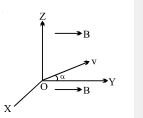
- 5In a region of space, a uniform magnetic field $B$ exists in the $y-$direction.Aproton is fired from the origin, with its initial velocity $v$ making a small angle $\alpha$ with the $y-$ direction in the $yz$ plane. In the subsequent motion of the proton,View Solution
- 6An electric field of $1500\, V/m$ and a magnetic field of $0.40\, weber/metre^2$ act on a moving electron. The minimum uniform speed along a straight line the electron could have isView Solution
- 7Two long straight parallel wires, carrying (adjustable) current $I_1$ and $I_2$, are kept at a distance $d$ apart. If the force $'F'$ between the two wires is taken as 'positive' when the wires repel each other and 'negative' when the wires attract each other, the graph showing the dependence of $'F'$, on the product $I_1 I_2$, would beView Solution
- 8A moving coil galvanometer has $50$ turns and each turn has an area $2 \times 10^{-4} m ^2$. The magnetic field produced by the magnet inside the galvanometer is $0.02 T$. The torsional constant of the suspension wire is $10^{-4} N m rad ^{-1}$. When a current flows through the galvanometer, a full scale deflection occurs if the coil rotates by $0.2$ rad. The resistance of the coil of the galvanometer is $50 \Omega$. This galvanometer is to be converted into an ammeter capable of measuring current in the range $0-1.0 A$. For this purpose, a shunt resistance is to be added in parallel to the galvanometer. The value of this shunt resistance, in ohms, is. . . . . .View Solution
- 9An electron is accelerated by a potential difference of $12000\, volts$. It then enters a uniform magnetic field of ${10^{ - 3}}\,T$ applied perpendicular to the path of electron. Find the radius of path. Given mass of electron $ = 9 \times {10^{ - 31}}\,kg$ and charge on electron $ = 1.6 \times {10^{ - 19}}\,C$View Solution
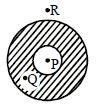
- 10View SolutionCurrent is flowing through a conducting hollow pipe whose area of cross-section is shown in the figure. The value of magnetic induction will be zero at