Question
A molecule. of hydrogen contains two protons and two electrons. The nuclear force between these two protons is always neglected while discussing the behaviour of a hydrogen molecule. Why?

Answer

Inside the nucleus, two protons exert nuclear force on each other. These forces are short-ranged (a few fm), strong and attractive forces. They also exert electrostatic repulsive force (long-ranged). While discussing the behaviour of a hydrogen molecule, the nuclear force between the two protons is always neglected. This is because the separation between the two protons in the molecule is ~70pm which is much greater than the range of the nuclear force.

Need a full question paper?

Generate a complete, print-ready paper with questions like this in minutes — across 16+ boards, with answer keys.
Start Generating Free

Similar questions

Explain the parallel connection of capacitors.
Estimate the number of electrons in 100g of water. How much is the total negative charge on these electrons?
A ball of superconducting material is dipped in liquid nitrogen and placed near a bar magnet.
  1. In which direction will it move?
  2. What will be the direction of it’s magnetic moment?
An experimenter's diary reads as follows: "A charged particle is projected in a magnetic field of $(7.0\vec{\text{i}}-3.0\vec{\text{j}})\times10^{-3}\text{T}.$ The acceleration of the particle is found to be $(\vec{\text{i}}+7.0\vec{\text{j}})\times10\text{m/s}^{2\text{n}}.$ The number to the left of $\vec{\text{i}}$ in the last expression was not readable. What can this number be?
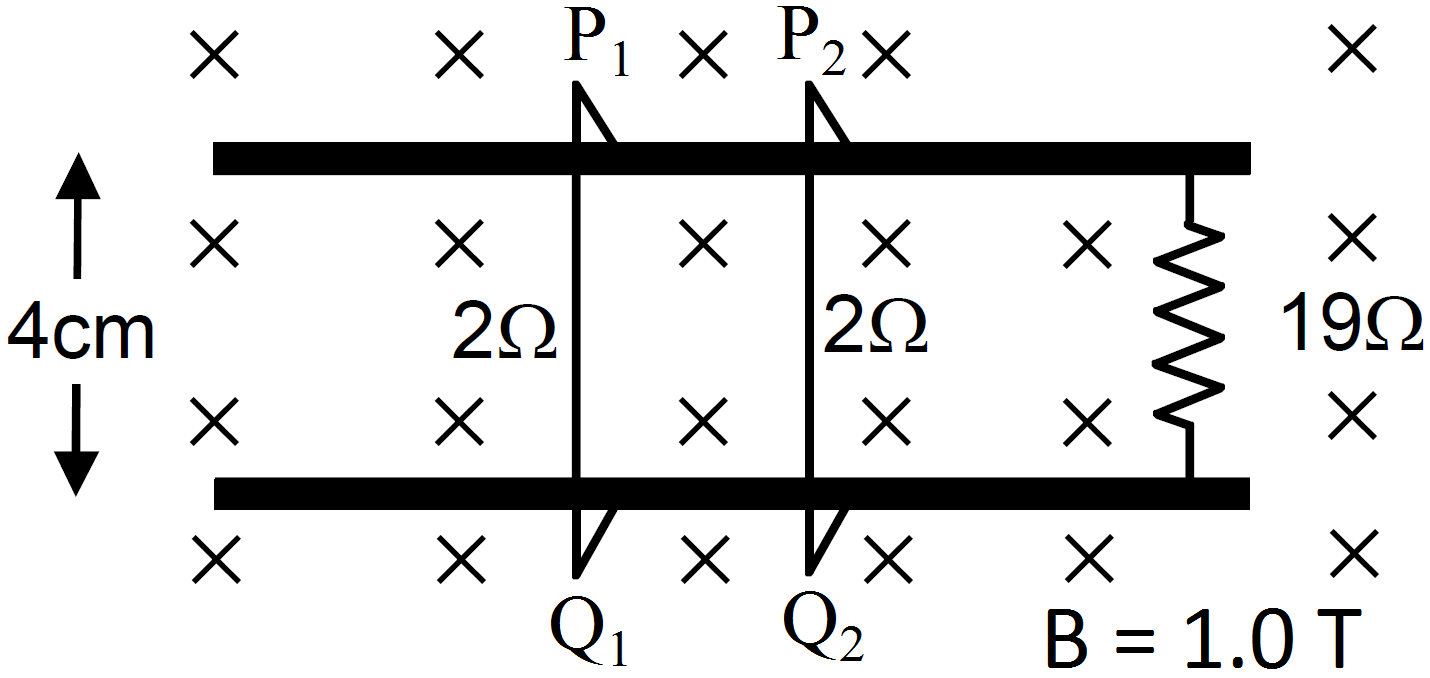
Consider the situation shown in figure. The wires P1Q1 and P2Q2 are made to slide on the rails with the same speed 5cm/s. Find the electric current in the $19\Omega$ resistor if:

  1. Both the wires move towards right.
  2. If P1Q1 moves towards left but P2Q2 moves towards right.

A double convex lens, made from a material of refractive index $\mu_1,$ is immersed in a liquid of refractive index $\mu_2$ where $\mu_1>\mu_2.$ What change, if any, would occur in the nature of the lens?
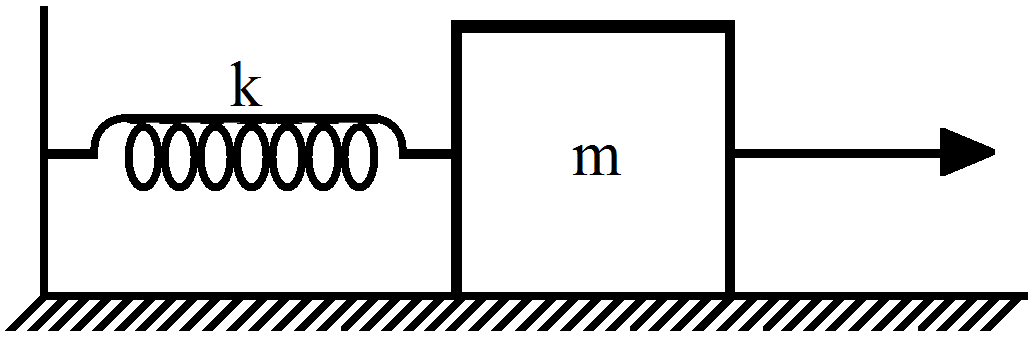
The spring shown in figure is unstretched when a man starts pulling on the cord. The mass of the block is M. If the man exerts a constant force F, find
  1. The amplitude and the time period of the motion of the block,
  2. The energy stored in the spring when the block passes through the equilibrium position and,
  3. The kinetic energy of the block at this position.

Sketch a graph showing the variation of fringe width versus the distance of the screen from the plane of the slits (keeping other parameters same) in Young’s double slit experiment. What information can one obtain from the slope of this graph?
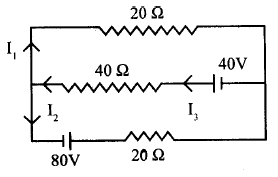
State Kirchhoff's rules of current distribution in an electrical network. Using these rules determine the value of the current I1 in the electric circuit given below.

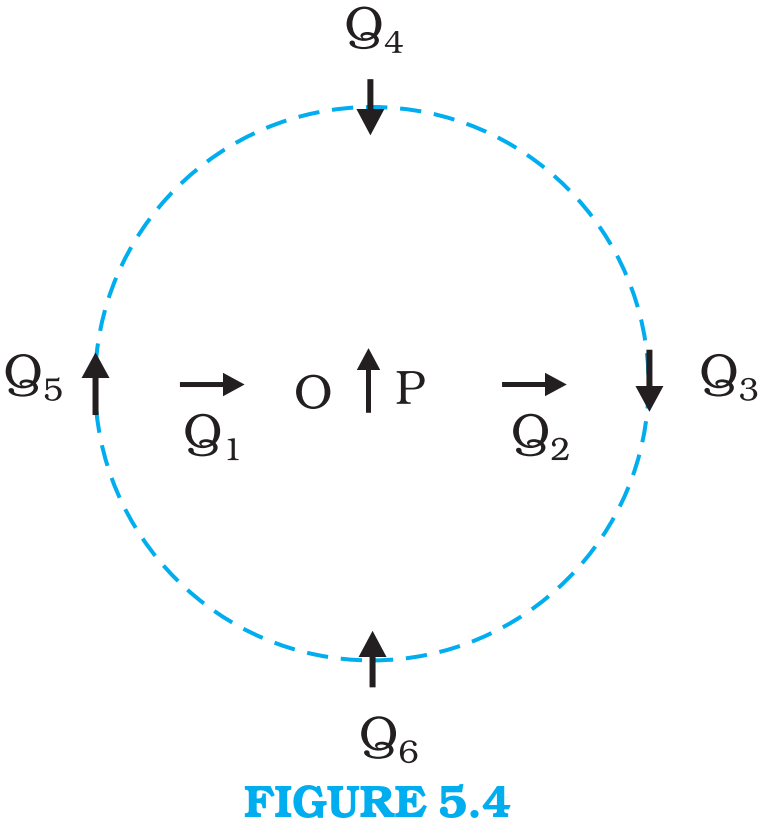
Figure 5.4 shows a small magnetised needle $P$ placed at a point $O$. The arrow shows the direction of its magnetic moment. The other arrows show different positions (and orientations of the magnetic moment) of another identical magnetised needle $Q$.
(a) In which configuration the system is not in equilibrium?
(b) In which configuration is the system in (i) stable, and (ii) unstable equilibrium?
(c) Which configuration corresponds to the lowest potential energy among all the configurations shown?
Image