A motorcyclist of mass m is to negotiate a curve of radius r with a speed v. The minimum value of the coefficient of friction so that this negotiation may take place safely, is
Medium


Download our appand get started for free
Experience the future of education. Simply download our apps or reach out to us for more information. Let's shape the future of learning together!No signup needed.*
Similar Questions
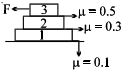
- 1If force $F$ is increasing with time and at $t = 0 , F = 0$ where will slipping first start?View Solution
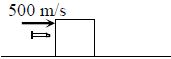
- 2A bullet of mass $20\, g$ travelling horizontally with a speed of $500 \,m/s$ passes through a wooden block of mass $10.0 \,kg$ initially at rest on a surface. The bullet emerges with a speed of $100\, m/s$ and the block slides $20 \,cm$ on the surface before coming to rest, the coefficient of friction between the block and the surface. $(g = 10\, m/s^2)$View Solution
- 3A block of weight $W$ rests on a horizontal floor with coefficient of static friction $\mu .$ It is desired to make the block move by applying minimum amount of force. The angle $\theta $ from the horizontal at which the force should be applied and magnitude of the force $F$ are respectively.View Solution
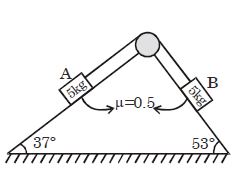
- 4In the shown arrangement if $f_A\,,\, f_B$ and $T$ be the frictional forces on $A$ Block, $B$ Block and tension in the string respectively, then their values areView Solution
- 5Find the maximum velocity for skidding for a car moved on a circular track of radius $100\, m$. The coefficient of friction between the road and tyre is $0.2$ ....... $m/s$View Solution
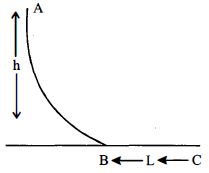
- 6$A$ block of mass $M$ is placed on $a$ horizontal surface and it is tied with an inextensible string to $a$ block of mass, as shown in figure. A block of mass $m_0$ is also placed on $M$ If friction force exists between the block $M$ and the block $m_0$ and not between the block $M$ and the horizontal surface, then the minimum value of $\mu$ for which the block m remains stationary isView Solution

- 7View SolutionWhich of the following statements is not true
- 8A block of mass $4\, kg$ rests on an inclined plane. The inclination of the plane is gradually increased. it is found that when the inclination is $3$ in $5\left( {\sin \theta = \frac{3}{5}} \right)$, the block just begins to slide down the plane. The coefficient of friction between the block and the plane isView Solution
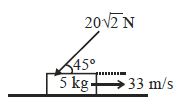
- 9A block of mass $5\, kg$ is kept on a rough horizontal floor. It is given a velocity $33\, m/s$ towards right. A force of $20\sqrt {2\,} \,N$ continuously acts on the block as shown in the figure. If the coefficient of friction between block and floor is $0.5$ the velocity of block after $3\, seconds$ is ........ $m/s$ ($g = 10\, m/s^2$)View Solution
- 10A small ball of mass $m$ starts at a point $A$ with speed $v_0$ and moves along a frictionless track $AB$ as shown. The track $BC$ has coefficient of friction $\mu $. The ball comes to stop at $C$ after travelling a distance $L$ which isView Solution