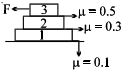
If force $F$ is increasing with time and at $t = 0 , F = 0$ where will slipping first start?
Advanced
Download our app for free and get started
Minimum force required for slipping to occur between $3 \mathrm{kg}$ and
$2 \mathrm{kg}=\mu N_{1}=0.5 \times$ $30=15 N$
Minimum force required for slipping to occur between $2 \mathrm{kg}$ and
$1 \mathrm{kg}=\mu N_{1}=0.3 \times$ $(30+20)=15 N$
Minimum force required for slipping to occur between $1 \mathrm{kg}$ and ground
$=\mu N_{1}=0.1 \times$ $(30+20+10)=6 N$
Thus slipping takes place first at the surface for which minimum force required is least. Thus slipping starts between $1 \mathrm{kg}$ block and ground.

Download our appand get started for free
Experience the future of education. Simply download our apps or reach out to us for more information. Let's shape the future of learning together!No signup needed.*
Similar Questions
- 1View SolutionStatic friction between two surfaces
- 2$A$ particle inside the rough surface of $a$ rotating cone about its axis is at rest relative to it at $a$ height of $1m$ above its vertex. Friction coefficient is $\mu = 0.5$, if half angle of cone is $45^o$, the maximum angular velocity of revolution of cone can be :View Solution
- 3View SolutionMeena applies the front brakes, while riding on her bicycle along a flat road. The force that slows her bicycle is provided by the
- 4A car is moving with a constant speed of $20\,m / s$ in a circular horizontal track of radius $40\,m$. A bob is suspended from the roof of the car by a massless string. The angle made by the string with the vertical will be : (Take $g =10$ $\left.m / s ^2\right)$View Solution
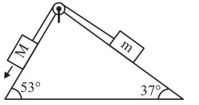
- 5In the given arrangement of a doubly inclined plane two blocks of masses $\mathrm{M}$ and $\mathrm{m}$ are placed. The blocks are connected by a light string passing over an ideal pulley as shown. The coefficient of friction between the surface of the plane and the blocks is $0.25$ . The value of $\mathrm{m}$, for which $\mathrm{M}=10$ $\mathrm{kg}$ will move down with an acceleration of $2 \mathrm{~m} / \mathrm{s}^2$, is : (take $\mathrm{g}=10 \mathrm{~m} / \mathrm{s}^2$ and $\left.\tan 37^{\circ}=3 / 4\right)$View Solution
- 6A cylinder of mass $10\,kg$ is sliding on a plane with an initial velocity of $10\,m/s$. If coefficient of friction between surface and cylinder is $ 0.5$, then before stopping it will describe ............. $\mathrm{m}$View Solution
- 7A body of mass $100\, g$ is sliding from an inclined plane of inclination $30^°$. What is the frictional force experienced if $\mu = 1.7$View Solution
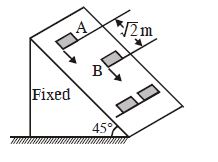
- 8Two blocks $A$ and $B$ of equal masses are sliding down along straight parallel lines on an inclined plane of $45^o$ . Their coefficients of kinetic friction are $\mu _A = 0.2$ and $\mu _B = 0.3$ respectively. At $t = 0$ , both the blocks are at rest and block $A$ is $\sqrt 2$ metre behind block $B$ . The time and distance from the initial position where the front faces of the blocks come in line on the inclined plane as shown in figure. (Use $g = 10\, ms^{-2}$ )View Solution
- 9A block of mass $m$ is placed on a surface having vertical cross section given by $y=x^2 / 4$. If coefficient of friction is $0.5$ , the maximum height above the ground at which block can be placed without slipping is:View Solution
- 10If the radius of curvature of the path of two particles of same masses are in the ratio $1 : 2$, then in order to have constant centripetal force, their velocity, should be in the ratio ofView Solution