Question

A narrow electron beam passes undeviated through an electric field E = 3  and an overlapping magnetic field B = 2 . If electric field and magnetic field are mutually perpendicular. The speed of the electrons is

(a) 60 m/s

(b) 10.3  

(c) 1.5  

(d) 0.67  

Answer

(c) 1.5  

Need a full question paper?

Generate a complete, print-ready paper with questions like this in minutes — across 16+ boards, with answer keys.

Start Generating Free

Similar questions

The shortest wavelength in Balmer’s series for Hydrogen atom is ...A... and this is obtained by substituting ...B ... in Balmer’s formula. Here, A and B refer to?
The angular momentum of an electron in an orbit is quantized because it is a necessary condition for the compatibility with:
The majority current carrier in $p$-type semi-conductor is :
For the ground state, the electron in the H-atom has an angular momentum = h, according to the simple Bohr model. Angular momentum is a vector and hence there will be infinitely many orbits with the vector pointing in all possible directions. In actuality, this is not true,
Examples of inorganic semiconductors is:

The frequency and work function of an incident photon are n and . If n­0 is the threshold frequency then necessary condition for the emission of photo electron is

(a)  

(b) v =  

(c)  

(d) None of these

During a nuclear fission reaction:
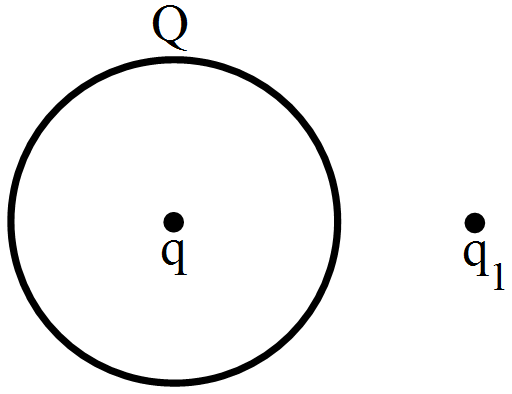
A thin, metallic spherical shell contains a charge Q on it. A point charge q is placed at the centre of the shell and another charge q1 is placed outside it as shown in figure. All the three charges are positive. The force on the charge at the centre is:

  1. Towards left.
  2. Towards right.
  3. Upward.
  4. Zero.
If mass-energy equivalence is taken into account, when water is cooled to form ice, the mass of water should:

Assertion  :   At a point in space, the electric field points towards north. In the region, surrounding this point the rate of change of potential will be zero along the east and west.

Reason     : Electric field due to a charge is the space around the charge.

(a) If both assertion and reason are true and the reason is the correct explanation of the assertion.

(b) If both assertion and reason are true but reason is not the correct explanation of the assertion.

(c) If assertion is true but reason is false.

(d) If the assertion and reason both are false.