Question
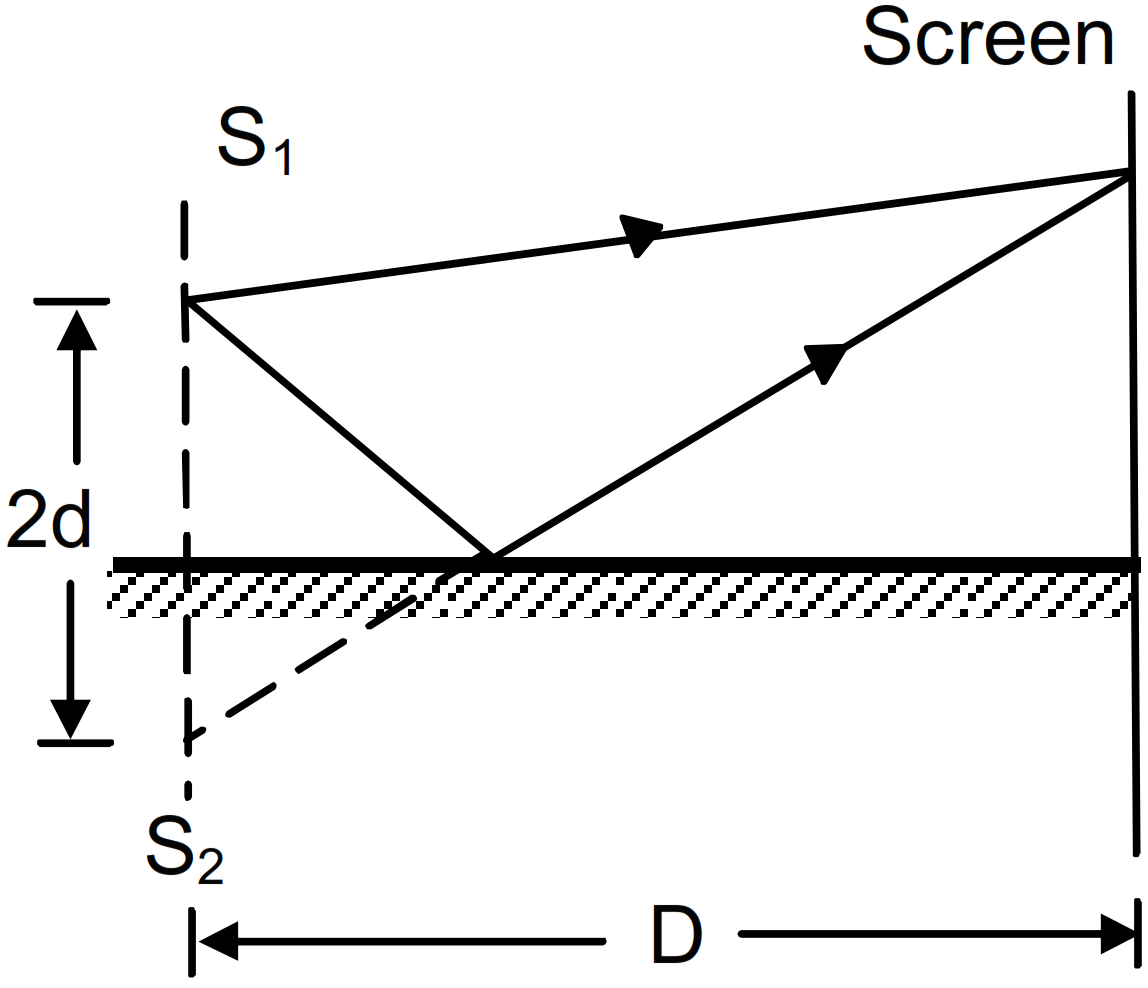
A narrow slit S transmitting light of wavelength $\lambda$ is placed a distance d above a large plane mirror as shown in figure (17-E1). The light coming directly from the slit and that coming after the reflection interfere at a screen $\sum$ placed at a distance D from the slit.
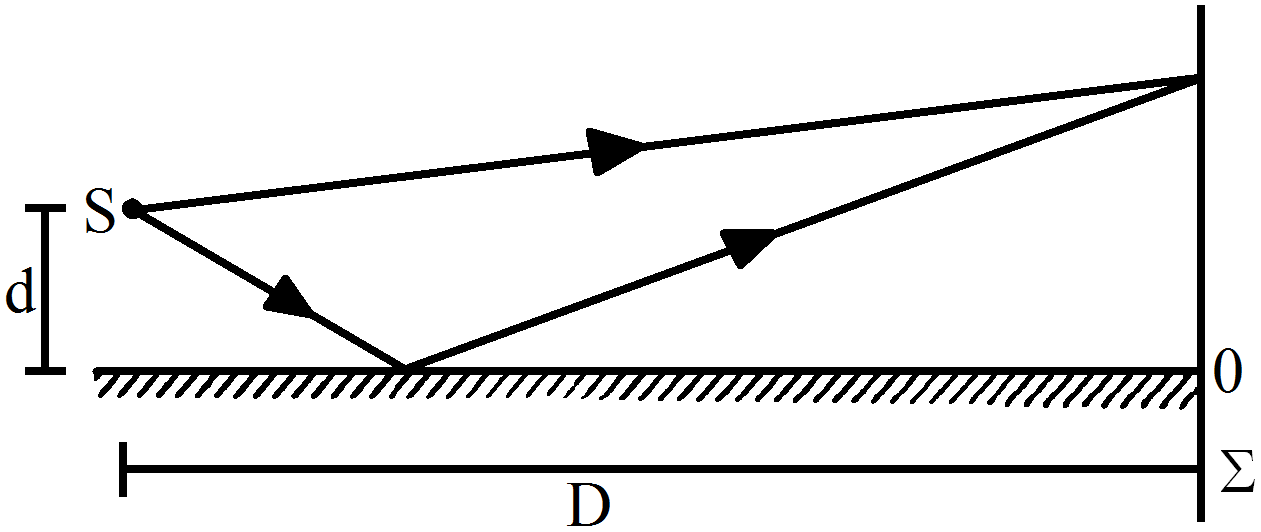
  1. What will be the intensity at a point just above the mirror, i.e., just above O?
  2. At what distance from 0 does the first maximum occur?
Answer

  1. Since, there is a phase difference of $\pi$ between direct light and reflecting light, the intensity just above the mirror will be zero.
  2. Here, 2d = equivalent slit separation

D = Distance between slit and screen.
We know for bright fringe, $\Delta\text{x}=\frac{\text{y}\times2\text{d}}{\text{D}}=\text{n}\lambda$
But as there is a phase reversal of $\frac{\lambda}{2}.$
$\Rightarrow\frac{\text{y}\times2\text{d}}{\text{D}}+\frac{\lambda}{2}=\text{n}\lambda$
$\Rightarrow\frac{\text{y}\times2\text{d}}{\text{D}}=\text{n}\lambda-\frac{\lambda}{2}\Rightarrow\text{y}=\frac{\lambda\text{D}}{4\text{d}}$

Need a full question paper?

Generate a complete, print-ready paper with questions like this in minutes — across 16+ boards, with answer keys.

Start Generating Free

Similar questions

Can two equipotential surfaces cut each other?
  1. Why photoelectric effect can not be explained on the basis of wave nature of light? Give reasons.
  2. Write the basic features of photon picture of electromagnetic radiation on which Einstein’s photoelectric equation is based.
Define relaxation time of the free electrons drifting in a conductor. How is it related to the drift velocity of free electrons? Use this relation to deduce the expression for the electrical resistivity of the material. 
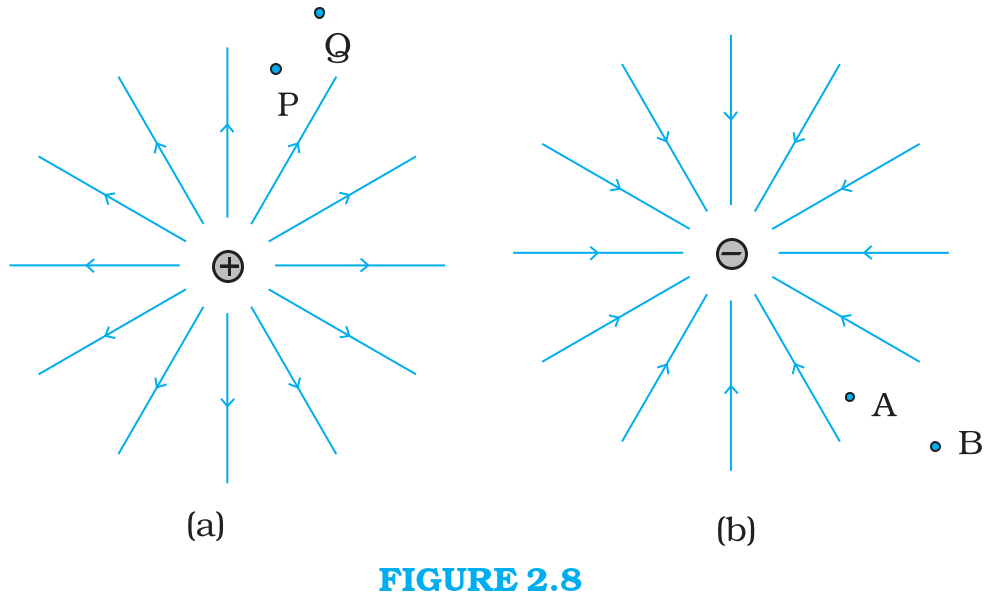
Figures 2.8 (a) and (b) show the field lines of a positive and negative point charge respectively.
Image
(a) Give the signs of the potential difference $V_{ P }-V_{ Q } ; V_{ B }-V_{ A }$.
(b) Give the sign of the potential energy difference of a small negative charge between the points $O$ and $P ; A$ and $B$.
(c) Give the sign of the work done by the field in moving a small positive charge from $Q$ to $P$.
(d) Give the sign of the work done by the external agency in moving a small negative charge from $B$ to $A$.
(e) Does the kinetic energy of a small negative charge increase or decrease in going from $B$ to $A$ ?
A tank is filled with water to a height of 12.5 cm. The apparent depth of a needle lying at the bottom of the tank is measured by a microscope to be 9.4 cm. What is the refractive index of water? If water is replaced by a liquid of refractive index 1.63 up to the same height, by what distance would be the microscope have to be moved to focus on the needle again?
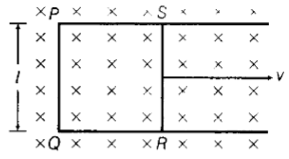
Figure shows a rectangular conducting loop $\text{PQRS}$ in which arm $RS$ of length I is movable. The loop is kept in a uniform magnetic field $B$ directed downward perpendicular to the plane of the loop. The arm $RS$ is moved with a uniform speed $v$.
Image

Deduce an expression for
$i$. the emf induced across the arm $RS$
$ii.$  the external force required to move the arm and
$iii.$ the power dissipated as heat.
Write Einstein's Photoelectric equation and mention which important features in photoelectric effect can be explained with the help of this equation.
The maximum kinetic energy of the photoelectrons gets doubled when the wavelength of light incident on the surface changes from $\lambda_{1}$ to $\lambda_{2}$. Derive the expressions for the threshold wavelength $\lambda_{\circ}$ and work function for the metal surface.
Two parallel wires carry equal currents of 10A along the same direction and are separated by a distance of 2.0cm. Find the magnetic field at a point which is 2.0cm away from each of these wires
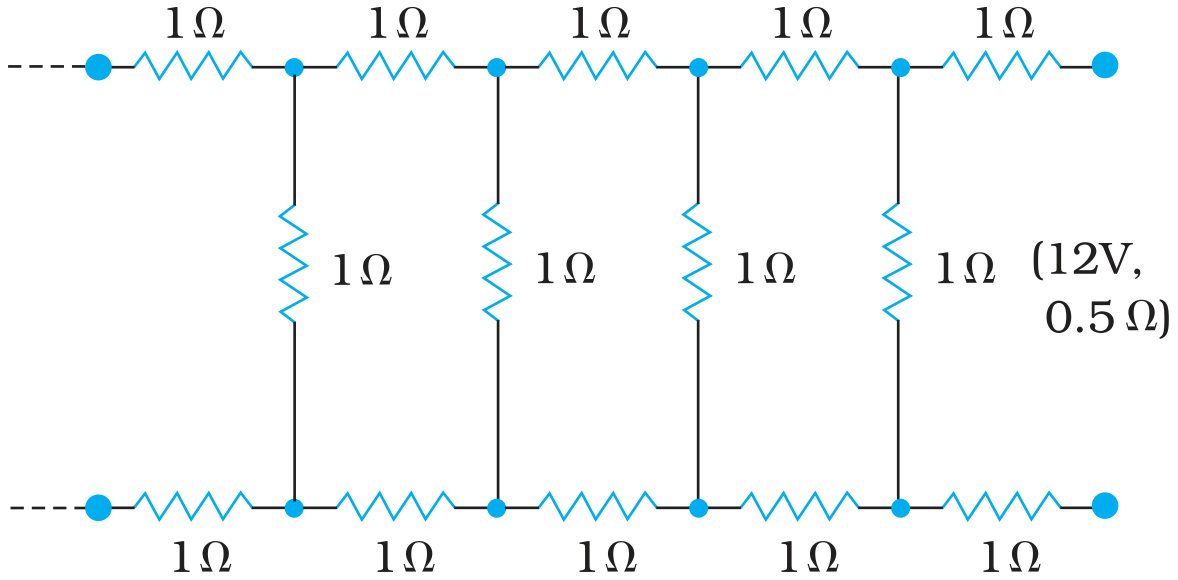
Determine the current drawn from a 12 V supply with internal resistance $0.5\ \Omega$ by the infinite network shown in Fig. Each resistor has $1\ \Omega$ resistance.
Can X-rays be used for photoelectric effect?