Define relaxation time of the free electrons drifting in a conductor. How is it related to the drift velocity of free electrons? Use this relation to deduce the expression for the electrical resistivity of the material.
CBSE OUTSIDE DELHI - SET 1 2012
Download our app for free and get started
Relaxation time$(\tau)$: The average time interval between two successive collisions. For the free electrons drifting within a conductor $($due to the action of the applied electric field$),$ is called relaxation time.
Relation
$\text{V}_{d} = ( - \text{e E } \tau) / \text{m}$
Since $i = - n e A v_d$
$n e^2 A \tau V / m l$
$\therefore\text{V}/ \text{i} = \text{ml}/(\text{ne}^{2}\text{A}\tau) = \rho\text{ l } / \text{A}$
$\therefore\rho = \text{m}/ (\text{n e}^{2}\tau). $
Relation
$\text{V}_{d} = ( - \text{e E } \tau) / \text{m}$
Since $i = - n e A v_d$
$n e^2 A \tau V / m l$
$\therefore\text{V}/ \text{i} = \text{ml}/(\text{ne}^{2}\text{A}\tau) = \rho\text{ l } / \text{A}$
$\therefore\rho = \text{m}/ (\text{n e}^{2}\tau). $

Download our appand get started for free
Experience the future of education. Simply download our apps or reach out to us for more information. Let's shape the future of learning together!No signup needed.*
Similar Questions
- 1View SolutionA potentiometer wire of length 1 m is connected to a driver cell of emf 3 V as shown in the figure. When a cell of 1.5 V emf is used in the secondary circuit, the balance point is found to be 60 cm. On replacing this cell and using a cell of unknown emf, the balance point shifts to 80 cm.
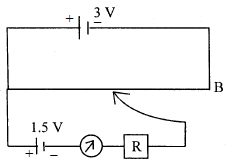
- Calculate unknown emf of the cell.
- Explain with reason, whether the circuit works, if the driver cell is replaced with a cell of emf 1 V.
- Does the high resistance R, used in the secondary circuit affect the balance point? Justify your answer.
- 2View SolutionA number of identical cells, n, each of emf E, internal resistance r connected in series are charged by a d.c. source of emf E', using a resistor R.
- Draw the circuit arrangement.
- Deduce the expressions for (a) the charging current and (b) the potential difference across the combination of the cells.
- 3View SolutionName the charge carriers of electric current in:
- Silver foil.
- Hydrogen discharge tube.
- Germanium semiconductor.
- Wire made of alloy nichrome.
- Superconductor.
- 4A coil of resistance $100\Omega$ is connected across a battery of emf $6.0V.$ Assume that the heat developed in the coil is used to raise its temperature. If the heat capacity of the coil is $4.0J/K,$ how long will it take to raise the temperature of the coil by $15^\circ C$?View Solution
- 5The current through a wire depends on time as $\text{i}=\text{i}_0+\alpha\text{t},$View Solution
Where $\text{i}_0=10\text{A}$ and $\alpha=4\text{A/ s}.$ Find the charge that crosses through a section of the wire in 10 seconds. - 6View Solution
- Derive an expression for drift velocity of free electrons.
- How does drift velocity of electrons in a metallic conductor vary with increase in temperature? Explain.
- 7View SolutionHow many time constants will elapse before the power delivered by a battery drops to half of its maximum value in an RC circuit?
- 8A potentiometer wire of length 1.0 m has a resistance of l5 $\Omega$. It is connected to a 5 V battery in series with a resistance of 5 $\Omega$ Determine the emf of the primary cell which gives a balance point at 60 cm.View Solution
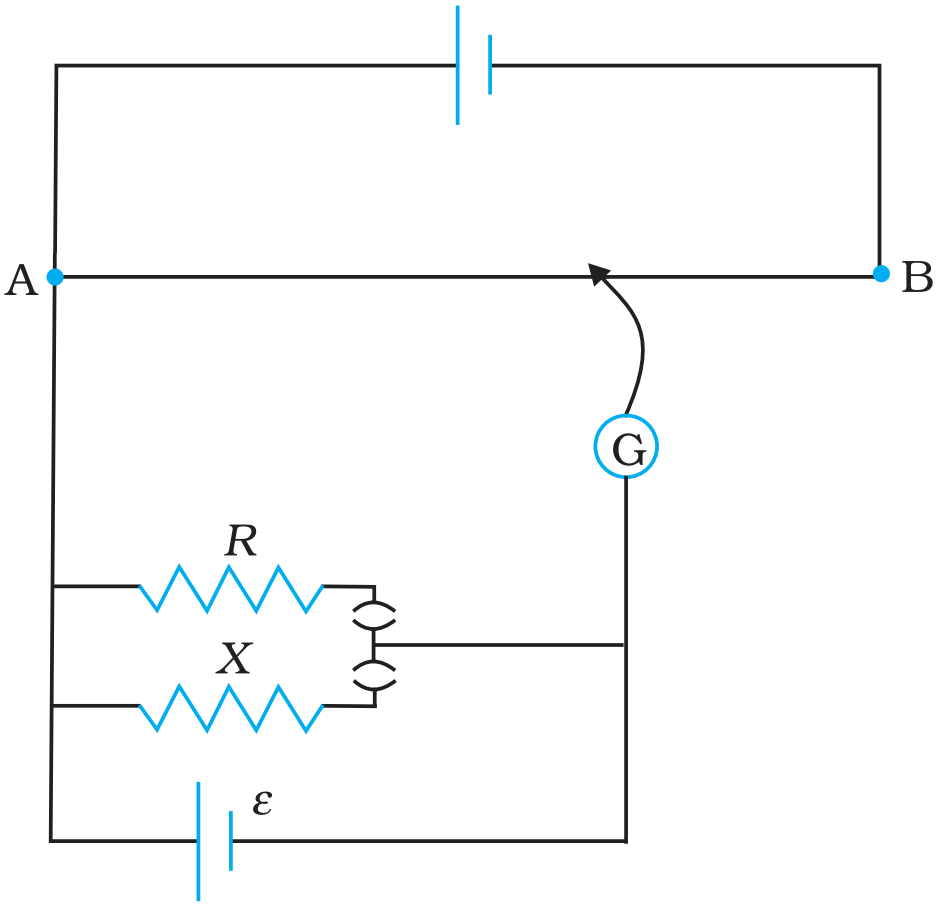
- 9Figure shows a potentiometer circuit for comparison of two resistances. The balance point with a standard resistor $\text{R}=10.0\ \Omega$ is found to be $58.3 \ cm,$ while that with the unknown resistance $X$ is $68.5 \ cm$. Determine the value of $X$. What might you do if you failed to find a balance point with the given cell of emf $\varepsilon?$View Solution
- 10Find the potential difference $V_a - V_b$ in the circuits shown in figure.View Solution