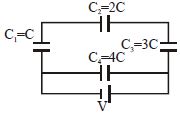
A network of four capacitors of capacity equal to $C_1 = C, C_2 = 2C, C_3 = 3C$ and $C_4 = 4C$ are conducted in a battery as shown in the figure. The ratio of the charges on $C_2$ and $C_4$ is
Diffcult
Download our app for free and get started
The charge in capacitor $C_{4}, q_{4}=C_{4} \times V=4 C V$
The capacitors $C_{1}, C_{2}$ and $C_{3}$ are connected in series. Let the resultant of these ca[acotors is $C^{\prime}$
$\frac{1}{C^{\prime}}=\frac{1}{C}+\frac{1}{2 C}+\frac{1}{3 C}$
$=\frac{6+3+2}{6 C}=\frac{11}{6 C}$
$\Rightarrow C^{\prime}=\frac{6 C}{11}$
Now $\mathrm{C}^{\prime}$ and $C_{4}$ from parallel combination giving $C^{\prime \prime}=C^{\prime}+C_{4}$
$=\frac{6 C}{11}+4 C=\frac{50 C}{11}$
Net charge $q=C^{\prime \prime} V$
$=\frac{50}{11} \mathrm{CV}$
Total charge flowing through $C_{1}, C_{2}$ and $C_{3}$ will be
$q^{\prime}=q^{\prime}-q_4$
$=\frac{50}{11} C V-4 C V=\frac{6 C V}{11}$
since, $C_{1}, C_{2}$ and $C_{3}$ are in series combination hence, charge flowing through these will be the same. Hence,
$q_{2}=q_{1}=q_{3}=q^{\prime}=\frac{6 C V}{11}$
Thus, $\frac{q_{2}}{q_{4}}=\frac{6 C V / 11}{4 C V}=\frac{3}{22}$

Download our appand get started for free
Experience the future of education. Simply download our apps or reach out to us for more information. Let's shape the future of learning together!No signup needed.*
Similar Questions
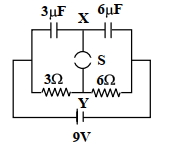
- 1A circuit is connected as shown in the figure with the switch $S$ open. When the switch is closed the total amount of charge that flows from $\mathrm{Y}$ to $\mathrm{X}$ isView Solution
- 2An electric dipole when placed in a uniform electric field $E$ will have minimum potential energy, when the angle made by dipole moment with field $E$ isView Solution
- 3A parallel plate capacitor is made of two square parallel plates of area $A$ , and separated by a distance $d < < \sqrt A $ . The capacitor is connected to a battery with potential $V$ and allowed to fully charge. The battery is then disconnected. A square metal conducting slab also with area $A$ but thickness $\frac {d}{2}$ is then fully inserted between the plates, so that it is always parallel to the plates. How much work has been done on the metal slab by external agent while it is being inserted?View Solution
- 4Positive and negative point charges of equal magnitude are kept at $\left(0,0, \frac{a}{2}\right)$ and $\left(0,0, \frac{-a}{2}\right)$, respectively. The work done by the electric field when another positive point charge is moved from $(-a, 0,0)$ to $(0, a, 0)$ isView Solution
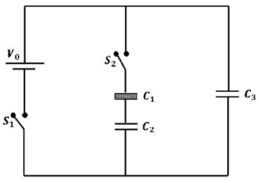
- 5Three identical capacitors $\mathrm{C}_1, \mathrm{C}_2$ and $\mathrm{C}_3$ have a capacitance of $1.0 \mu \mathrm{F}$ each and they are uncharged initially. They are connected in a circuit as shown in the figure and $\mathrm{C}_1$ is then filled completely with a dielectric material of relative permittivity $\varepsilon_{\mathrm{r}}$. The cell electromotive force (emf) $V_0=8 \mathrm{~V}$. First the switch $S_1$ is closed while the switch $S_2$ is kept open. When the capacitor $C_3$ is fully charged, $S_1$ is opened and $S_2$ is closed simultaneously. When all the capacitors reach equilibrium, the charge on $\mathrm{C}_3$ is found to be $5 \mu \mathrm{C}$. The value of $\varepsilon_{\mathrm{r}}=$. . . .View Solution
(image)
- 6View SolutionAn uncharged capacitor is connected to a battery. On charging the capacitor
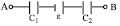
- 7A circuit shown in the figure consists of a battery of $emf$ $10$ $V$ and two capacitance $C_1$ and $C_2 $ of capacitances $1.0$ $ \mu F$ and $2.0$ $\mu F$ respectively. The potential difference $V_A - V_B$ is $5\,V$View Solution
- 8Energy per unit volume for a capacitor having area $A$ and separation $d$ kept at potential difference $V$ is given byView Solution
- 9Voltage rating of a parallel plate capacitor is $500\,V$. Its dielectric can withstand a maximum electric field of ${10^6}\,\frac{V}{m}$. The plate area is $10^{-4}\, m^2$ . What is the dielectric constant if the capacitance is $15\, pF$ ? (given ${ \in _0} = 8.86 \times {10^{ - 12}}\,{C^2}\,/N{m^2}$)View Solution
- 10Two metal spheres, one of radus $R$ and the other of radius $2 R$ respectively have the same surface charge density $\sigma$. They are brought in contact and separated. What will be the new surface charge densities on them?View Solution