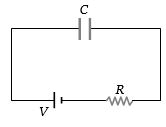
As in figure shown, if a capacitor $C$ is charged by connecting it with resistance $R$, then energy is given by the battery will be
Easy
Download our app for free and get started
(b) Some energy lost in the form of heat in resistance also.

Download our appand get started for free
Experience the future of education. Simply download our apps or reach out to us for more information. Let's shape the future of learning together!No signup needed.*
Similar Questions
- 1An electron enters in high potential region ${V_2}$ from lower potential region ${V_1}$ then its velocityView Solution
- 2Two point charges $100\,\mu \,C$ and $5\,\mu \,C$ are placed at points $A$ and $B$ respectively with $AB = 40\,cm$. The work done by external force in displacing the charge $5\,\mu \,C$ from $B$ to $C$, where $BC = 30\,cm$, angle $ABC = \frac{\pi }{2}$ and $\frac{1}{{4\pi {\varepsilon _0}}} = 9 \times {10^9}\,N{m^2}/{C^2}$.........$J$View Solution
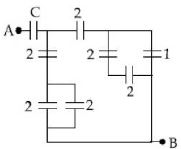
- 3In the circuit shown, find $C$ if the effective capacitance of the whole circuit is to be $0.5\,\mu F.$ All values in the circuit are in $\mu F.$View Solution
- 4A battery does $200 \,J$ of work in charging a capacitor. The energy stored in the capacitor is ......... $J$View Solution
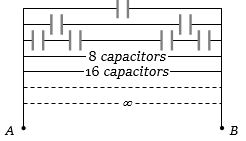
- 5An infinite number of identical capacitors each of capacitance $1\,\mu F$ are connected as in adjoining figure. Then the equivalent capacitance between $A$ and $B$ is......$\mu F$View Solution
- 6This question has Statement $-1$ and Statement $-2$ Of the four choices given after the Statements, choose the one that best describes the two StatementsView Solution
Statement $1$ : No work is required to be done to move a test charge between any two points on an equipotential surface
Statement $2$ : Electric lines of force at the equipotential surfaces are mutually perpendicular to each other
- 7An air capacitor of capacity $C = 10\,\mu F$ is connected to a constant voltage battery of $12\,V$. Now the space between the plates is filled with a liquid of dielectric constant $5$. The charge that flows now from battery to the capacitor is......$\mu C$View Solution
- 8The plates of a parallel plate condenser are pulled apart with a velocity $v$. If at any instant their mutual distance of separation is $d$, then the magnitude of the time of rate of change of capacity depends on $d$ as followsView Solution
- 9A parallel plate air capacitor is charged to a potential difference of $V$. After disconnecting the battery, distance between the plates of the capacitor is increased using an insulating handle. As a result, the potential difference between the platesView Solution
- 10When two identical capacitors are in series have $3\,\mu F$ capacitance and when parallel $12\,\mu F$. What is the capacitance of each.......$\mu \,F$View Solution