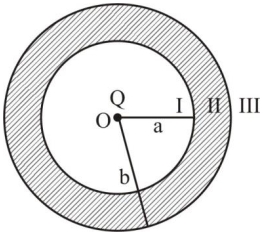
As shown in the figure, a point charge $Q$ is placed at the centre of conducting spherical shell of inner radius a and outer radius $b$. The electric field due to charge $Q$ in three different regions I, II and III is given by: $( I : r < a , II : a < r < b , III : r > b )$
JEE MAIN 2023, Medium
Download our app for free and get started
Electric field inside material of conductor is zero.

Download our appand get started for free
Experience the future of education. Simply download our apps or reach out to us for more information. Let's shape the future of learning together!No signup needed.*
Similar Questions
- 1A series combination of three capacitors of capacities $1\,\mu \,F,\,2\,\mu \,F$ and $8\,\mu \,F$ is connected to a battery of $e.m.f.$ $13\, volt$. The potential difference across the plates of $2\,\mu \,F$ capacitor will be.....$V$View Solution
- 2Two condensers of capacities $1\,\mu F$ and $2\,\mu F$ are connected in series and the system is charged to $120\;volts$. Then the $P.D.$ on $1\,\mu F$ capacitor (in $volts$) will beView Solution
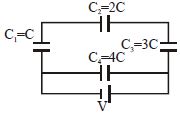
- 3A network of four capacitors of capacity equal to $C_1 = C, C_2 = 2C, C_3 = 3C$ and $C_4 = 4C$ are conducted in a battery as shown in the figure. The ratio of the charges on $C_2$ and $C_4$ isView Solution
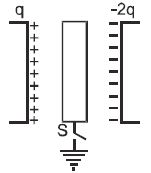
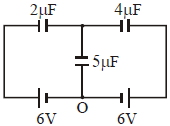
- 4In the circuit shown, charge on the $5\, \mu F$ capacitor is$........\mu C$View Solution
- 5The material filled between the plates of a parallel plate capacitor has resistivity $200 \Omega \, {m}$. The value of capacitance of the capacitor is $2\, {pF}$. If a potential difference of $40 \,{V}$ is applied across the plates of the capacitor, then the value of leakage current flowing out of the capacitor isView Solution
(given the value of relative permitivity of material is $50$ )
- 6Charges are placed on the vertices of a square as shown. Let $E$ be the electric field and $V$ the potential at the centre. If the charges on $A$ and $B$ are interchanged with those on $D$ and $C$ respectively, thenView Solution
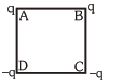
- 7If the capacity of a spherical conductor is $1$ picofarad, then its diameter, would beView Solution
- 8Two equal charges $q$ of opposite sign separated by a distance $2a$ constitute an electric dipole of dipole moment $p$. If $P$ is a point at a distance $r$ from the centre of the dipole and the line joining the centre of the dipole to this point makes an angle $\theta $ with the axis of the dipole, then the potential at $P$ is given by $(r > > 2a)$ (Where $p = 2qa$)View Solution
- 9A resistor '$R$' and $2\ μF$ capacitor in series is connected through a switch to $200\ V$ direct supply. Across the capacitor is a neon bulb that lights up at $120\ V$. Calculate the value of $R$ to make the bulb light up $5\ s$ after the switch has been closed. $(log_{10} 2.5 = 0.4)$.View Solution
- 10The metal plate on the left in figure carries a charge $+q$. The metal plate on the right has a charge of $-2q$. What charge will flow through $S$ when it is closed, if central plate is initially neutralView Solution