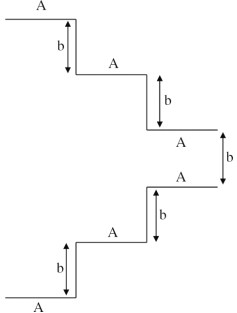
A paralle plate capacitor is made up of stair like structure with a palte area $A$ of each stair and that is connected with a wire of length $b$, as shown in the figure. The capacitance of the arrangement is $\frac{ x }{15} \frac{\varepsilon_{0} A }{ b }$. The value of $x$ is ............
JEE MAIN 2022, Diffcult
Download our app for free and get started
Parallel combination
$c _{ eq }=\varepsilon_{0} A \left[\frac{1}{5 b }+\frac{1}{3 b }+\frac{1}{ b }\right]=\frac{23}{15} \frac{\varepsilon_{0} A }{ b }$

Download our appand get started for free
Experience the future of education. Simply download our apps or reach out to us for more information. Let's shape the future of learning together!No signup needed.*
Similar Questions
- 1Two capacitors of $1\,\mu F$ and $2\,\mu F$ are connected in series, the resultant capacitance will be.....$\mu \,F$View Solution
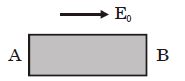
- 2View SolutionA metallic rod is placed in a uniform electric field. Select the correct option.
- 3Two large vertical and parallel metal plates having a separation of $1 \ cm$ are connected to a $DC$ voltage source of potential difference $X$. A proton is released at rest midway between the two plates. It is found to move at $45^{\circ}$ to the vertical $JUST$ after release. Then $X$ is nearlyView Solution
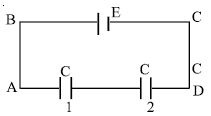
- 4In the adjoining figure, capacitor $(1)$ and $(2)$ have a capacitance $‘C’$ each. When the dielectric of dielectric consatnt $K$ is inserted between the plates of one of the capacitor, the total charge flowing through battery isView Solution
- 5Two capacitors connected in parallel having the capacities ${C_1}$ and ${C_2}$ are given $'q'$ charge, which is distributed among them. The ratio of the charge on ${C_1}$ and ${C_2}$ will beView Solution
- 6From a supply of identical capacitors rated $8\ \mu F$, $250\ V$, the minimum number of capacitors required to form a composite $16$ $\mu F$, $1000$ $V$ is :View Solution
- 7Choose the $CORRECT$ optionView Solution
- 8Three charges $-q, Q$ and $-q$ are placed respectively at equal distances on a straight line. If the potential energy of the system of three charges is zero, then what is the ratio of $Q: q$ ?View Solution
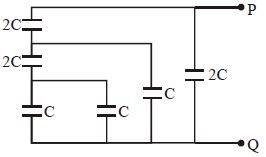
- 9The value of equivalent capacitance of the combination shown in figure, between points $P$ and $Q$ isView Solution
- 10Two metallic spheres of radii $1\,cm$ and $2\,cm$ are given charges ${10^{ - 2}}\,C$ and $5 \times {10^{ - 2}}\,C$ respectively. If they are connected by a conducting wire, the final charge on the smaller sphere isView Solution