Question
  1. A parallel plate capacitor $(C_1)$ having charge $Q$ is connected, to an identical uncharged capacitor $C_2$ in series. What would be the charge accumulated on the capacitor $C_2?$
  2. Three identical capacitors each of capacitance $3mF$ are connected, in tern, in series and in parallel combination to the common source of $V$ volt. Find out the ratio of the energies stored in two configurations.
Answer

  1. Zero.
  2. We have $\text{C}_{series} = \frac{3\mu\text{F}}{3} =1 \mu\text{F}$
Also, $\text{C}_{parallel} =( 3 + 3 +3 ) =9 \mu\text{F}$
Energy stored $ = \frac{1}{2}\text{CV}^{2}$
$\therefore$Energy in series combination $ =\frac{1}{2}1 \times10^{-6}\times\text{V}^{2}$
Energy in parallel combination $ =\frac{1}{2}9 \times10^{-6}\times\text{V}^{2}$
$\therefore$ Ratio $= 1:9.$

Need a full question paper?

Generate a complete, print-ready paper with questions like this in minutes — across 16+ boards, with answer keys.

Start Generating Free

Similar questions

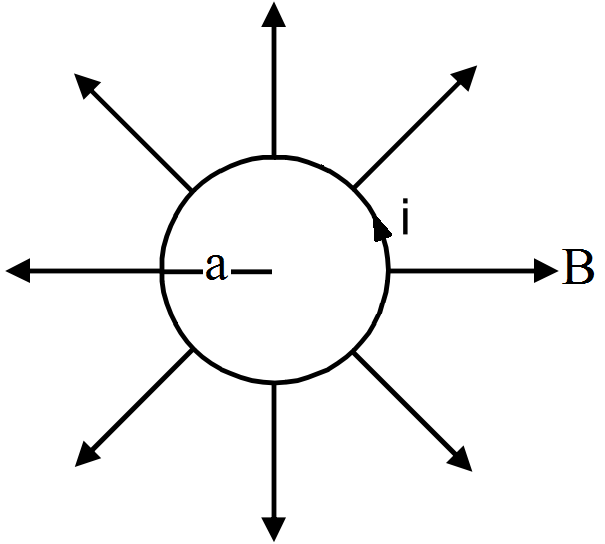
A circular loop of radius a, carrying a current i, is placed in a two-dimensional magnetic field. The centre of the loop coincides with the centre of the field The strength of the magnetic field at the periphery of the loop is B. Find the magnetic force on the wire.
The energy flux of sunlight reaching the surface of the earth is $1.388 \times 10^3 W / m ^2$. How many photons $($nearly$)$ per square metre are incident on the Earth per second? Assume that the photons in the sunlight have an average wavelength of $550\ nm$ .
Deduce the expression for the electrostatic energy stored in a capacitor of capacitance 'C' and having charge 'Q'.
How will the (i) energy stored and (ii) the electric field inside the capacitor be affected when it is completely filled with a dielectric material of dielectric constant 'K'?
It is found that photosynthesis starts in certain plants when exposed to the sunlight but it does not start if the plant is exposed only to infrared light. Explain.
What will be maximum mutual inductance between coils of self-inductance $L_1$ and $L_2$ ?
Explain how $p-n$ junction is formed.
$i.$ State two important features of Einstein's photoelectric equation.
$ii.$ Radiation of frequency $10^{15} Hz$ is incident on two photosensitive surface $P$ and $Q.$ There is no photoemission from surface $P.$ Photoemission occurs from surface $Q$ but photoelectrons have zero kinetic energy. Explain these observations and find the value of work function for surface $Q.$
An electron in a hydrogen atom makes transitions from orbits of higher energies to orbits of lower energies.
a. When will such transitions result in (a) Lyman (b) Balmer series?
b. Find the ratio of the longest wavelength in Lyman series to the shortest wavelength in Balmer series.
Two long strings $A$ and $B,$ each having linear mass density $1.2 \times 10^{-2}\ kg/m$, are stretched by different tensions $4.8N$ and $7.5N$ respectively and are kept parallel to each other with their left ends at $x = 0.$ Wave pulses are produced on the strings at the left ends at $t = 0$ on string $A$ and at $t = 20\ ms$ on string $B.$ When and where will the pulse on $B$ overtake that on $A$?
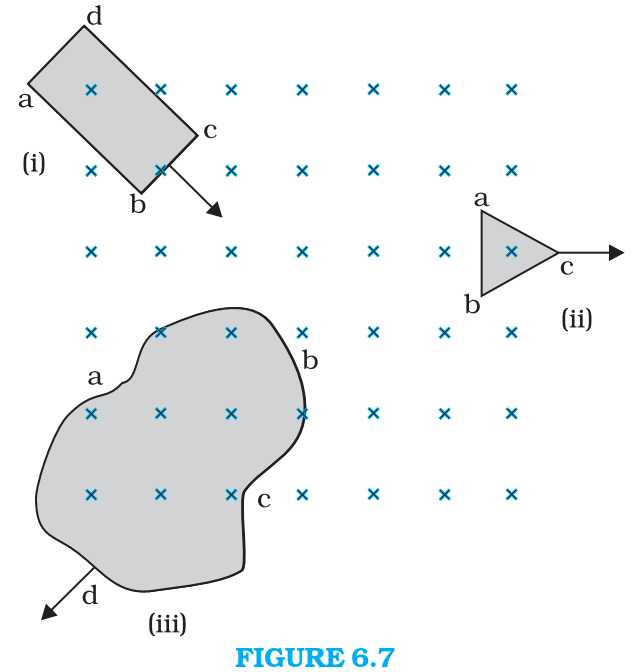
shows planar loops of different shapes moving out of or into a region of a magnetic field which is directed normal to the plane of the loop away from the reader. Determine the direction of induced current in each loop using Lenz's law.
Image