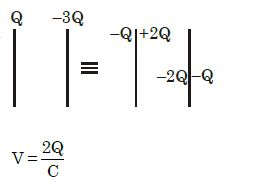
A parallel plate capacitor has capacitance $C$ . If charges of the plates are $Q$ and $-3Q$ , find the potential difference between the plates
Easy


Download our appand get started for free
Experience the future of education. Simply download our apps or reach out to us for more information. Let's shape the future of learning together!No signup needed.*
Similar Questions
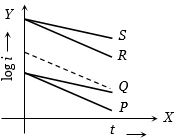
- 1In an $RC$ circuit while charging, the graph of in $i$ versus time is as shown by the dotted line in the diagram figure, where $i$ is the current. When the value of the resistance is doubled, which of the solid curve best represents the variation of in $i$ versus timeView Solution
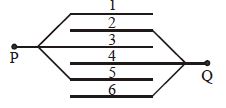
- 2Six metallic plates each with a surface area of one side $A$, are placed at a distance $d$ from each other. The alternate plates are connected to points $P$ and $Q$ as shown in figure. The capacitance of the system isView Solution
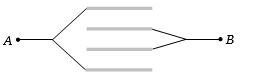
- 3Four plates of equal area $A$ are separated by equal distances $d$ and are arranged as shown in the figure. The equivalent capacity isView Solution
- 4Ten charges are placed on the circumference of a circle of radius $R$ with constant angular separation between successive charges. Alternate charges $1,3,5,7,9$ have charge $(+q)$ each, while $2,4,6,8,10$ have charge $(-q)$ each. The potential $V$ and the electric field $E$ at the centre of the circle are respectivelyView Solution
(Take $V =0$ at infinity $)$
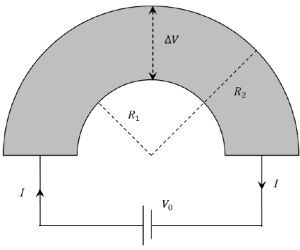
- 5Shown in the figure is a semicircular metallic strip that has thickness $t$ and resistivity $\rho$. Its inner radius is $R_1$ and outer radius is $R_2$. If a voltage $V_0$ is applied between its two ends, a current $I$ flows in it. In addition, it is observed that a transverse voltage $\Delta V$ develops between its inner and outer surfaces due to purely kinetic effects of moving electrons (ignore any role of the magnetic field due to the current). Then (figure is schematic and not drawn to scale)-View Solution
$(A)$ $I =\frac{V_0 t}{\pi \rho} \ln \left(\frac{R_2}{R_1}\right)$
$(B)$ the outer surface is at a higher voltage than the inner surface
$(C)$ the outer surface is at a lower voltage than the inner surface
$(D)$ $\Delta V \propto I ^2$
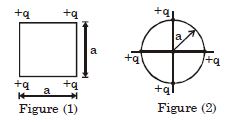
- 6Consider the configuration of a system of four charges each of value $+q$ . The work done by external agent in changing the configuration of the system from figure $(1)$ to figure $(2)$ isView Solution
- 7View SolutionThe capacity of a parallel plate capacitor increases with the
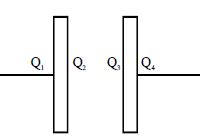
- 8In an insulated parallel-plate capacitor of capacitance $C$, the four surfaces have charges $Q_1, Q_2, Q_3$ and $Q_4$ as shown. The potential difference between the plate isView Solution
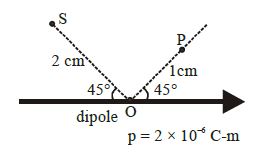
- 9If $OP = 1\,\,cm$ and $OS = 2\,\, cm$, work done by electric field in shifting a point charge $\frac {4\sqrt 2}{27}\,\, μC$ from point $P$ to $S$ in given figure isView Solution
- 10In a capacitor of capacitance $20\,\mu \,F$, the distance between the plates is $2\,mm$. If a dielectric slab of width $1\,mm$ and dielectric constant $2$ is inserted between the plates, then the new capacitance is......$\mu \,F$View Solution