MCQ
A particle executing simple harmonic motion along $Y- $axis has its motion described by the equation $y = A\sin (\omega \,t) + B$. The amplitude of the simple harmonic motion is
  • $A$
  • B
    $B$
  • C
    $A + B$
  • D
    $\sqrt {A + B} $

Answer

Correct option: A.
$A$
a
(a)The amplitude is a maximum displacement from the mean position.

Need a full question paper?

Generate a complete, print-ready paper with questions like this in minutes — across 16+ boards, with answer keys.
Start Generating Free

Similar questions

A truck is stationary and has a bob suspended by a light string, in a frame attached to the truck. The truck, suddenly moves to the right with an acceleration of $a$. The pendulum will the
What happen to the instantaneous velocity in a non - uniformly accelerated motion?
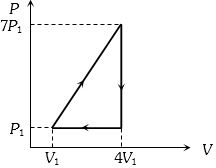
In the cyclic process shown in the figure, the work done by the gas in one cycle is
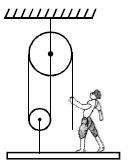
A man of mass $60\ kg$ is standing on a platform of mass $40\ kg$ as shown in figure then what force man should apply on rope so that he accelerate up with the platform with acceleration of $2\ m/s^2$ ............ $N$
The temperature at which the speed of sound in air becomes double of its value at ${0^o}C$ is  ...... $K$
The heat is flowing through a rod of length $50 cm$ and area of cross-section $5c{m^2}$. Its ends are respectively at ${25^o}C$ and ${125^o}C$. The coefficient of thermal conductivity of the material of the rod is $0.092 kcal/m×s×^\circ C$. The temperature gradient in the rod is
If $\overrightarrow P .\overrightarrow Q = PQ,$ then angle between $\overrightarrow P $and $\overrightarrow Q $ is ....... $^o$
A black body radiates $ 20\,W$ at temperature ${227^o}C$. If temperature of the black body is changed to ${727^o}C$ then its radiating power will be ..... $W$
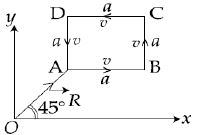
A particle of mass $m$ is moving along the side of a square of side '$a$', with a uniform speed $v$ in the $x-y$ plane as shown in the figure

Which of the following statement is false for the angular momentum $\vec L$ about the origin ?
Given below are two statements:

Statement $I:$ A truck and a car moving with same kinetic energy are brought to rest by applying brakes which provide equal retarding forces. Both come to rest in equal distance.

Statement $II:$ A car moving towards east takes a turn and moves towards north, the speed remains unchanged. The acceleration of the car is zero.

In the light of given statements, choose the most appropriate answer from the options given below.