A particle free to move along the $x-$axis has potential energy given by $U(x) = k[1 - \exp {( - x)^2}]$ for $ - \infty \le x \le + \infty $, where k is a positive constant of appropriate dimensions. Then
IIT 1999,AIIMS 1995, Diffcult
Download our app for free and get started
(d)Potential energy of the particle $U = k(1 - {e^{ - {x^2}}})$
Force on particle$F = \frac{{ - dU}}{{dx}} = - k[ - {e^{ - {x^2}}} \times ( - 2x)]$
F$ = \, - 2kx{e^{ - {x^2}}}$$ = - 2kx\left[ {1 - {x^2} + \frac{{{x^4}}}{{2\,!}} - ......} \right]$
For small displacement $F = - 2kx$
$⇒$ $F(x) \propto - x$ i.e. motion is simple harmonic motion.
Force on particle$F = \frac{{ - dU}}{{dx}} = - k[ - {e^{ - {x^2}}} \times ( - 2x)]$
F$ = \, - 2kx{e^{ - {x^2}}}$$ = - 2kx\left[ {1 - {x^2} + \frac{{{x^4}}}{{2\,!}} - ......} \right]$
For small displacement $F = - 2kx$
$⇒$ $F(x) \propto - x$ i.e. motion is simple harmonic motion.

Download our appand get started for free
Experience the future of education. Simply download our apps or reach out to us for more information. Let's shape the future of learning together!No signup needed.*
Similar Questions
- 1A point performs simple harmonic oscillation of period $T$ and the equation of motion is given by $x=Asin$$\left( {\omega t + \frac{\pi }{6}} \right)$. After the elapse of what fraction of the time period the velocity of the point will be equal to half of its maximum velocity?View Solution
- 2The phase (at a time $t$) of a particle in simple harmonic motion tellsView Solution
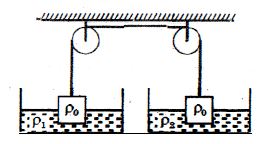
- 3Consider two identical cylinders [each of mass $m$ density $\rho _0$ horizontal cross-section area $s$] in equilibrium, partially submerged in two containers filled with liquids of densities $\rho_1$ and $\rho_2$ as shown in figure. Find the period of small oscillations of this system about its equilibrium. Neglect the changes in the level of liquids in the containers. Neglect mass of the strings. acceleration due to gravity is $g$ . ($v$ is volume of each block)View Solution
- 4A simple pendulum consisting of a light inextensible string of length $\ell$ attached to a heavy small bob of mass $m$ is at rest. The bob is imparted a horizontal impulsive force which gives it a speed of $\sqrt{4 g \ell}$. The speed of the bob at its highest point is ( $g$ is the accelaration due to gravity)View Solution
- 5A pendulum bob has a speed of $3\, m/s$ at its lowest position. The pendulum is $0.5\, m$ long. The speed of the bob, when the length makes an angle of ${60^o}$ to the vertical, will be ..... $m/s$ (If $g = 10\,m/{s^2}$)View Solution
- 6A mass $m =100\, gms$ is attached at the end of a light spring which oscillates on a frictionless horizontal table with an amplitude equal to $0.16$ metre and time period equal to $2 \,sec$. Initially the mass is released from rest at $t = 0$ and displacement $x = - 0.16$ metre. The expression for the displacement of the mass at any time $t$ isView Solution
- 7The displacement of an oscillating particle varies with time (in seconds) according to the equation $y (cm) = sin \frac{\pi }{2}\left( {\frac{t}{2} + \frac{1}{3}} \right)$. The maximum acceleration of the particle is approximately ..... $cm/s^2$View Solution
- 8The displacement of a particle varies according to the relation $x$ = $3 sin100t + 8cos^2 50t$. Which of the following is $INCORRECT$ about this motionView Solution
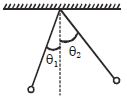
- 9Two masses, both equal to $100\, g$, are suspended at the ends of identical light strings of length $\lambda = 1.0\, m$, attached to the same point on the ceiling (see figure). At time $t = 0$, they are simultaneously released from rest, one at angle $\theta_1 = 1^o$, the other at angle $\theta_2 = 2^o$ from the vertical. The masses will collideView Solution
- 10A particle moves in the $x-y$ plane according to equation $\overrightarrow r = (\widehat i + 2\widehat j)\, A \, \cos \omega t$. The motion of the particle isView Solution