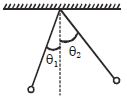
Two masses, both equal to $100\, g$, are suspended at the ends of identical light strings of length $\lambda = 1.0\, m$, attached to the same point on the ceiling (see figure). At time $t = 0$, they are simultaneously released from rest, one at angle $\theta_1 = 1^o$, the other at angle $\theta_2 = 2^o$ from the vertical. The masses will collide
Diffcult
Download our app for free and get started
$\mathrm{T}=2 \pi \sqrt{\frac{\ell}{\mathrm{g}}}=2 \pi \sqrt{\frac{1}{10}}=2 \mathrm{sec}$
$t=\frac{T}{4}=\frac{2}{4}=0.5 \mathrm{sec}$

Download our appand get started for free
Experience the future of education. Simply download our apps or reach out to us for more information. Let's shape the future of learning together!No signup needed.*
Similar Questions
- 1View SolutionTime period of pendulum, on a satellite orbiting the earth, is
- 2A particle performs $S.H.M.$ of amplitude $A$ with angular frequency $\omega$ along a straight line. Whenit is at a distance $\frac{{\sqrt 3 }}{2}$ $A$ from mean position, its kinetic energy gets increased by an amount $\frac{1}{2}m{\omega ^2}{A^2}$ due to an impulsive force. Then its new amplitude becomesView Solution
- 3Two simple harmonic motions are represented by equations ${y_1} = 4\,\sin \,\left( {10t + \phi } \right)$ and ${y_2} = 5\,\cos \,10\,t$ What is the phase difference between their velocities?View Solution
- 4On a frictionless horizontal plane, a bob of mass $m=0.1 kg$ is attached to a spring with natural length $l_0=0.1 m$. The spring constant is $k_1=0.009 Nm ^{-1}$ when the length of the spring $I > l_0$ and is $k_2=0.016 Nm ^{-1}$ when $ I < l_0$. Initially the bob is released from $l=0.15 m$. Assume that Hooke's law remains valid throughout the motion. If the time period of the full oscillation is $T=(n \pi) s$, then the integer closest to $n$ is. . . . .View Solution
- 5Which one of the following statements is true for the speed $v$ and the acceleration $a$ of a particle executing simple harmonic motionView Solution
- 6The amplitude of a damped oscillator decreases to $0.9\,times$ its original magnitude in $5\,s.$ In another $10\,s$ it will decrease to $\alpha $ times its original magnitude, where $\alpha $ equalsView Solution
- 7A particle executing simple harmonic motion with amplitude of $0.1 \,m$. At a certain instant when its displacement is $0.02 \,m$, its acceleration is $0.5 \,m/s^2$. The maximum velocity of the particle is (in $m/s$)View Solution
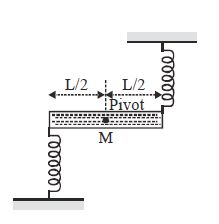
- 8A uniform stick of mass $M$ and length $L$ is pivoted at its centre. Its ends are tied to two springs each of force constant $K$ . In the position shown in figure, the strings are in their natural length. When the stick is displaced through a small angle $\theta $ and released. The stickView Solution
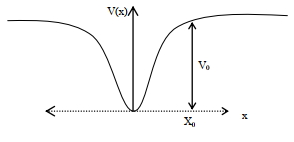
- 9When a particle of mass $m$ moves on the $x$-axis in a potential of the form $V(x)=\mathrm{kx}^2$ it performs simple harmonic motion. The corresponding time period is proportional to $\sqrt{\frac{\mathrm{m}}{\mathrm{k}}}$, as can be seen easily using dimensional analysis. However, the motion of a particle can be periodic even when its potential energy increases on both sides of $\mathrm{x}=0$ in a way different from $\mathrm{kx}^2$ and its total energy is such that the particle does not escape to infinity. Consider a particle of mass $\mathrm{m}$ moving on the $x$-axis. Its potential energy is $V(x)=\alpha x^4(\alpha>0)$ for $|x|$ near the origin and becomes a constant equal to $\mathrm{V}_0$ for $|x| \geq X_0$ (see figure). $Image$View Solution
$1.$ If the total energy of the particle is $E$, it will perform periodic motion only if
$(A)$ $E$ $<0$ $(B)$ $E$ $>0$ $(C)$ $\mathrm{V}_0 > \mathrm{E}>0$ $(D)$ $E > V_0$
$2.$ For periodic motion of small amplitude $\mathrm{A}$, the time period $\mathrm{T}$ of this particle is proportional to
$(A)$ $\mathrm{A} \sqrt{\frac{\mathrm{m}}{\alpha}}$ $(B)$ $\frac{1}{\mathrm{~A}} \sqrt{\frac{\mathrm{m}}{\alpha}}$ $(C)$ $\mathrm{A} \sqrt{\frac{\alpha}{\mathrm{m}}}$ $(D)$ $\mathrm{A} \sqrt{\frac{\alpha}{\mathrm{m}}}$
$3.$ The acceleration of this particle for $|\mathrm{x}|>\mathrm{X}_0$ is
$(A)$ proportional to $\mathrm{V}_0$
$(B)$ proportional to $\frac{\mathrm{V}_0}{\mathrm{mX}_0}$
$(C)$ proportional to $\sqrt{\frac{\mathrm{V}_0}{\mathrm{mX}_0}}$
$(D)$ zero
Give the answer qustion $1,2$ and $3.$
- 10A body is moving in a room with a velocity of $20\, m / s$ perpendicular to the two walls separated by $5$ meters. There is no friction and the collisions with the walls are elastic. The motion of the body isView Solution