The displacement of an oscillating particle varies with time (in seconds) according to the equation $y (cm) = sin \frac{\pi }{2}\left( {\frac{t}{2} + \frac{1}{3}} \right)$. The maximum acceleration of the particle is approximately ..... $cm/s^2$
Easy
Download our app for free and get started
${a_{\max }} = {\omega ^2}a = {\left( {\frac{\pi }{4}} \right)^2}a = 0.62\;cm/se{c^2}$ $[ a =1]$

Download our appand get started for free
Experience the future of education. Simply download our apps or reach out to us for more information. Let's shape the future of learning together!No signup needed.*
Similar Questions
- 1A linear harmonic oscillator of force constant $2 \times {10^6}N/m$ and amplitude $0.01\, m$ has a total mechanical energy of $160$ joules. ItsView Solution
- 2$Assertion :$ In simple harmonic motion, the motion is to and fro and periodicView Solution
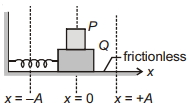
$Reason :$ Velocity of the particle $(v) = \omega \sqrt {k^2 - x^2}$ (where $x$ is the displacement). - 3In the figure shown, there is friction between the blocks $P$ and $Q$ but the contact between the block $Q$ and lower surface is frictionless. Initially the block $Q$ with block $P$ over it lies at $x=0$, with spring at its natural length. The block $Q$ is pulled to right and then released. As the spring - blocks system undergoes $S.H.M.$ with amplitude $A$, the block $P$ tends to slip over $Q . P$ is more likely to slip atView Solution
- 4View SolutionWhich of the diagrams shown in figure represents variation of total mechanical energy of a pendulum oscillating in water as function of time ?
- 5A pendulum bob has a speed of $3\, m/s$ at its lowest position. The pendulum is $0.5\, m$ long. The speed of the bob, when the length makes an angle of ${60^o}$ to the vertical, will be ..... $m/s$ (If $g = 10\,m/{s^2}$)View Solution
- 6For a particle executing simple harmonic motion, the kinetic energy $K$ is given by $K = {K_o}{\cos ^2}\omega t$. The maximum value of potential energy isView Solution
- 7The particle executing simple harmonic motion has a kinetic energy $K_0cos^2 \omega t$. The maximum values of the potential energy and the total energy are respectivelyView Solution
- 8A body of mass $m $ is attached to the lower end of a spring whose upper end is fixed. The spring has negligible mass. When the mass $m$ is slightly pulled down and released , it oscillates with a time period of $3\,s$ . When the mass $m$ is increased by $1\,kg$ , the time period of oscillations becomes $5\,s$ . The value of $m$ in $kg$ isView Solution
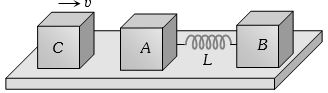
- 9Two blocks $A$ and $B$ each of mass m are connected by a massless spring of natural length L and spring constant $K$. The blocks are initially resting on a smooth horizontal floor with the spring at its natural length as shown in figure. A third identical block $C$ also of mass $m$ moves on the floor with a speed $v$ along the line joining $A$ and $B$ and collides with $A$. ThenView Solution
- 10Three simple harmonic motions of equal amplitudes $A$ and equal time periods in the same direction combine. The phase of the second motion is $60^o$ ahead of the first and the phase of the third motion is $60^o$ ahead of the second. Find the amplitude of the resultant motionView Solution