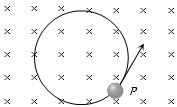
A particle having a charge of $10.0\,\mu C$ and mass $1\,\mu g$ moves in a circle of radius $10\,cm$ under the influence of a magnetic field of induction $0.1\,T$. When the particle is at a point $P$, a uniform electric field is switched on so that the particle starts moving along the tangent with a uniform velocity. The electric field is......$V/m$
Medium
Download our app for free and get started
(c) When the particle moves along a circle in the magnetic field $B$, the magnetic force is radially inward. If an electric field of proper magnitude is switched on which is directed radially outwards, the particle may experience no force. It will then move along a straight line with uniform velocity. This will be the case when $qE = \varepsilon vB \Rightarrow E = vB$
also $r = \frac{{mv}}{{qB}} \Rightarrow v = \frac{{qBr}}{m}$
So $E = \frac{{q{B^2}r}}{m}$
$ = \frac{{(10 \times {{10}^{ - 6}}) \times {{(0.1)}^2} \times 10 \times {{10}^{ - 2}}}}{{1 \times {{10}^{ - 3}} \times {{10}^{ - 6}}}} = 10\;V/m$
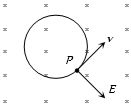
also $r = \frac{{mv}}{{qB}} \Rightarrow v = \frac{{qBr}}{m}$
So $E = \frac{{q{B^2}r}}{m}$
$ = \frac{{(10 \times {{10}^{ - 6}}) \times {{(0.1)}^2} \times 10 \times {{10}^{ - 2}}}}{{1 \times {{10}^{ - 3}} \times {{10}^{ - 6}}}} = 10\;V/m$

Download our appand get started for free
Experience the future of education. Simply download our apps or reach out to us for more information. Let's shape the future of learning together!No signup needed.*
Similar Questions
- 1The magnetic moment of a current $(i)$ carrying circular coil of radius $(r)$ and number of turns $(n)$ varies asView Solution
- 2A charged particle is moving in a circular orbit of radius $6\, cm$ with a uniform speed of $3 \times 10^6\, m/s$ under the action of a uniform magnetic field $2 \times 10^{-4}\, Wb/m^2$ which is at right angles to the plane of the orbit. The charge to mass ratio of the particle isView Solution
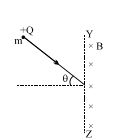
- 3A particle with charge $+Q$ and mass m enters a magnetic field of magnitude $B,$ existing only to the right of the boundary $YZ$. The direction of the motion of the $m$ particle is perpendicular to the direction of $B.$ Let $T = 2\pi\frac{m}{{QB}}$ . The time spent by the particle in the field will beView Solution
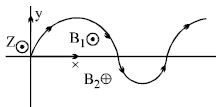
- 4At $t = 0$ a charge $q$ is at the origin and moving in the $y-$ direction with velocity $\overrightarrow v = v\,\hat j .$ The charge moves in a magnetic field that is for $y > 0$ out of page and given by $B_1 \hat z$ and for $y < 0$ into the page and given $-B_2 \hat z .$ The charge's subsequent trajectory is shown in the sketch. From this information, we can deduce thatView Solution
- 5A galvanometer coil has $500$ turns and each turn has an average area of $3 \times 10^{-4}\, m ^{2}$. If a torque of $1.5\,Nm$ is required to keep this coil parallel to magnetic field when a current of $0.5\, A$ is flowing through it, the strength of the field (in $T )$ isView Solution
- 6In an ammeter $0.2\%$ of main current passes through the galvanometer. If resistance of galvanometer is $G,$ the resistance of ammeter will beView Solution
- 7charged particle with charge $q$ enters a region of constant, uniform and mutually orthogonal fields $\vec E$ and $\vec B$ with a velocity $\vec v$ perpendicular to both $\vec E$ and $\vec B$ , and comes out without any change in magnitude or direction of $\vec v$ . ThenView Solution
- 8A particle with ${10^{ - 11}}\,coulomb$ of charge and ${10^{ - 7}}\,kg$ mass is moving with a velocity of ${10^8}\,m/s$ along the $y$-axis. A uniform static magnetic field $B = 0.5\,Tesla$ is acting along the $x$-direction. The force on the particle isView Solution
- 9A horizontal rod of mass $10\, gm$ and length $10\, cm$ is placed on a smooth plane inclined at an angle of $60^\circ $ with the horizontal, with the length of the rod parallel to the edge of the inclined plane. A uniform magnetic field of induction $B$ is applied vertically downwards. If the current through the rod is $1.73$ $ampere$, then the value of $B$ for which the rod remains stationary on the inclined plane is......$Tesla$View Solution
- 10The magnetic induction in air at a point $1\,cm $ away from a long wire that carries a current of $1\,A$, will beView Solution