A particle having some charge is projected in $x-y$ plane with a speed of $5\ m/s$ in a region having uniform magnetic field along $z-$ axis. Which of the following cannot be the possible value of velocity at any time ?
Easy


Download our appand get started for free
Experience the future of education. Simply download our apps or reach out to us for more information. Let's shape the future of learning together!No signup needed.*
Similar Questions
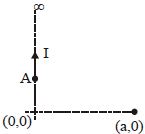
- 1An infinitely long wire carrying current $I$ is along $Y$ axis such that its one end is at point $A(0, b)$ while the wire extends upto $+ \infty .$ The magnitude of magnetic field strength at point $(a, 0)$View Solution
- 2Consider the motion of a positive point charge in a region where there are simultaneous uniform electric and magnetic fields $\vec{E}=E_0 \hat{j}$ and $\vec{B}=B_0 \hat{j}$. At time $t=0$, this charge has velocity $\nabla$ in the $x$-y plane, making an angle $\theta$ with $x$-axis. Which of the following option$(s)$ is(are) correct for time $t>0$ ?View Solution
$(A)$ If $\theta=0^{\circ}$, the charge moves in a circular path in the $x-z$ plane.
$(B)$ If $\theta=0^{\circ}$, the charge undergoes helical motion with constant pitch along the $y$-axis.
$(C)$ If $\theta=10^{\circ}$, the charge undergoes helical motion with its pitch increasing with time, along the $y$-axis.
$(D)$ If $\theta=90^{\circ}$, the charge undergoes linear but accelerated motion along the $y$-axis.
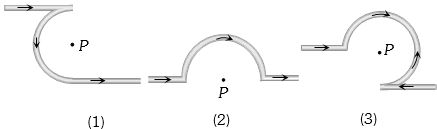
- 3The magnetic field at the centre of a circular coil of radius $r$ is $\pi $ times that due to a long straight wire at a distance $r$ from it, for equal currents. Figure here shows three cases : in all cases the circular part has radius $r$ and straight ones are infinitely long. For same current the $B$ field at the centre $P$ in cases $1$, $2$, $ 3$ have the ratioView Solution
- 4A large current carrying plate is kept along $y-z$ plane with $k$ $amp$ current per unit length in the $+ve$ $y$ direction. Find the net force on the semi cricular current carrying looplying in the $x-y$ plane. Radius of loop is $R$, current is $i$ and centre is at $(d,0, 0)$ where $(d > R)$View Solution
- 5A proton is moving along $Z$-axis in a magnetic field. The magnetic field is along $X$-axis. The proton will experience a force alongView Solution
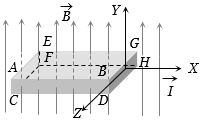
- 6A metallic block carrying current $I$ is subjected to a uniform magnetic induction $\overrightarrow B $ as shown in the figure. The moving charges experience a force $\overrightarrow F $ given by ........... which results in the lowering of the potential of the face ........ Assume the speed of the carriers to be $v$View Solution
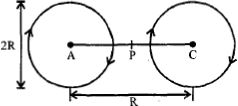
- 7A Helmholtz coil has pair of loops, each with $N$ turns and radius $R$. They are placed coaxially at distance $R$ and the same current $I$ flows through the loops in the same direction. The magnitude of magnetic field at $P$, midway between the centres $A$ and $C$, is given by (Refer to figure)View Solution
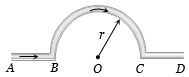
- 8the magnetic induction at $O$ due to the whole length of the conductor isView Solution
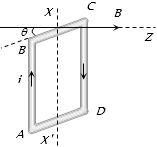
- 9The square loop $ABCD$, carrying a current $i$, is placed in uniform magnetic field $B$, as shown. The loop can rotate about the axis $XX$'. The plane of the loop makes and angle $\theta$ ($\theta$ $< 90^o$) with the direction of $B$. Through what angle will the loop rotate by itself before the torque on it becomes zeroView Solution
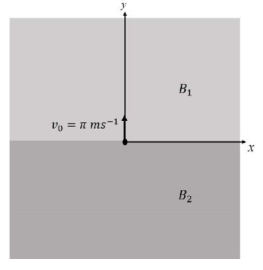
- 10In the xy-plane, the region $y >0$ has a uniform magnetic field $B_1 \hat{k}$ and the region $y<0$ has another uniform magnetic field $B_2 \hat{k}$. A positively charged particle is projected from the origin along the positive $y$-axis with speed $v _0=\pi m s ^{-1}$ at $t =0$, as shown in the figure. Neglect gravity in this problem. Let $t = T$ be the time when the particle crosses the $x$-axis from below for the first time. If $B_2=4 B_1$, the average speed of the particle, in $m s ^{-1}$, along the $x$-axis in the time interval $T$ is. . . . . .View Solution