Question
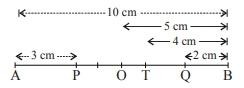
A particle is in linear simple harmonic motion between two points, $A$ and $B, 10 cm$ apart. Take the direction from $A$ to $B$ as the positive direction and give the signs of velocity, acceleration and force on the particle when it is :
(a) at the end A,
(b) at the end B,
(c) at the mid-point of AB going towards A ,
(d) at 2 cm away from B going towards A ,
(e) at 3 cm away from $A$ going towards $B$, and
(f) at 4 cm away from $B$ going towards $A$.
Answer

Here A and B are in S.H.M. denote two ends in we do for velocity, the direction from A and B is considered the positive direction for acceleration and force, the positive direction is taken along AP and the negative direction is taken along BP
Image

(a) Particle S.H.M. at end A while doing that it is momentarily at rest because it is the end of the motion, hence its velocity is zero, the acceleration is along the positive AP . The force is also in the positive direction because it is along AP , hence the answer is $0,+,+$.
(b) Velocity at end B is zero, here both acceleration and force are negative due to being along BP. Hence the answer is $0,-,-$.
(c) At the mid-point of AB , the particle moving towards A is at the middle position, and its tendency is to move along BA, i.e. in the negative direction, hence the velocity is negative and both acceleration and force are zero. Hence, the answer is-, 0,0 .
(d) 2 cm from B the particle is at Q towards A at distance and its the tendency is to move along QP, which is the negative direction therefore velocity, acceleration and force are all negative. Hence the answer is,-,-,- .
(e) 3 cm from A while going towards B at distance the particle is now at P . Which has a tendency to move along the PO for this reason velocity, acceleration and the forces are all positive. Hence the answer is,+,+,+ .
(f) 4 cm from B . The particle is moving towards distance A is at T and its tendency is to move along TP, which is the negative direction for velocity. Therefore velocity is negative, acceleration and force are also towards TP, for this reason both are debts. Hence the answer is,-,-,- .

Need a full question paper?

Generate a complete, print-ready paper with questions like this in minutes — across 16+ boards, with answer keys.

Start Generating Free

Similar questions

A cylindrical log of wood of height h and area of cross-section A floats in water. It is pressed and then released. Show that the log would execute S.H.M. with a time period.

$\text{T}=2\pi\sqrt{\frac{\text{m}}{\text{A}\rho\text{g}}}$

where m is mass of the body and ρ is density of the liquid.

A pebble of mass 0.05kg is thrown vertically upwards. Give the direction and magnitude of the net force on the pebble,
  1. During its upward motion
  2. During its downward motion.
  3. At the highest point where it is momentarily at rest. Do your answers change if the pebble was thrown at an angle of 45° with the horizontal direction? Ignore air resistance.
Air is streaming past a horizontal air plane wing such that its speed is 120ms-1 over the upper surface and 90ms-1 at the lower surface. If the density of air is 1.3kg m-3, find the difference in pressure between the top and bottom of the wing. If wing is 10m long and has an average width of 2m, calculate the gross lift of the wing.
Verify the conservation of mechanical energy by obtaining expressions for the potential energy, kinetic energy and total energy of a particle in simple harmonic motion.
Water stands at a depth H in a tank, whose side walls are vertical. A hole is made on one of the walls at a depth h below the water surface. Find at what distance from the foot of the wall does the emerging stream of water strike the floor and for what value of h this range is maximum.
A disc of radius R is rotating with an angular speed $\omega_\text{o}$ about a horizontal axis. It is placed on a horizontal table. The coefficient of kinetic friction is $\mu_\text{k}{:}$
  1. What was the velocity of its centre of mass before being brought in contact with the table?
  2. What happens to the linear velocity of a point on its rim when placed in contact with the table?
  3. What happens to the linear speed of the centre of mass when disc is placed in contact with the table?
  4. Which force is responsible for the effects in (b) and (c).
  5. What condition should be satisfied for rolling to begin?
  6. Calculate the time taken for the rolling to begin.
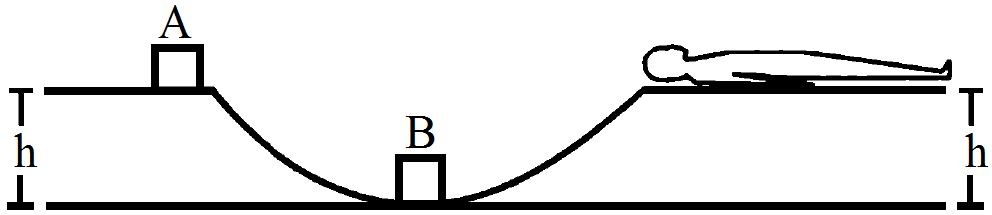
The track shown in figure is frictionless. The block B of mass 2m is lying at rest and the block A of mass m is pushed along the track with some speed. The collision between A and B is perfectly elastic. With what velocity should the block A be started to get the sleeping man awakened?

On a two-lane road, car A is travelling with a speed of 36km h–1. Two cars B and C approach car A in opposite directions with a speed of 54km h–1 each. At a certain instant, when the distance AB is equal to AC, both being 1km, B decides to overtake A before C does. What minimum acceleration of car B is required to avoid an accident?
A cubical block of mass 1.0kg and edge 5.0cm is heated to 227°C. It is kept in an evacuated chamber maintained at 27°C. Assuming that the block emits radiation like a blackbody, find the rate at which the temperature of the block will decrease. Specific heat capacity of the material of the block is 400Jkg-1K-1.
A projectile is projected horizontally with a velocity u. Show that its trajectory is parabolic. And obtain expressions for:
i. Time of flight
ii. Horizontal range
iii. Velocity at any instant $t$.