Question
A projectile is projected horizontally with a velocity u. Show that its trajectory is parabolic. And obtain expressions for:
i. Time of flight
ii. Horizontal range
iii. Velocity at any instant $t$.
Answer

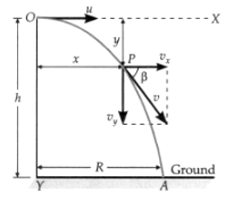
Projectile fired parallel to horizontal. As shown in figure, suppose a body is projected horizontally with velocity u from a point O at a certain height h above the ground level. The body is under the influence of two simultaneous independent motions:
i. Uniform horizontal velocity u.
ii. Vertically downward accelerated motion with constant acceleration g.
Under the combined effect of the above two motions, the body moves along the path OPA.
Image
Horizontal projection of a projectile.
Trajectory of the projectile. After the time $t$, suppose the body reaches the point P (x, y).
The horizontal distance covered by the body in time $t$ is
$
x=\text { ut } \therefore t=\frac{x}{u}
$
The vertical distance travelled by the body in time $t$ is given by
$
s=u t+\frac{1}{2} a t^2
$
or $y =0 \times t+\frac{1}{2} g t^2=\frac{1}{2} g t^2$ [For vertical motion, $u =0$ ]
or $y=\frac{1}{2} g\left(\frac{x}{u}\right)^2=\left(\frac{g}{2 u^2}\right) x^2\left[\because t=\frac{x}{u}\right]$
or $y = kx ^2$ [Here $k =\frac{g}{2 u^2}=$ a constant $]$
As $y$ is a quadratic function of $x$, so the trajectory of the projectile is a parabola.
Time of flight. It is the total time for which the projectile remains in its flight (from O to A ). Let T be its time of flight.
For the vertical downward motion of the body, we use
$s=u t+\frac{1}{2} a t^2$ or $h =0 \times T+\frac{1}{2} g T^2$
or $T-\sqrt{\frac{2 h}{g}}$
Horizontal range. It is the horizontal distance covered by the projectile during its time of flight. It is equal to $O A=R$. Thus $R =$ Horizontal velocity $\times$ time of flight $= u \times T$
or $R =u \sqrt{\frac{2 h}{g}}$
Velocity of the projectile at any instant. At the instant $t$ (when the body is at point P ), let the velocity of the projectile be v . The velocity v has two rectangular components:
Horizontal component of velocity, $v _{ x }= u$
Vertical component of velocity, $v _{ y }=0+ gt = gt$
$\therefore$ The resultant velocity at point $P$ is
$
v=\sqrt{v_x^2+v_y^2}=\sqrt{u^2+g^2 t^2}
$
If the velocity v makes an angle p with the horizontal, then $\tan \beta=\frac{v_y}{v_x}=\frac{g t}{u}$
or $\beta=\tan ^{-1}\left(\frac{g t}{u}\right)$

Need a full question paper?

Generate a complete, print-ready paper with questions like this in minutes — across 16+ boards, with answer keys.

Start Generating Free

Similar questions

Two masses of 90kg and 160kg are at a distance 5m apart. Compute the magnitude of intensity of the gravitational field at a point distance 3m from the 90kg and 4m from the 160kg mass. G = 6.67 × 10-11Nm2kg-2.
A metre long narrow bore held horizontally (and closed at one end) contains a 76cm long mercury thread, which traps a 15cm column of air. What happens if the tube is held vertically with the open end at the bottom?
Explain why,
  1. A horse cannot pull a cart and run in empty space.
  2. Passengers are thrown forward from their seats when a speeding bus stops suddenly.
  3. It is easier to pull a lawn mower than to push it.
  4. A cricketer moves his hands backwards while holding a catch.
An airline passenger late for a flight walks on an airport moving sidewalk at a speed of 5.00km/ h relative to the sidewalk in the direction ofits motion. The sidewalkis moving at 3.00km/ h relative to the ground and has a total length of 135m.
  1. What is the passenger's speed relative to the ground?
  2. How long does it take him to reach the end of the sidewalk?
  3. How much of the sidewalk has he covered by the time he reaches the end?
Consider a one-dimensional motion of a particle with total energy E. There are four regions A, B, C and D in which the relation between potential energy V, kinetic energy (K) and total energy E is as given below:
Region A : V > E
Region B : V < E
Region C : K > E
Region D : V > K
State with reason in each case whether a particle can be found in the given region or not.
A 50kg girl wearing high heel shoes balances on a single heel. The heel is circular with a diameter 1.0cm. What is the pressure exerted by the heel on the horizontal floor?
Consider a non-conducting plate of radius r and mass m that has a charge q distributed uniformly over it. The plate is rotated about its axis with an angular speed $\omega.$ Show that the magnetic moment $\mu$ and the angular momentum of the plate are related as $\mu=\frac{\text{q}}{2\text{m}}\text{l}.$
A geyser heats water flowing at the rate of 3.0 litres per minute from 27°C to 77°C. If the geyser operates on a gas burner, what is the rate of consumption of the fuel if its heat of combustion is 4.0 × 10⁴J/g?
Convince yourself that parts (a), (b) and (c) of figure are identical. Find the capacitance between the points A and B of the assembly.