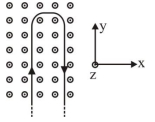
If an electron is going in the direction of magnetic field $\overrightarrow B $ with the velocity of $\overrightarrow {v\,} $ then the force on electron is
Easy
Download our app for free and get started
(a) $F = qvB\sin \theta = qvB\sin 0 = 0$

Download our appand get started for free
Experience the future of education. Simply download our apps or reach out to us for more information. Let's shape the future of learning together!No signup needed.*
Similar Questions
- 1Two thin long parallel wires, separated by a distance $d$ carry a current of $I$ $amp$ in the same direction. They willView Solution
- 2A particle of charge per unit mass $\alpha$ is released from origin with a velocity $\bar{v}=v_0 \vec{i}$ in a uniform magnetic field $\bar{B}=-B_0 \hat{k}$. If the particle passes through $(0, y, 0)$ then $y$ is equal toView Solution
- 3A proton and an electron both moving with the same velocity $v$ enter into a region of magnetic field directed perpendicular to the velocity of the particles. They will now move in circular orbits such thatView Solution
- 4A galvanometer of resistance $25\,\Omega $ gives full scale deflection for a current of $10$ milliampere, is to be changed into a voltmeter of range $100\, V$ by connecting a resistance of $‘R’$ in series with galvanometer. The value of resistance $R$ in $\Omega $ isView Solution
- 5A galvanometer having a coil resistance of $60\,\Omega $ shows full scale deflection when a current of $1.0\, amp$ passes through it. It can be converted into an ammeter to read currents upto $5.0\, amp$ byView Solution
- 6What is the magnitude of magnetic force per unit length on a wire carrying a current of $8\,A$ and making an angle of $30^o$ with the direction of a uniform magnetic field of $0.15\, T$ ?.....$Nm^{-1}$View Solution
- 7The magnetic moment of a circular orbit of radius $‘r’$ carrying a charge $‘q’$ and rotating with velocity $v$ is given byView Solution
- 8A rectangular coil $20\,cm \times 20\,cm$ has $100$ $turns$ and carries a current of $1\, A$. It is placed in a uniform magnetic field $B =0.5\, T$ with the direction of magnetic field parallel to the plane of the coil. The magnitude of the torque required to hold this coil in this position is........$N-m$View Solution
- 9View SolutionIf a charged particle goes unaccelerated in a region containing electric and magnetic fields
- 10A rigid wire consists of a semicircular portion of radius $R$ and two straight sections. The wire is partially immerged in a perpendicular magnetic field $B=B_0\ {j}$ as shown in figure. The magnetic force on the wire if it has a current $i$ is :View Solution