One plate of parallel plate capacitor is smaller than other, then charge on smaller plate will be
Easy


Download our appand get started for free
Experience the future of education. Simply download our apps or reach out to us for more information. Let's shape the future of learning together!No signup needed.*
Similar Questions
- 1A point electric dipole placed at the origin has a potential given by $V(r, \theta)=\frac{p \cos \theta}{4 \pi \varepsilon_0 r^2}$, where $\theta$ is the angle made by the position vector with the direction of the dipole. Then,View Solution
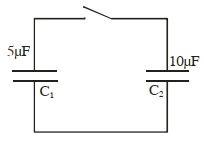
- 2A capacitor $C _{1}$ of capacitance $5\,\mu F$ is charged to a potential of $30\,V$ using a battery. The battery is then removed and the charged capacitor is connected to an uncharged capacitor $C _{2}$ of capacitance $10\,\mu F$ as shown in figure. When the switch is closed charge flows between the capacitors. At equilibrium, the charge on the capacitor $C _{2}$ is________ $\mu C$View Solution
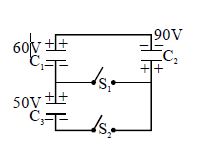
- 3Three charged capacitors, $C_1$ = $17\ μF$, $C_2$ = $34\ μF$, $C_3$ = $41\ μF$and two open switches, $S_1$ and $S_2$ are assembled into a network with initial voltages and polarities, as shown. Final status of the network is attained when the two switches, $S_1$ and $S_2$ are closed. In the figure, the final charge on capacitor $C_3$ in $mC$, is closet to:View Solution
- 4The plates of a capacitor are charged to a potential difference of $320 \, volts$ and are then connected across a resistor. The potential difference across the capacitor decays exponentially with time. After $1 $ second the potential difference between the plates of the capacitor is $240 \, volts$, then after $2$ and $3$ seconds the potential difference between the plates will beView Solution
- 5Two electric charges $12\,\mu C$ and $ - 6\,\mu C$ are placed $20\, cm$ apart in air. There will be a point $P$ on the line joining these charges and outside the region between them, at which the electric potential is zero. The distance of $P$ from $ - 6\,\mu C$ charge is.......$m$View Solution
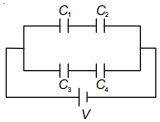
- 6Find the charge on capacitor $C_3$View Solution
Given, that $C_1=C_2=C$ and $C_3=C_4=3 C$.
- 7A capacitor of capacity $C$ has charge $Q$ and stored energy is $W$. If the charge is increased to $2Q$, the stored energy will beView Solution
- 8A parallel plate capacitor of capacitance $C$ has spacing $d$ between two plates having area $A$. The region between the plates is filled with $N$ dielectric layers, parallel to its plates, each with thickness $\delta=\frac{ d }{ N }$. The dielectric constant of the $m ^{\text {th }}$ layer is $K _{ m }= K \left(1+\frac{ m }{ N }\right)$. For a very large $N \left(>10^3\right)$, the capacitance $C$ is $\alpha\left(\frac{ K \varepsilon_0 A }{ d \;ln 2}\right)$. The value of $\alpha$ will be. . . . . . . .View Solution
[ $\epsilon_0$ is the permittivity of free space]
- 9Following operations can be performed on a capacitor : $X$ - connect the capacitor to a battery of $emf$ $E.$ $Y$ - disconnect the battery $Z$ - reconnect the battery with polarity reversed. $W$ - insert a dielectric slab in the capacitorView Solution
- 10Two positively charged particles $X$ and $Y$ are initially far away from each other and at rest. $X$ begins to move towards $Y$ with some initial velocity. The total momentum and energy of the system are $p$ and $E$.View Solution