Question
A particle performing simple harmonic motion makes 1200 oscillations per minute and its velocity while passing through the mean position is $3.14 m / s$ lives. Also obtain the displacement equation of the particle if the displacement at moment $t=0$.
Answer

We know that the velocity of the particle is maximum in the mean position. If the particle's amplitude is $A$ and angular velocity is $\omega$ then maximum velocity.
$\begin{aligned}v_{\max } & =\omega A \\\text { Amplitude } A & =\frac{V_{\max }}{\omega}=\frac{V_{\max }}{2 \pi n}\end{aligned}$
$\because \omega=2 \pi n$, Here frequency is $n$,
As per question
$\begin{aligned}v_{\max } & =3.1 m / s \\n & =1200 \text { per minute }=\frac{1200}{60} \text { per second } \\n & =20 \text { per second } \\\text { Amplitude } A & =\frac{3.1}{2 \times 3.14 \times 20}=\frac{1}{40}=0.025 m\end{aligned}$
Displacement of the particle at $t=0$ that is the particle is in its equilibrium state, then the equation of simple harmonic motion is,
$y=A \sin \omega t=A \sin 2 \pi n t$
Keeping the value of A and $n$
$\begin{array}{l}y=0.025 \sin 2 \pi \times 20 t \\y=0.025 \sin 40 \pi t\end{array}$

Need a full question paper?

Generate a complete, print-ready paper with questions like this in minutes — across 16+ boards, with answer keys.

Start Generating Free

Similar questions

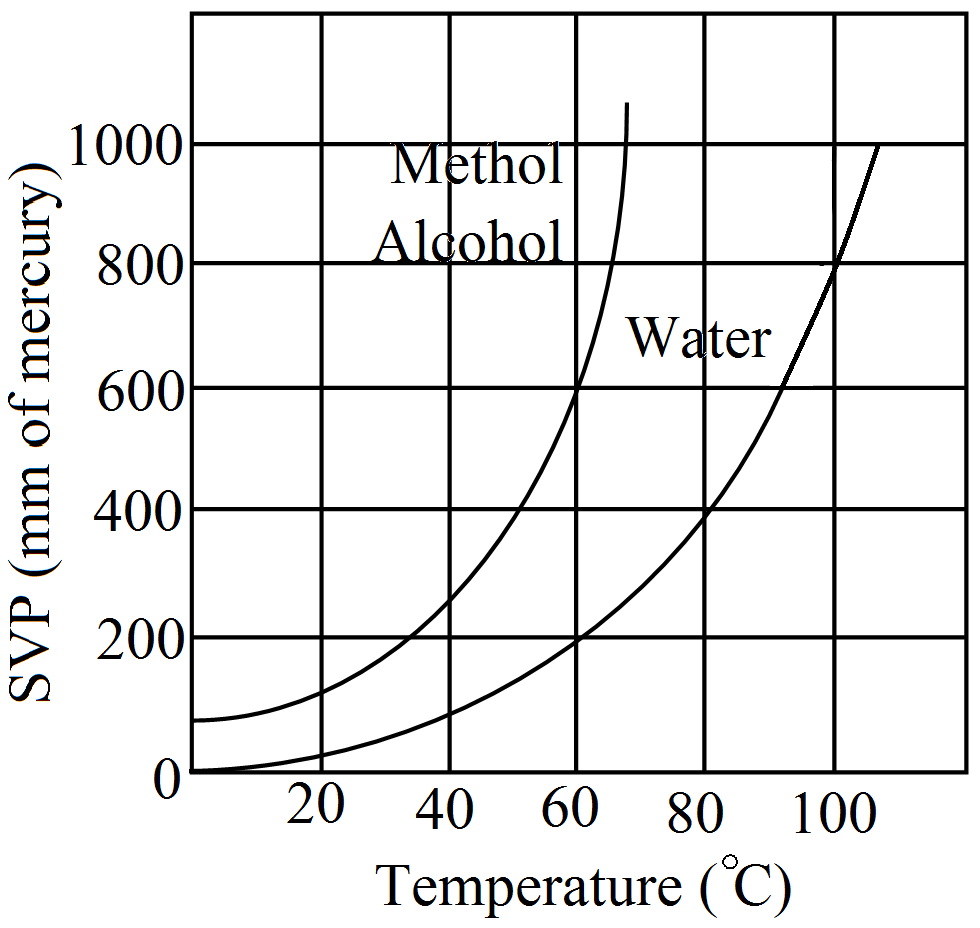
Using figure. of the text, find the boiling point of methyl alcohol at 1atm (760mm of mercury) and at 0.5atm.

Define angular acceleration.
The distance of a galaxy is of the order of 1025m. Calculate the order of magnitude of time taken by light to reach us from the galaxy.
An ideal Carnot engine uses an ideal gas. The source temperature is 500 K and the arrival temperature is 375 K . If the engine takes 500 K cal from the source per cycle then estimate (a) efficiency of engine (b) work done per cycle (c) per heat dissipated in bicycle access.
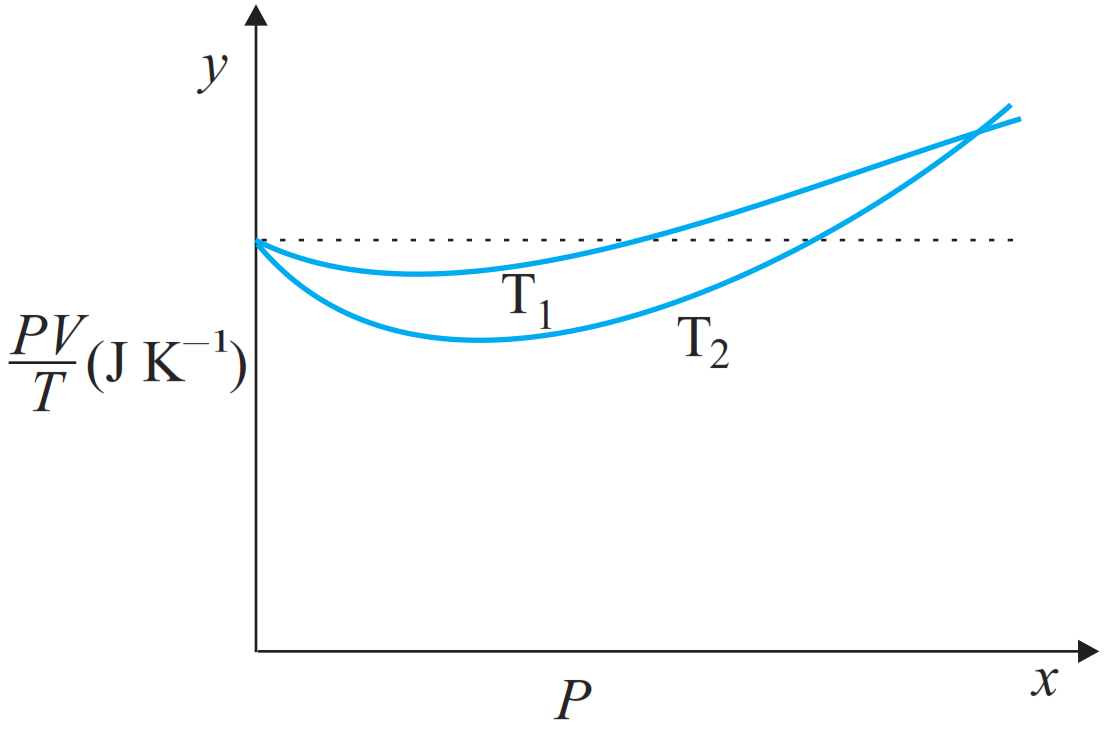
Shows plot of $\frac{\text{PV}}{\text{T}}$ versus P for 1.00 × 10⁻³kg of oxygen gas at two different temperatures:
Which is true, T1 > T2 or T1 < T2?

A block of mass 5.0kg slides down an incline of inclination 30° and length 10m. Find the work done by the force of gravity.
Find the value of percentage change in the time period of the simple pendulum in the following situations :
(i) By increasing the length of pendulum by $5 \%$
(ii) On increasing the mass of the pendulum by $5\%$
(iii) By reducing the amplitude of pendulum by $5\%.$
The length and breadth of a rectangle are $(5.7\pm0.1)\text{cm}$ and $(3.4\pm0.2)\text{cm}$ Calculate area of the rectangle with error limits.
At what separation should two equal charges, 1.0C each, be placed so that the force between them equals the weight of a 50kg person?
Two forces of 3 N each are acting simultaneously on a 6 kg wooden bundle.
(i) If these forces makes an angle of $90^{\circ}$ with each other then find the magnitude and direction of the acceleration produced in cart.
(ii) If the force in one direction what will be the acceleration?
(iii) What will be acceleration if the forces are acting in opposite directions?