Questions

2 Marks Questions

🎯

Test yourself on this topic

47 questions · timed · auto-graded

Question 12 Marks
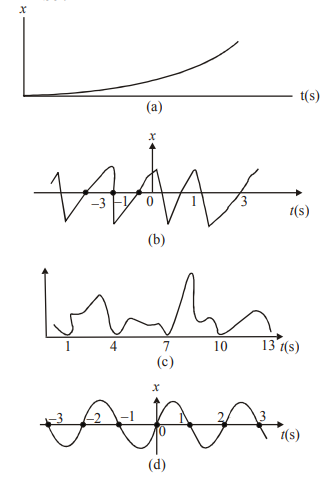
depicts four x-t plots for linear motion of a particle. Which of the plots represent periodic motion? What is the period of motion (in case of periodic motion)?
Image
Answer
(a) It does not represent periodic motion because the motion neither repeats nor comes to the mean position.
(b) It represents the time period of motion $2 s$.
(c) This motion is not periodic since it repeats uniformly does not happens.
(d) It distorts periodic motion whose period of oscillation is $2 s$.
View full question & answer
Question 22 Marks
Which of the following examples represent (nearly) simple harmonic motion and which represent periodic but not simple harmonic motion?
(a) the rotation of earth about its axis.
(b) motion of an oscillating mercury column in a U-tube.
(c) motion of a ball bearing inside a smooth curved bowl, when released from a point slightly above the lower most point.
(d) general vibrations of a polyatomic molecule about its equilibrium position.
Answer
(a) It is harmonic motion but not simple harmonic motion since there is no movement here and there on either side of the fixed point.
(b) This is simple harmonic motion.
(c) This is simple harmonic motion.
(d) This motion is periodic but not simple periodic motion. One polyatomic molecules have many natural shapes and usually have different periodic S.H.M.
The resulting motion is periodic but not simple harmonic motion.
View full question & answer
Question 32 Marks
The piston in the cylinder head of a locomotive has a stroke (twice the amplitude) of 1.0 m . If the piston moves with simple harmonic motion with an angular frequency of $200 rad / min$, what is its maximum speed?
Answer
The amplitude A is considered to be twice the stroke amplitude of the piston and the stroke length is given as 2 A (stroke length is given as 1 m )
$
1=2 A \text { or } A=\frac{1}{2} m
$
Angular frequency $(\omega)=200$ radian $/ min$.
$
\begin{aligned}
v_{\max } & =\text { maximum speed }=? \\
v_{\max } & =\omega A=200 \times \frac{1}{2}=100 m / min \\
& =\frac{100}{60} m / s=\frac{5}{3} m / s
\end{aligned}
$
View full question & answer
Question 42 Marks
A body hanging from a spring can oscillate in a horizontal plane with angular velocity $\omega$ without friction or damping when it is stretched to a distance and then released. It passes through the equilibrium center with a velocity at time $t=0$. Find the amplitude of the resultant oscillation in terms of parameter $\omega_0, x_0$ and $v_0$.
[Hint : The equation $x=a \cos (\omega t+\theta)$ is negative keep in mind that the initial]
Answer
Let at any time t
$x=A \cos (\omega t+\theta)$
$A =$ Amplitude, $\theta=$ initial phase angle
Velocity $\frac{d x}{d t}=- A \omega \sin (\omega t +\theta)$
when $t=0, x=x_0$ and $\frac{d x}{d t}=- v _0$
$\begin{aligned}x_0 & =A \cos \theta\quad\ldots\ldots (1) \\-v_0 & =-A \omega \sin \theta \\A \sin \theta & =\frac{v_0}{\omega}\quad\ldots\ldots (2)\end{aligned}$
By squaring equation (1) and (2) and adding
$\begin{array}{l}( A \cos \theta)^2+( A \sin \theta)^2=x_0^2+\left(\frac{ v _0}{\omega}\right)^2 \\ A^2\left(\cos ^2 \theta+\sin ^2 \theta\right)=x_0^2+\frac{ v _0^2}{\omega^2} \\ A^2 \times 1=x_0^2+\frac{ v _0^2}{\omega^2} \\ A=\left(x_0^2+\frac{ v _0^2}{\omega^2}\right)^{\frac{1}{2}}\end{array}$
View full question & answer
Question 52 Marks
An object moves in simple harmonic motion with an amplitude of 5 cm and a frequency of 0.2 sec . Find the acceleration and velocity of the object when the displacement of the object is (a) 5 cm (b) 3 cm (c) 0 cm .
Answer
Given :
$\begin{aligned}A & =5 cm=0.05 m \\& =5 \times 10^{-2} m \\T & =0.2 \text { second } \\\omega & =\frac{2 \pi}{T}=\frac{2 \pi}{0.2}=10 \pi \text { radian } / sec .\end{aligned}$
Displacement is $y$ then acceleration $a=-\omega^2 A$
Velocity $v =\omega \sqrt{ A ^2- y ^2}$
Position (a) when $y=5 cm=0.05 m$
$\begin{aligned}a & =-(10 \pi)^2 \times 0.05 \\& =-5 \pi^2 m / s^2\end{aligned}$
Velocity $v =10 \pi \sqrt{(0.05)^2-(0.05)^2}=0 m / s$
Position (b) when $y=3 cm=0.03 m$, acceleration $a=-\omega^2 A$
$\begin{aligned}a & =-(10 \pi)^2 \times 0.03 \\& =-3 \pi^2 m / s^2 \\v & =10 \pi \times \sqrt{(0.05)^2-(0.03)^2} \\& =10 \pi \times 0.04=0.4 \pi m / s\end{aligned}$
Position (c) when $y=0, A=-(10 \pi)^2 \times 0=0 m / s ^2$
$\begin{aligned}v & =10 \pi \sqrt{(0.05)^2-(0)^2} \\& =10 \pi \times 0.05 \\& =0.5 \pi m / s\end{aligned}$
View full question & answer
Question 62 Marks
A circular disc of 10 kg liquid is hanging from a string attached to its centre. By turning the disc, it is freed by creating a twist in the wire. The period of torsional oscillation is 1.5 sec . The diameter of the disc is 15 cm . find the torsional spring constnat of the wire [The torsional spring constant is $\alpha, \tau=-\alpha \theta$ by the relation, here the elastic force pair is end is the torsion angle $\theta$ ].
Answer
Given that
$\begin{aligned}m & =10 kg \\R & =15 cm=0.15 m \\T & =1.5 \text { second } \\\alpha & =?\end{aligned}$
Moment of inertia of circular disc
$\begin{aligned}I & =\frac{1}{2} m R^2 \\I & =\frac{1}{2} \times 10 \times(0.15)^2 kg m^2 \\I & =5 \times 225 \times 10^{-4} kg m^2 \\T & =2 \pi \sqrt{\frac{I}{\alpha}} \\\alpha & =\frac{4 \pi^2 I}{T^2} \\\text { Put value } & =\frac{4 \times\left(\frac{22}{7}\right)^2 \times 5 \times 225 \times 10^{-4}}{(1.5)^2} \\& =\frac{4 \times 22 \times 22 \times 5 \times 225 \times 10^{-4}}{49 \times 2.25} \\& =\frac{217.8}{110.25} \\\alpha & =1.976 Nm / radian\end{aligned}$
View full question & answer
Question 72 Marks
Time period of a simple pendulum on the earth's surface $T_1$ is and when it is taken to a heights $\frac{1}{2} R$ from the earth's surface then period becomes $T_2 . R$ is the radius of earth. Find the value of $\frac{T_1}{T_2}.$
Answer
Sol.
$
\begin{aligned}
T_1 & =2 \pi \sqrt{\frac{l}{g_{e}}} \\
T_2 & =2 \pi \sqrt{\frac{l}{g_{h}}} \\
\frac{T_1}{T_2} & =\sqrt{\frac{g_{h}}{g_{e}}}
\end{aligned}
$
$\begin{aligned} \frac{g_h}{g_e} & =\left(\frac{R_e}{R_e+h}\right)^2=\left(\frac{R}{R+\frac{1}{2} R}\right)^2 \\ \left(\frac{g_h}{g_e}\right) & =\left(\frac{R}{\frac{3}{2} R}\right)^2=\left(\frac{2}{3}\right)^2=\frac{4}{9} \\ \frac{T_1}{T_2} & =\sqrt{\frac{4}{9}}=\frac{2}{3}\end{aligned}$
View full question & answer
Question 82 Marks
The angular frequency of damepd harmonic motion $\omega=\sqrt{\frac{k}{m}-\left(\frac{b}{2 m}\right)^2}$ where $b$ is called the damping constant. Such the displacement in motion is $x =A e ^{\frac{- bt }{2 m}} \cos (\omega t +\phi)$ and retarding force $F =- b v$ where $v$ is the speed of particle. What can you say from the given equations? Can guess :
(a) How does the oscillation amplitude change?
(b) Does the period of oscillation also change with displacement?
Answer
(a) Oscillation amplitude decreases due to damping force as it is clear from the displacement equation that the oscillation amplitude decreases exponentially. Since damping force depends on velocity.
(b) The period of oscillation does not change in damped oscillation
View full question & answer
Question 92 Marks
What do you understand by damped oscillation?
Answer
Those oscillation of a body which occur in the presence of resistive force, such as fluid viscosity, friction, air friction etc. the amplitude of the oscillation keeps decreasing continuously. These oscillations are called damped oscillation.
View full question & answer
Question 102 Marks
How is the value of spring constant affected when several small indentical spring are combined (i) in series and (ii) in parallel?
Answer
When we combine several small identical spring in series, then the value of the effective spring constant $k$ of the combination becomes $\frac{1}{n}$ times the each small spring.
Here $n$ is the number of small identical spring. That is, compared $\frac{1}{n}$ to spring connected in parallel, the effective force constant is equal to the sum of the force constant of each spring.
$
k=k_1+k_2
$
View full question & answer
Question 112 Marks
Write the time period formula of a simple pendulum. Which factor affect the period?
Answer
Oscillation period $T =2 \pi \sqrt{\frac{l}{g}}$
It is clear that the oscillation period of a simple pendulum is proportional to the square roots of its effective length and inversely proportional to the square root of the gravitational acceleration g. It happens due to change in the value of gravitational acceleration g, the oscillation period is also affected. The period of oscillation does not depend on the mass of the sphere. Changing the length of a simple pendulum also affects the periods of oscillations.
View full question & answer
Question 122 Marks
Find the value of percentage change in the time period of the simple pendulum in the following situations :
(i) By increasing the length of pendulum by $5 \%$
(ii) On increasing the mass of the pendulum by $5\%$
(iii) By reducing the amplitude of pendulum by $5\%.$
Answer
We know
$T=2 \pi \sqrt{\frac{l}{g}}\ldots\ldots (1)$
Here the length of pendulum is $l$ and the time period s T.
(i) On differentiation
$d T=\frac{2 \pi}{\sqrt{g}} \frac{1}{2 \sqrt{l}} d l\ldots\ldots (2)$
Equation (2) divided by (1)
$\begin{aligned}\frac{dT}{T} & =\frac{\frac{2 \pi}{\sqrt{g}} \frac{1}{2 \sqrt{l}} d l}{\frac{2 \pi}{\sqrt{g}} \sqrt{l}} \\\frac{dT}{T} & =\frac{d l}{2 l}\end{aligned}$
$\frac{dT}{T} \times 100 \%=\frac{1}{2}\left[\frac{d l}{l} \times 100 \%\right]$
Given : $\quad \frac{d l}{l} \times 100=5$
$\frac{dT}{T} \times 100=\frac{5}{2}$
Hence, percentage increase in time period is $=2.5 \%$.
(ii) The time period does not depend on the mass of the pendulum, hence it the mass in increased the time period will remain the same.
(iii) The period does not depend on the amplitude of the motion, hence if the amplitude is reduced the period will remain.
Hence, percentage change zero.
View full question & answer
Question 132 Marks
Two pendulum of length 1.00 and 1.1025 meters start vibrating simultaneously. After how many oscillations will they start oscillating together again ?
Answer
Let the period of both length be $T_1$ and $T_2$. To oscillate together again, there must be a difference of 1 between two oscillations. If the big pendulum oscillation in this time interval then the oscillations of the small pendulum will be $(n+1)$, i.e.
$n T_2=(n+1) T_1\ldots\dots (1)$
As per question
$T_1=2 \pi \sqrt{\frac{l_1}{g}}$
$\begin{aligned}T_2 & =2 \pi \sqrt{\frac{l_2}{g}} \\\therefore \quad \frac{T_1}{T_2} & =\sqrt{\frac{l_1}{l_2}}=\sqrt{\frac{1.00}{1.1025}}=\frac{1}{1.05} \\\frac{T_1}{T_2} & =\frac{1}{1.05}\ldots \ldots (2)\end{aligned}$
From the equation (1) and (2)
$\begin{aligned}\frac{n}{n+1} & =\frac{1}{1.05} \\1.05 n & =n+1 \\1.05 n-n & =1 \\0.05 n & =1 \\n & =\frac{1}{0.05} \text { so, } n=20\end{aligned}$
Hence, 20 of the big pendulum and after 21 oscillations of the small pendulum they will oscillate together again.
View full question & answer
Question 142 Marks
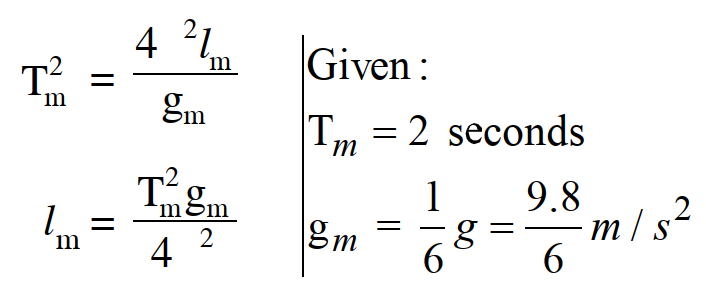
Find the length of a second pendulum on the moon where the value of gravitational acceleration is equal to the gravitational acceleration of the earth is more $\frac{1}{6}$ times. (On earth $g=9.8 m / s ^2$ )
View full question & answer
Question 152 Marks
The period of simple harmonic motion of a body suspended from a spring is cut the spring into two equal parts.
(a) Hang the same body from one spring and make it oscillate, then find the time period.
(b) What will be the period of oscillation if both the pieces are connected in parallel and oscillated?
Answer
(a) Let the force of spring constant is $k$ and the mass of the body is $m$. Then the time period will be
$T=2 \pi \sqrt{\frac{m}{k}}\ldots\ldots (1)$
Now the spring is divided into two equal parts. For this reason, the force constant of spring will be $2 k$ and the time period is considered to be $T ^1$.
$T^{\prime}=2 \pi \sqrt{\frac{m}{2 k}}\ldots\ldots (2)$
Equation (1) divided by (2)
$\begin{aligned}\frac{T}{T^{\prime}} & =\frac{2 \pi \sqrt{\frac{m}{k}}}{2 \pi \sqrt{\frac{m}{2 k}}} \\\frac{T}{T^{\prime}} & =\sqrt{2} \\T^{\prime} & =\frac{1}{\sqrt{2}} T\end{aligned}$
(b) When the spring of constant $k$ is divided into two parts, the spring constant of each piece becomes $2 k$. By combining 2 pieces of these 2 constant in parallel, the effective result is
$\begin{aligned}k^{\prime} & =2 k+2 k=4 k \\\text { Time period } T^{\prime} & =2 \pi \sqrt{\frac{m}{k^{\prime}}} \\T^{\prime} & =2 \pi \sqrt{\frac{m}{4 k}}\end{aligned}$
$\begin{array}{l} T ^{\prime}=\frac{1}{2} \times 2 \pi \sqrt{\frac{m}{ k }} \\ T =2 \pi \sqrt{\frac{m}{ k }} \\ T ^{\prime}=\frac{1}{2} T\end{array}$
View full question & answer
Question 162 Marks
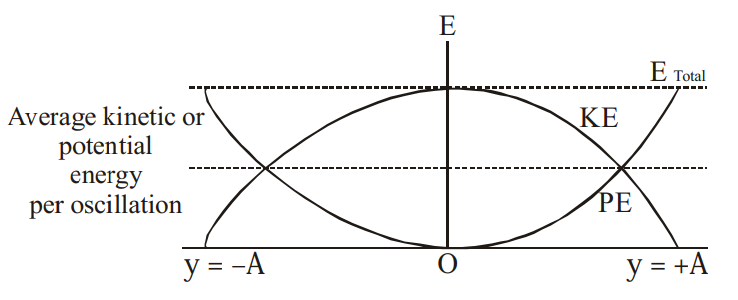
Show that for a particle performing linear simple harmonic motion, the average kinetic energy of any period of oscillation is equal to the average potential energy of the same period.
Answer
Suppose a particle of mass performs simple harmonic motion for time period T. At the instant when time is measured from the mean position, the displacement of the particle is
$y=a \sin \omega t\ldots\ldots (1)$
We know that
$\begin{aligned}v & =\text { Velocity of particle } \\& =\frac{d y}{d t}=\frac{d}{d t}(a \sin \omega t) \\v & =a \omega \cos \omega t \ldots\ldots(2) \\KE, E_k & =\frac{1}{2} m v^2=\frac{1}{2} m(a \omega \cos \omega t)^2 \\& =\frac{1}{2} m a^2 \omega^2 \cos ^2 \omega t \\\text { P.E., } E_p & =\frac{1}{2} ky^2=\frac{1}{2} k(a \sin \omega t)^2 \\E_p & =\frac{1}{2} ka^2 \sin ^2 \omega t \\& =\frac{1}{2} m \omega^2 a^2 \sin ^2 \omega t \\\left(E_k\right)_{a v} & =\text {Average kinetic energy of one cycle} \\& =\frac{1}{T} \int_0^{T} E_k d t \\& =\frac{1}{T} \int_0^{T}\left(\frac{1}{2} m a^2 \omega^2 \cos { }^2 \omega t\right) d t\end{aligned}$
$\begin{aligned}& =\frac{1}{2 T} m a^2 \omega^2 \int_0^{T} \cos ^2 \omega t d t \\& =\frac{1}{2 T} m a^2 \omega^2 \int_0^{T}\left(\frac{1+\cos 2 \omega t}{2}\right) d t \\& =\frac{1}{4 T} m a^2 \omega^2\left[\int_0^{T} 1 \cdot d t+\int_0^{T} \cos 2 \omega t d t\right] \\& =\frac{1}{4 T} m a^2 \omega^2\left[(T-0)+\left(\frac{\sin 2 \omega t}{2 \omega}\right)_0^{T}\right] \\& =\frac{ma^2 \omega^2}{4 T}\left[T+\frac{1}{2 \omega}\left(\sin \frac{4 \pi}{T} \times T-\sin 0\right)\right] \\& =\frac{ma^2 \omega^2}{4 T}\left[T+\frac{1}{2 \omega}(0-0)\right] \\\therefore \sin n \pi & =0, n=0,1,2 \ldots \\\left(E_i\right)_{a v} & =\frac{1}{4} ma^2 \omega^2\ldots\ldots (3)\end{aligned}$
Average potential energy one cycle
$\begin{array}{l}\left(E_{p}\right)_{a v}=\frac{1}{T} \int_0^{T} E_{p} \cdot d t \text { given by } \\\left(E_{p}\right)_{av}=\frac{1}{T} \int_0^{T} \frac{1}{2} m \omega^2 a^2 \sin ^2 \omega t d t \\=\frac{m \omega^2 a^2}{2 T} \int_0^{T} \sin ^2 \omega t d t \\=\frac{m \omega^2 a^2}{2 T} \int_0^T\left(\frac{1-\cos 2 \omega t}{2}\right) d t \\\because \cos 2 \theta=1-2 \sin ^2 \theta \\=\frac{1}{4 T} m \omega^2 a^2\left[\int_0^{T} 1 . d t-\int_0^{T} \cos 2 \cos d t\right] \\=\frac{1}{4 T} m \omega^2 a^2\left[(T-0)-\left(\frac{\sin 2 \omega t}{2 \omega}\right)_0^{T}\right] \\\left(E_{p}\right)_{a v}=\frac{1}{4} m a^2 \omega^2\ldots\ldots (4)\end{array}$
Thus, from equation (3) and (4) we see that the average K.E. over one oscillation time period is and during the same period the average P.E. is equiralent to.
View full question & answer
Question 172 Marks
The time period of a simple pendulum is 4 seconds and its effective length is 4 meters. By what length given that should it make 15 oscillations in 30 seconds?
Answer
We know that
$T=2 \pi \sqrt{\frac{l}{g}}\ldots\ldots (1)$
Let the new length be $l_1$ and time period will be $T _1$.
$T_1=2 \pi \sqrt{\frac{l_1}{g}}\ldots\ldots (2)$
Hence on dividing equation (1) by equation (2)
$\begin{aligned}\frac{T}{T_1} & =\sqrt{\frac{l}{l_1}} \\\left(\frac{T}{T_1}\right)^2 & =\frac{l}{l_1} \text { or } l_1=\left(\frac{T_1}{T}\right)^2 l\end{aligned}$
Per question $T =4$ seconds, $l=4$ meter
$\begin{aligned}T_1 & =\frac{\text { Time interval }}{\text { Number of oscillations }} \\\frac{30}{15} & =2 \text { seconds } \\l_1 & =\left(\frac{2}{4}\right)^2 \times 4=\frac{4}{4}=1 m\end{aligned}$
View full question & answer
Question 182 Marks
By hanging a mass of 0.60 kg from a spring, its length increases by 0.25 m , if a mass of 0.24 kg is hung in a spring and left a little below, then what will be the time period of the spring? $\left(g=10 m / s ^2\right)$
Answer
Force constant of spring $k=\frac{\text { Force }}{\text { Stretch }}=\frac{ F }{ y }$
Force $F = Mg =0.60 \times 10=6.0$ Newton
Stretch $y=0.25 m$
$k=\frac{6.0}{0.25}=\frac{600}{25}$
Hanging from the spring $m=0.24 kg$ period of oscillations of it
$\begin{array}{l}T=2 \pi \sqrt{\frac{m}{k}}=2 \times 3.14 \sqrt{\frac{0.24}{24}} \\T=0.628 \text { seconds }\end{array}$
View full question & answer
Question 192 Marks
In an ideal spring the length is 0.5 kg one of mass vertical oscillations are made by suspending the body. If the oscillation period is $\frac{\pi}{2}$ then what is the spring constant?
Answer
Given : $m=0.5 kg$ and $T=\frac{\pi}{2} sec$
$T=2 \pi \sqrt{\frac{m}{k}}$
$\frac{\pi}{2}=2 \pi \sqrt{\frac{m}{k}}$
$\frac{1}{4}=\sqrt{\frac{0.5}{k}}$
On squaring
$\frac{1}{16}=\frac{0.5}{k}$
$\begin{aligned} k & =16 \times 0.5 \\ & =8 N / m \end{aligned}$
View full question & answer
Question 202 Marks
The potential energy of a body is $U _y= U _0(1-\cos \alpha y)$. Explain the characteristics of the motion of a body.
Answer
Given: $\quad U _y= U _0(1-\cos \alpha y)$
On differentiating the function with $y$
$\begin{aligned}\frac{d}{d y}\left(U_y\right) & =U_0\left(0-\frac{d}{d y}(\cos \alpha y)\right) \\\frac{d U_y}{d y} & =U_0(\alpha \sin \alpha y) \\\frac{d\left(U_y\right)}{d y} & =U_0 \alpha \sin \alpha y \\F & =-\frac{d U_y}{d y} \\F & =-U_0 \alpha \sin \alpha y\end{aligned}$
Here taking $\sin \alpha y=\alpha y$ because $\alpha y$ is small
$\begin{array}{l}F=-U_0 \alpha^2 y \\F=-K y\end{array}$
Here, $K = U _0 \alpha^2$ is a constant.
Hence the motion of the body is simple harmonic motion. Since the equation obtained above is the force equation of simple harmonic motion.
View full question & answer
Question 212 Marks
A simple pendulum makes 60 oscillations per minute. Find its effective length.
Answer
60 time of oscillation= $1 min=60 sec$
$\therefore 1$ oscillation time $=\frac{60}{60}=1 sec$
$\begin{array}{l}\text {We know}\quad l=\frac{g T^2}{4 \pi^2}=\frac{9.8 \times(1)^2}{4 \times 9.86}\left(\because \pi^2=9.86\right) \\\quad \quad \quad \quad\quad l=\frac{9.8}{39.44}=0.2485 m\end{array}$
Hence, effective length $=0.2485 m$
View full question & answer
Question 222 Marks
A particle performing simple harmonic motion makes 1200 oscillations per minute and its velocity while passing through the mean position is $3.14 m / s$ lives. Also obtain the displacement equation of the particle if the displacement at moment $t=0$.
Answer
We know that the velocity of the particle is maximum in the mean position. If the particle's amplitude is $A$ and angular velocity is $\omega$ then maximum velocity.
$\begin{aligned}v_{\max } & =\omega A \\\text { Amplitude } A & =\frac{V_{\max }}{\omega}=\frac{V_{\max }}{2 \pi n}\end{aligned}$
$\because \omega=2 \pi n$, Here frequency is $n$,
As per question
$\begin{aligned}v_{\max } & =3.1 m / s \\n & =1200 \text { per minute }=\frac{1200}{60} \text { per second } \\n & =20 \text { per second } \\\text { Amplitude } A & =\frac{3.1}{2 \times 3.14 \times 20}=\frac{1}{40}=0.025 m\end{aligned}$
Displacement of the particle at $t=0$ that is the particle is in its equilibrium state, then the equation of simple harmonic motion is,
$y=A \sin \omega t=A \sin 2 \pi n t$
Keeping the value of A and $n$
$\begin{array}{l}y=0.025 \sin 2 \pi \times 20 t \\y=0.025 \sin 40 \pi t\end{array}$
View full question & answer
Question 232 Marks
A body of mass 10 g is 6cm performs simple harmonic motion on a long line, its maximum speed is $12 ~\text {cm / second}$. Find the period and maximum potential energy.
Answer
Given :
$\begin{aligned}A & =3 cm, \omega=\frac{v_{\max }}{A}=\frac{12}{3} \\\omega & =4 \text { radian } / sec . \\T & =\frac{2 \pi}{\omega}=\frac{2 \pi}{4}=\frac{2 \times 3.14}{4} \\T & =1.57 \text { second }\end{aligned}$
Maximum potential energy
$\begin{array}{l}U=\frac{1}{2} m^2 A^2 \\U=\frac{1}{2} \times 10 \times 10^{-3} \times 4 \times 4 \times 3 \times 3 \times 10^{-4} \\U=720 \times 10^{-7} \text { joules }\end{array}$
View full question & answer
Question 242 Marks
In simple harmonic motion, the period of oscillation is 0.5 seconds and the amplitude is 0.1 m. Find the maximum velocity and maximum acceleration of the oscillator.
Answer
Time period $=0.5$ second
$A=0.1 m$
maximum velocity $v _{\max }= A \omega$
Displacement is zero for maximum velocity.
$\begin{array}{l}v_{\max }=A \times 2 \pi n \\v_{\max }=\frac{A \times 2 \pi}{T} \quad \because n=\frac{1}{T} \\v_{\max }=\frac{0.1 \times 2 \pi}{0.5}=0.4 \pi m / s\end{array}$
Maximum acceleration
$\left(a_{\max }\right)=-A \omega^2$
$=-0.1\left(\frac{2 \pi}{T}\right)^2=-\frac{0.1 \times 4 \pi^2}{0.5 \times 0.5}$
$=-\frac{4 \pi^2}{2.5}=-1.6 \pi^2 m / s ^2$
View full question & answer
Question 252 Marks
A body of mass 20 g in simple harmonic motion has a dimension of 5 cm and the period is 2 sec. Find the total energy of the particle.
Answer
Time period $( T )=2 \pi$ second
$\therefore$ Harmonic motion $\omega=\frac{2 \pi}{T}$
$\omega=\frac{2 \pi}{2 \pi}=1 ~\text {radian / sec}$
Maximum velocity $\left(v_{\max }\right)= A \omega$
Here, $a$ is the amplitude of simple harmonic motion.
$v_{\max }=5 \times 1=5 cm / sec$
Total energy of simple harmonic motion $=$ Maximum kinetic energy of simple harmonic motion.
$\begin{aligned}\text { Total energy }= & \frac{1}{2} mv_{\max }^2 \\= & \frac{1}{2} \times 20 \times(5)^2 \\= & 10 \times 25=250 \text { ergs } \\= & 250 \times 10^{-7} \text { joules } \\& \because 1 erg=10^{-7} \text { joule } \\= & 2.50 \times 10^{-5} \text { joules}\end{aligned}$
View full question & answer
Question 262 Marks
The acceleration away from the mean position of a particle 3 cm performing harmonic motion is $\frac{\pi^2}{3} cm / sec$. Find the period of the particle.
Answer
For simple harmonic motion, the relation between acceleration $(a)$ and displacement $(y)$
$\begin{aligned}a & =-\omega^2 y \\a & =\frac{\pi^2}{3} \text { and } y=3 cm \\\omega & =\sqrt{\frac{a}{y}}=\sqrt{\frac{\pi^2}{3 \times 3}}=\frac{\pi}{3} \\\omega & =2 \pi n=\frac{\pi}{3} \\n & =\frac{1}{6} \quad \therefore n=\frac{1}{T} \\\frac{1}{6} & =\frac{1}{T} \quad \therefore T=6 \text { second. }\end{aligned}$
View full question & answer
Question 272 Marks
In which situation of a body performing simple harmonic motion, the velocity is half of the maximum velocity?
Answer
Given : $\text v=\frac{1}{2} \text v_{\max }$
$\text {We know}\quad v=\omega \sqrt{A^2-x^2} $
$\begin{aligned}\text {On squaring}\quad v^2 & =\omega^2\left(A^2-x^2\right)\end{aligned}$
Has been given $\quad v=\frac{v_{\max }}{2}=\frac{A \omega}{2}$
By substituting the values in the above equation
$\begin{aligned}\frac{\omega^2 A^2}{4} & =\omega^2\left(A^2-x^2\right) \\\frac{A^2}{4} & =A^2-x^2 \\x^2 & =\frac{3 A^2}{4} \\x & = \pm \frac{\sqrt{3}}{4} A\end{aligned}$
View full question & answer
Question 282 Marks
At what time is the potential of a simple harmonic and kinetic energy oscillator equal?
Answer
Potential energy of simple harmonic oscillator :
$U_{t}=\frac{1}{2} k A^2 \sin ^2 \omega t$
Kinetic energy $K _{ t }=\frac{1}{2} k A^2 \cos ^2 \omega t$
$\begin{aligned}\frac{1}{2} k A^2 \sin ^2 \omega t & =\frac{1}{2} k A^2 \cos ^2 \omega t \\\sin ^2 \omega t & =\cos ^2 \omega t \\\sin ^2 \omega t & =1-\sin ^2 \omega t \\2 \sin ^2 \omega t & =1\end{aligned}$
$\begin{aligned}\sin ^2 \omega t & =\frac{1}{2} \\\sin \omega t & = \pm \frac{1}{\sqrt{2}}=\sin \frac{\pi}{4} \text { or } \sin \frac{3 \pi}{4} \\\omega t & =\frac{\pi}{4} \text { or } \frac{3 \pi}{4} \\t & =\frac{\pi}{4 \omega}=\frac{\pi}{4 \times \frac{2 \pi}{T}} \\t & =\frac{T}{8} \\t & =\frac{3 \pi}{4 \omega}=\frac{3 \pi}{4 \times \frac{2 \pi}{T}}=\frac{3 T}{8}\end{aligned}$
View full question & answer
Question 292 Marks
For which value of displacement are the potential and kinetic energies equal in value in simple harmonic motion?
Answer
If in simple harmonic motion in equilibrium positon x displacement rate potential energy.
$\begin{aligned} \frac{1}{2} k x^2 & =\frac{1}{2} k\left(A^2-x^2\right) \\ x^2 & = A ^2-x^2 \\ 2 x^2 & = A ^2 \\ x & = \pm \frac{ A }{\sqrt{2}}= \pm 0.707 A \\ x & = \pm 0.707 A\end{aligned}$
View full question & answer
Question 302 Marks
Why is the sphere taken to be spherical to make a simple pendulum?
Answer
These are two reasons for this :
(i) The center of the gravity of spherical objects is located at their centre. Therefore, the position of the center of gravity can be determined accurately. Hence the value of effective length of the pendulum is also known accurately.
(ii) For a given value, the surface area of a spherical object is minimum, hence the force of air friction on it also minimum due to which the oscillations continue for a longer time.
View full question & answer
Question 312 Marks
A simple pendulum moves from one $\left(\frac{1}{2}\right)$ end to other in a second, what will be its frequency?
Answer
Period T $=2 \times \frac{1}{2}$ second $=1$ second
Frequency $n=\frac{1}{T}=\frac{1}{1 sec }=1 sec ^{-1}$
View full question & answer
Question 322 Marks
Two particles move periodically in the same straight line, their amplitude and frequency are the same. At the time when their displacement is half the amplitude, they cross each other going in opposite directions, what is the time difference between them?
Answer
Taking the general equation of simple harmonic motion,
$y=A \sin (\omega t+\phi)$
Where $(\omega t +\phi)$ is called the total phase of the particle.
When $y=\frac{1}{2} A$ then $\frac{1}{2} A= A \sin (\omega t +\phi)$
$\begin{aligned}\frac{1}{2} & =\sin (\omega t+\phi) \\\omega t+\phi & =30^{\circ} \text { or } 150^{\circ}\end{aligned}$
At the moment both particles are moving in opposite directions, the phase of one of them is $30^{\circ}.$ So, the phase of second will be $180^{\circ}-30^{\circ}=150^{\circ}$. If one is $150^{\circ}$ then the other is $180^{\circ}-150^{\circ}=30^{\circ}$.
Hence the time difference at that moment
$=150^{\circ}-30^{\circ}=120^{\circ}$
View full question & answer
Question 332 Marks
Write the differential equation and two difference of time period in linear and angular simple harmonic motion.
Answer
Linear simple harmonic motion differential equation of motion
$
\begin{aligned}
\frac{d^2 y}{dt^2}+\omega^2 y & =0 \\
\omega & =\sqrt{\frac{k}{m}}
\end{aligned}
$
Period of motion $T=2 \pi \sqrt{\frac{m}{ k }}$
Angular simple harmonic motion differential equation of motion
$\frac{ d ^2 \theta}{ dt ^2}+\omega^2 \theta=0$
$\omega=\sqrt{\frac{ C }{ I }}$
Time period of motion $T=2 \pi \sqrt{\frac{ I }{ C }}$
View full question & answer
Question 342 Marks
The bob of a simple pendulum is hollow and has been filled with water. There is a small hole below it. If this sphere continuously performs simple harmonic motion and water keeps falling out of the hole, then how will the period of oscillations change?
Answer
When the sphere is completely filled with water, its center of mass is located at the center of sphere, let its period be T. As the water moves towards the sphere, its center of mass moves down. Due to this the length increases, therefore, initially the value of period increase. When all water comes out, the center of mass comes back to the center and due to this the value of period again becomes equal to previous value.
View full question & answer
Question 352 Marks
A clock controlled by an oscillator becomes slow when taken from a field to a mountain. But the wrist watch controlled by the spring remains unaffected. Explain the reason for this difference in the behaviour of clocks.
Answer
The value of 'g' reduces by taking it from the plains to the mountains. Due to change in 'g' the period of the pendulum of the oscillator clock increases due to which the clock becomes slow. But the spring remains unaffected by the change of 'g' as a result the watch also keeps accurate time.
View full question & answer
Question 362 Marks
How is the time period affected when the U-tube is filled with an equal amount of sweet sherbet instead of water and is made to oscillate?
Answer
Time period of fluid filled in U-tube
$T =2 \pi \sqrt{\frac{h}{ g }}$
If equally sweet sherbet is filled in place of water then the period of oscillation will remain unchanged.
View full question & answer
Question 382 Marks
What do you understand by resonant oscillation ?
Answer
When a periodic force is applied on a body and the body frequency is equal to its natural periodicity, that is, if the frequency of thrust oscillations is equal to the natural periodicity of the body, then the oscillation amplitude will be maximum. Such oscillations are called resonant oscillations of the body. If sound is produced by oscillations then it will be of maximum intensity.
View full question & answer
Question 392 Marks
Differentiate between forced oscillations and supported oscillations.
Answer
Under the influence of an external induced force, a body which oscillation with a frequency other than its natural frequency called forced oscillation if the energy is replenished at the same rate at which the oscillator's energy is lost, then the amplitude of oscillation remains unchanged. Such oscillation are called supported oscillations. For example, the oscillations of a pendulum clock or the movement of the balance wheel of a wrist watch are examples of supported oscillations.
View full question & answer
Question 402 Marks
For S.H.M. why is a restoring force necessary ?
Answer
Restoring force is the force which restores or tries to restore the body or brings it back to its collected state. When a body S.H.M. it crosses the mean position due to its kinetic energy, the restoring force acts towards the equilibrium position, the same process is repeated. Therefore in oscillatory motion S.H.M. restoring force is essential in inclusion.
View full question & answer
Question 412 Marks
Why are soldiers marching in unison asked to break up step (walk like a normal person) while crossing the bridge?
Answer
If the soldiers walk in step, then the frequency generated due to the rhythm of their steps can be equal to the natural oscillation frequency of the bridge. Therefore, it can oscillate with high amplitude and cause resonance phenomenon which can cause damage to the bridge.
View full question & answer
Question 422 Marks
A girl is swining in a sitting position. If it becomes vertical, how will the period of the swing change?
Answer
Oscillation time of simple pendulum is
$T =2 \pi \sqrt{\frac{l}{g}}$ i.e. $T \propto \sqrt{l}$
When the girl stand up, the distance between the suspension point and the center of mass of the swinging body reduces, that is reduced. This is why the value of T will decrease.
View full question & answer
Question 432 Marks
The time period of a bundle floating in water is T. How will the periodic period of the same vessel be affected while floating in salty plank?
Answer
Oscillation period of a floating rectangular wooden plank.
$T =2 \pi \sqrt{\frac{h}{g}}$
We know that wooden plank will sink less in salty water. For this reason, the value of H will be less than before, here G is constant. For this reason the value of period T will be less than before.
View full question & answer
Question 442 Marks
On what factors does the force constant of a spring depend?
Answer
The value of spring constant (coefficient of elasticity) k, apart from the elastic properties of the spring, also depends on the original length of the spring, the value of k is less for soft spring and the value of k for hard spring it happen more. Similarly, for a longer spring, k is less and for a shorter spring, k is greater.
View full question & answer
Question 452 Marks
If the simple pendulum (including the base) start falling freely, then what will be the period of oscillation? Give positive reason.
Answer
If the simple pendulum starts falling freely then g = 0 will be done.
If the value of time period :
$T =2 \pi \sqrt{\frac{l}{g}}$
G is kept at zero then the period of the simple pendulum will become infinite due to which it will not oscillate.
View full question & answer
Question 462 Marks
S.H.M. displacement of a particle in $x=A$ $\sin (\omega t+\phi)$ is given by. So that the value of $x$ remains same if the time increased by $\frac{2 \pi}{\omega}$.
Answer
S.H.M. displacement of particle in at time
$ x=A \sin (\omega t+\phi) $
If the time $\left( T +\frac{2 \pi}{\omega}\right)$ then the particle displacement is $x_1$, then
$ \begin{array}{l} x_1=A \sin \left(\omega\left(t+\frac{2 \pi}{\omega}\right)+\phi\right) \\ x_1=A \sin [(\omega t+2 \pi)+\phi]=A \sin [2 \pi+(\omega t+\phi)] \\ x_1=A \sin (\omega t+\phi)=x \\ x_1=x \end{array} $
So, the time in S.H.M. is remains same.
View full question & answer
Question 472 Marks
The time period of a simple harmonic oscillator is 6 seconds. How much time will it take for the oscillator to start moving from the equilibrium position? After that its displacement will be half of its amplitude?
Answer
$x=A \sin \frac{2 \pi}{T} t$
Here is $T=6$ second and
$x=\frac{1}{2} A$
Then $\quad \frac{A}{2}=A \sin \frac{2 \pi}{6} t$
$\frac{1}{2}=\sin \frac{2 \pi t}{6}=\sin \frac{\pi t}{3}$
$\sin \frac{\pi}{6}=\sin \frac{\pi t}{3}$
$\frac{\pi}{6}=\frac{\pi t}{3}$
$T=\frac{3 \pi}{6 \pi}=\frac{1}{2}$ second
View full question & answer
2 Marks Questions - Physics STD 11 Science Questions - Vidyadip