MCQ
A partition divides a container having insulated walls into two compartments $I$ and $II$. the same gas fills the two compartments. The ratio of the number of molecules in compartments $I$ and $II$ is
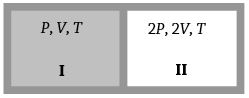
- A$1:6$
- B$6:1$
- C$4:1$
- ✓$1:4$
Generate a complete, print-ready paper with questions like this in minutes — across 16+ boards, with answer keys.
| ${ }_1^1 H$ | $1.007825 u$ | ${ }_2^1 H$ | $2.014102 u$ | ${ }_3^1 H$ | $3.016050 u$ | ${ }_2^4 He$ | $4.002603 u$ |
| ${ }_3^6 Li$ | $6.015123 u$ | ${ }_7^3 Li$ | $7.016004 u$ | ${ }_70^30 Zn$ | $69.925325 u$ | ${ }_{34}^{82} Se$ | $81.916709 u$ |
| ${ }_{64}^{152} Gd$ | $151.919803 u$ | ${ }_{206}^{82} Gd$ | $205.974455 u$ | ${ }_{209}^{83} Bi$ | $208.980388 u$ | ${ }_{84}^{210} Po$ | $209.982876 u$ |
$1.$ The correct statement is:
$(A)$ The nucleus ${ }_3^6 Li$ can emit an alpha particle
$(B)$ The nucleus ${ }_{84}^{210} P_0$ can emit a proton
$(C)$ Deuteron and alpha particle can undergo complete fusion.
$(D)$ The nuclei ${ }_{30}^{70} Zn$ and ${ }_{34}^{82} Se$ can undergo complete fusion.
$2.$ The kinetic energy (in $keV$ ) of the alpha particle, when the nucleus ${ }_{84}^{210} P _0$ at rest undergoes alpha decay, is:
$(A)$ $5319$ $(B)$ $5422$ $(C)$ $5707$ $(D)$ $5818$
Give the answer question $1$ and $2.$
$y = a\sin (kx + \omega t)$ ......$(1)$
$y = a\sin (\omega t - kx)$ ......$(2)$
$y = a\cos (kx + \omega t)$ ......$(3)$
$y = a\cos (\omega t - kx)$ ......$(4)$
emitted by four different sources ${S_1},\,{S_2},\,{S_3}$ and ${S_4}$ respectively, interference phenomena would be observed in space under appropriate conditions when