A pendulum bob has a speed of $3\, m/s$ at its lowest position. The pendulum is $0.5\, m$ long. The speed of the bob, when the length makes an angle of ${60^o}$ to the vertical, will be ..... $m/s$ (If $g = 10\,m/{s^2}$)
Medium
Download our app for free and get started
(d) Let bob velocity be $v$ at point $B$ where it makes an angle of $60^o$ with the vertical, then using conservation of mechanical energy
$K{E_A} + P{E_A} = K{E_B} + P{E_B}$
==> $\frac{1}{2}m \times {3^2} = \frac{1}{2}m{v^2} + mgl(1 - \cos \theta )$
$⇒ 9 = {v^2} + 2 \times 10 \times 0.5 \times \frac{1}{2} $
$⇒ v = 2\,m/s$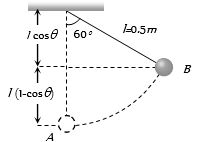

Download our appand get started for free
Experience the future of education. Simply download our apps or reach out to us for more information. Let's shape the future of learning together!No signup needed.*
Similar Questions
- 1The variation of kinetic energy $(KE)$ of a particle executing simple harmonic motion with the displacement $(x)$ starting from mean position to extreme position $(A)$ is given byView Solution
- 2A particle executing $S.H.M.$ of amplitude 4 cm and $T = 4 \,sec.$ The time taken by it to move from positive extreme position to half the amplitude is ..... $\sec$View Solution
- 3A simple pendulum of frequency $f$ has a metal bob. If bob is charged negatively and is allowed to oscillate with large positive charged plate under it, frequency will beView Solution
- 4The equation of motion of a particle is $\frac{{{d^2}y}}{{d{t^2}}} + Ky = 0$, where $K$ is positive constant. The time period of the motion is given byView Solution
- 5Which of the following quantities are always negative in a $SHM$View Solution
- 6The angular frequency of motion whose equation is $4\frac{{{d^2}y}}{{d{t^2}}} + 9y = 0$ is ($y =$ displacement and $t =$ time)View Solution
- 7A particle of mass $2 \,kg$, executing $SHM$ has amplitude $20 \,cm$ and time period $1 \,s$. Its maximum speed is ......... $m / s$View Solution
- 8A massless spring $(k = 800\, N/m)$, attached with a mass $(500\, g)$ is completely immersed in $1\, kg$ of water. The spring is stretched by $2\, cm$ and released so that it starts vibrating. What would be the order of magnitude of the change in the temperature of water when the vibrations stop completely? (Assume that the water container and spring receive negligible heat and specific heat of mass $= 400\, J/kg\, K$, specific heat of water $= 4184\, J/kg\, K$)View Solution
- 9When an oscillator completes $100$ oscillations its amplitude reduced to $\frac{1}{3}$ of initial value. What will be its amplitude, when it completes $200$ oscillations?View Solution
- 10A particle executes $S.H.M$ between $x =\, -A$ to $x =\, +A$ . The time taken for it in going from $0$ to $A/2$ is $T_1$ and from $A/2$ to $A$ is $T_2$. ThenView Solution