The variation of kinetic energy $(KE)$ of a particle executing simple harmonic motion with the displacement $(x)$ starting from mean position to extreme position $(A)$ is given by
- A
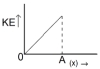
- B
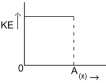
- C
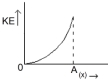
- D
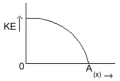
JEE MAIN 2023, Medium


Download our appand get started for free
Experience the future of education. Simply download our apps or reach out to us for more information. Let's shape the future of learning together!No signup needed.*
Similar Questions
- 1A ring is hung on a nail. It can oscillate, without slipping or sliding $(i)$ in its plane with a time period $T_{1}$ and, $(ii)$ back and forth in a direction perpendicular to its plane, with a period $T _{2}$. the ratio $\frac{ T _{1}}{ T _{2}}$ will beView Solution
- 2The graphs in figure show that a quantity $y$ varies with displacement $d$ in a system undergoing simple harmonic motion. Which graphs best represents the relationship obtained when $y$ is The total energy of the systemView Solution

- 3The period of simple pendulum is measured as $T$ in a stationary lift. If the lift moves upwards with an acceleration of $5\, g$, the period will beView Solution
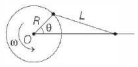
- 4One end of a rod of length $L$ is fixed to a point on the circumference of a wheel of radius $R$. The other end is sliding freely along a straight channel passing through the centre of the wheel as shown in the figure below. The wheel is rotating with a constant angular velocity $\omega$ about $O$. Taking $T=\frac{2 \pi}{\omega}$, the motion of the rod isView Solution
- 5The energy of a particle executing simple harmonic motion is given by $E = Ax^2 + Bv^2$, where $x$ is the displacement from mean position $x = 0$ and $v$ is the velocity of the particle at $x$ then choose the incorrect statementView Solution
- 6Kinetic energy of a particle executing simple harmonic motion in straight line is $pv^2$ and potential energy is $qx^2$, where $v$ is speed at distance $x$ from the mean position. It time period is given by the expressionView Solution
- 7The particle executing $SHM$ of amplitude $'a'$ has displacement $-\frac {a}{2}$ at $t = \frac {T}{4}$ and a positive velocity. Find the initial phase of particleView Solution
- 8A simple pendulum with iron bob has a time period $T$. The bob is now immersed in a non-viscous liquid and oscillated. If the density of liquid is $\frac{1}{12}$ th that of iron, then new time period will beView Solution
- 9The displacement of a particle executing $SHM$ is given by $y=0.25 \sin 200 t$ $cm$. The maximum speed of the particle is $.........cm s^{-1}$View Solution
- 10If a simple harmonic oscillator has got a displacement of $0.02\, m$ and acceleration equal to $2.0\,m{s^{ - 2}}$ at any time, the angular frequency of the oscillator is equal to .... $rad\,{s^{ - 1}}$View Solution