Question
A perfectly elastic rubber ball is dropped from the top of a building. A man standing in front of a window $2m$ high notes that the ball takes a time of $0.2s$ in crossing the window. The ball strikes the ground suffering a perfectly elastic collision and reappears at the bottom of the window during its upward journey again after $2$ seconds. What is (1) the height of the building and (2) the height of the bottom of the window above the ground? Take $g = 10ms^{-2}$.
Answer

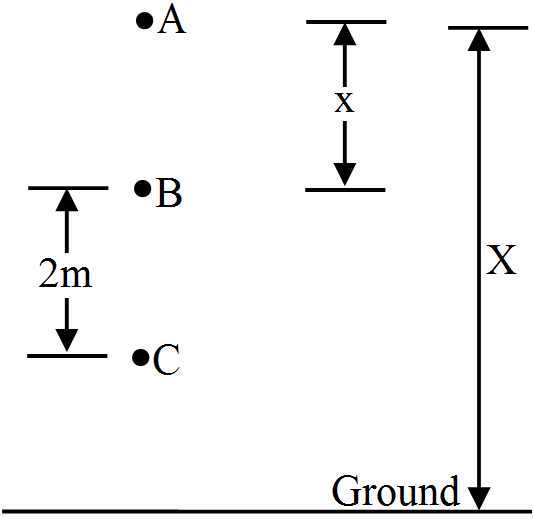
Let A be the top of the building at a height X above the ground. BC is the window of height 2m. Let $t_1$ be the time taken by the ball to fall from A to B.

 Then the time taken to fall through a distance $(x + 2) m$ is $(t_1 + 0.2) s$. Then $\text{x}=\frac{1}{2}\times10\times\text{t}^2_1\ \dots(1)$ and $\text{x}+2=\frac{1}{2}\times10\times(\text{t}_2+0.2)^2$ From Eqns. (1) and (2), we have $5\text{t}^2_1+2=5\text{t}^2_1+0.2+2\text{t}_1$
$1.8=2\text{t}_1$
$\therefore \text{t}_1=0.9\text{s}$
$\therefore \text{x}=\frac{1}{2}\times10\times(0.9)^2=4.05\text{m}$ Let v_1 be the speed acquired by the ball as it reaches the bottom C of the window. Then $\text{v}_1=0 + 10\times1.1 = 11\text{ms}^{-1}$ During the downward journey the ball experiences an acceleration equal to g and strikes the ground with speed V. Since it undergoes a perfectly elastic collision its speed reverses. The time taken in falling from C to ground to back is 2s. Therefore, time taken to fall from C to ground must be 1s. Hence $\text{X}-(\text{x}+2)=11\times1+\frac{1}{2}\times10(1)^2$
$\text{X}-6.05=11+5=16$
$\therefore \text{X}=22.05\text{m}$ The height of the building is 22.05m and the bottom of the window is at height of 16m from the ground.

Need a full question paper?

Generate a complete, print-ready paper with questions like this in minutes — across 16+ boards, with answer keys.

Start Generating Free

Similar questions

Define impulse and establish its relation with momentum change. Explain the importance of impulse. Or Define impulse of a force and prove that the impulse of a force on a body is equal to change in momentum. Or State the momentum impulse theorem. Explain its physical importance with examples.
Why does blowing over a spoonful of hot tea cools it? Does evaporation play a role? Does radiation play a role?
Obtain expressions for the velocity and acceleration of the particle in simple harmonic motion and show their transformation graphs.
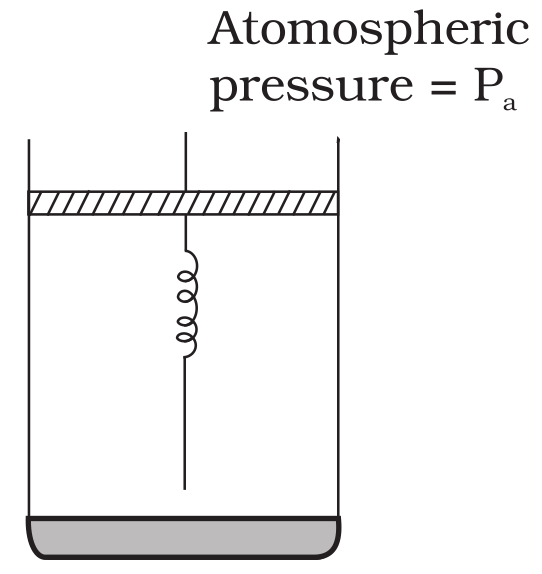
Consider one mole of perfect gas in a cylinder of unit cross section with a piston attached (Fig.) A spring (spring constant k) is attached (unstretched length L) to the piston and to the bottom of the cylinder. Initially the spring is unstretched and the gas is in equilibrium. A certain amount of heat Q is supplied to the gas causing an increase of volume from $V_o$ to $V_1$.
  1. What is the initial pressure of the system.
  2. What is the final pressure of the system.
  3. Uing the first law of thermodynamics, write down a relation between $Q, P_a, V, V_o$ and $k$.
The position of a particle is given by $\text{r}=3.0\text{t}\hat{\text{i}}-2.0\text{t}^2\hat{\text{j}}+4.0\hat{\text{k }}\text{m}$ Where t is in seconds and the coefficients have the proper units for r to be in metres. (a) Find the v and a of the particle? (b) What is the magnitude and direction of velocity of the particle at t = 2.0s?
Estimate the average mass density of a sodium atom assuming its size to be about $2.5 \mathring{\text{A}}.$ (Use the known values of Avogadro’s number and the atomic mass of sodium). Compare it with the mass density of sodium in its crystalline phase: $970kg ~m^{–3}$. Are the two densities of the same order of magnitude? If so, why?
What is adiabatic process? Establish the equation of state for this.
Find the increase in surface energy when a large drop of water is sprayed into small droplets.
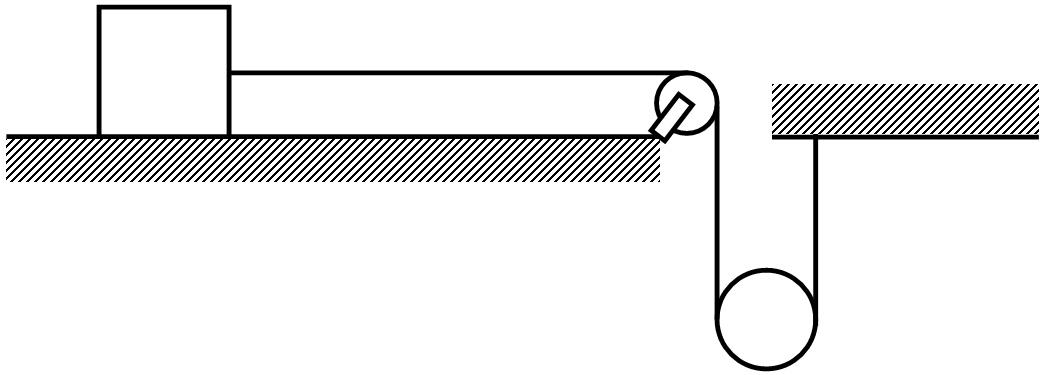
The descending pulley shown in figure has a radius $20cm$ and moment of inertia $0.20kg-m^2$. The fixed pulley is light and the horizontal plane frictionless. Find the acceleration of the block if its mass is $1.0kg$.
A car is speeding up on a horizontal road with an acceleration a. Consider the following situations in the car.
  1. A ball is suspended from the ceiling through a string and is maintaining a constant angle with the vertical. Find this angle.
  2. A block is kept on a smooth incline and does not slip on the incline. Find the angle of the incline with the horizontal.