A person feels $2.5\%$ difference of frequency of a motor-car horn. If the motor-car is moving to the person and the velocity of sound is $320\, m/sec,$ then the velocity of car will be
Medium


Download our appand get started for free
Experience the future of education. Simply download our apps or reach out to us for more information. Let's shape the future of learning together!No signup needed.*
Similar Questions
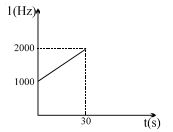
- 1A detector is released from rest over a source of sound of frequency $f = 10^3 \,\,Hz$. The frequency observed by the detector at time $t$ is plotted in the graph. The speed of sound in air is $(g = 10 \,\,m/s^2)$ ... $m/s$View Solution
- 2A vibrating string of certain length $l$ under a tension $T$ resonates with a mode corresponding to the first overtone (third harmonic) of an air column of length $75\, cm$ inside a tube closed at one end. The string also generates $4\, beats$ per second when excited along with a tuning fork of frequency $n$. Now when the tension of the string is slightly increased the number of beats reduces to $2\, per second$. Assuming the velocity of sound in air to be $340\, m/s$, the frequency $n$ of the tuning fork in $Hz$ isView Solution
- 3The mass per unit length of a uniform wire is $0.135\, g / cm$. A transverse wave of the form $y =-0.21 \sin ( x +30 t )$ is produced in it, where $x$ is in meter and $t$ is in second. Then, the expected value of tension in the wire is $x \times 10^{-2} N$. Value of $x$ is . (Round-off to the nearest integer)View Solution
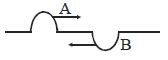
- 4View SolutionTwo identical harmonic pulses travelling in opposite directions in a taut string approach each other. At the instant when they completely overlap, the total energy of the string will be
- 5In a closed organ pipe, the frequency of fundamental note is $30 \mathrm{~Hz}$. A certain amount of water is now poured in the organ pipe so that the fundamental frequency is increased to $110 \mathrm{~Hz}$. If the organ pipe has a cross-sectional area of $2 \mathrm{~cm}^2$, the amount of water poured in the organ tube is _____________$g.$ (Take speed of sound in air is $330 \mathrm{~m} / \mathrm{s}$ )View Solution
- 6One end of a taut string of length $3 \ m$ along the $x$-axis is fixed at $x=0$. The speed of the waves in the string is $100 \ m / s$. The other end of the string is vibrating in the $y$-direction so that stationary waves are set up in the string. The possible waveform$(s)$ of these stationary waves is (are)View Solution
$(A)$ $y(t)=A \sin \frac{\pi x}{6} \cos \frac{50 \pi t}{3}$
$(B)$ $y(t)=A \sin \frac{\pi x}{3} \cos \frac{100 \pi t}{3}$
$(C)$ $y(t)=A \sin \frac{5 \pi x}{6} \cos \frac{250 \pi t}{3}$
$(D)$ $y(t)=A \sin \frac{5 \pi x}{2} \cos 250 \pi t$
- 7The second overtone of an open organ pipe $A$ and a closed pipe $B$ have the same frequency at a given temperature. It follows that the ratio of theView Solution
- 8A person blows into open-end of a long pipe. As a result, a high-pressure pulse of air travels down the pipe. When this pulse reaches the other end of the pipe.View Solution
$(A)$ a high-pressure pulse starts traveling up the pipe, if the other end of the pipe is open.
$(B)$ a low-pressure pulse starts traveling up the pipe, if the other end of the pipe is open.
$(C)$ a low-pressure pulse starts traveling up the pipe, if the other end of the pipe is closed.
$(D)$ a high-pressure pulse starts traveling up the pipe, if the other end of the pipe is closed.
- 9If the velocity of sound in air is $336 m/s$. The maximum length of a closed pipe that would produce a just audible sound will beView Solution
- 10A steel wire has a length of $12.0 \;m$ and a mass of $2.10 \;kg .$ What should be the tension in the wire so that speed of a transverse wave on the wire equals the speed of sound in dry air at $20\,^{\circ} C =343\; m s ^{-1}$View Solution