Question
A person is suffering from hypermetropia (long sightedness). It is a defect in which a human eye can see far off object clearly, but is unable to see nearby object distinctly. The near point of the person is $1.5 m$. Assume that the near point of the normal eye is $25 cm$.
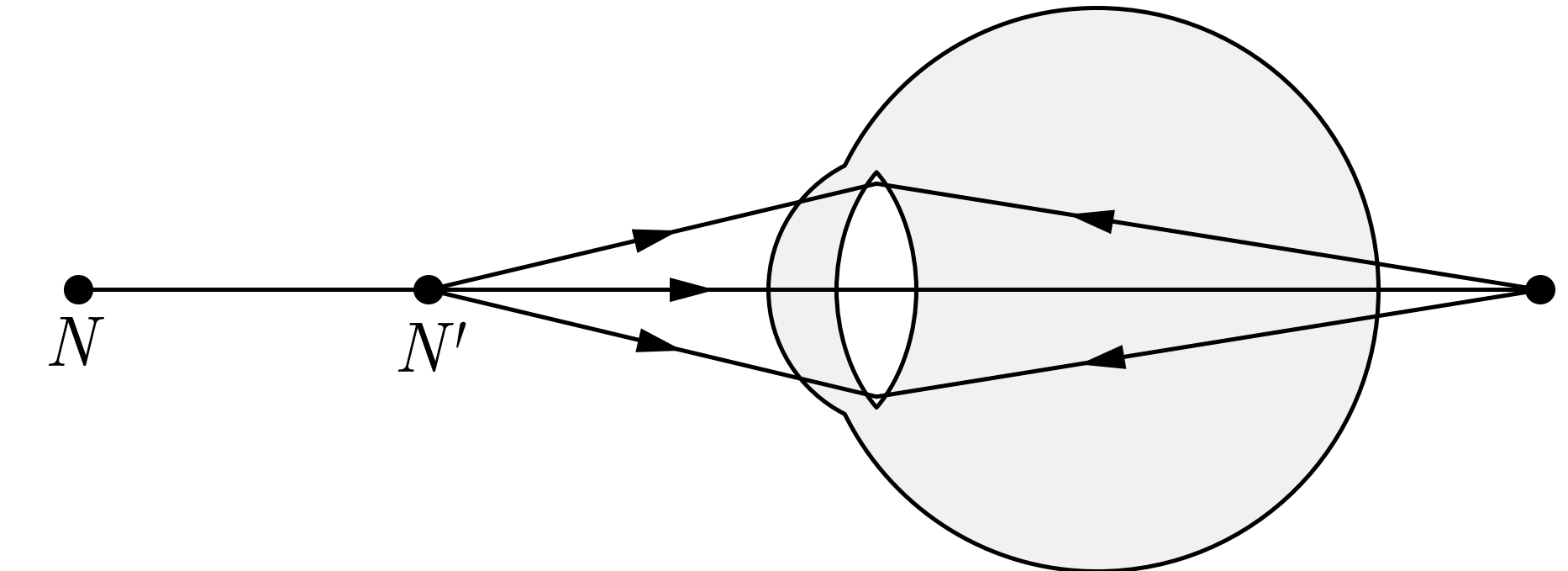
(i) What type of lens should be used in his spectacles?
(ii) What should be the focal length of the lens he used?
(iii) What will be the potver of the lens?
or
(iv) Write one possible cause of this defect.
Answer

(i) Convex lens is to be used in his spectacles.
(ii) Here,
$\begin{aligned}d & =150 cm \\D & =25 cm \\v & =-150 cm \\u & =-25 cm\end{aligned}$
Using lens formula,
$\begin{aligned}\frac{1}{f} & =\frac{1}{v}-\frac{1}{u} \\& =\frac{1}{-150 cm }-\frac{1}{-25 cm } \\& =\frac{-1+6}{150 cm }=\frac{5}{150 cm } \\f & =30 cm\end{aligned}$
(iii) Power of the lens,
$P=\frac{100}{f} D =\frac{100}{30} D =3.3 D$
or
(iv) Increase in focal length of the eye lens, when the eye is fully relaxed is the cause of hypermetropia.

Need a full question paper?

Generate a complete, print-ready paper with questions like this in minutes — across 16+ boards, with answer keys.

Start Generating Free

Similar questions

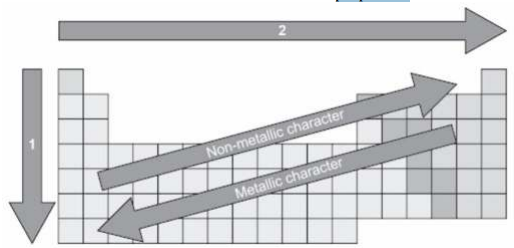
The picture shows an incomplete periodic table.
Arrow 1 and arrow 2 indicate increase or decrease in chemical properties.

Image
7. What do arrow 1 and arrow 2 represent?

Arrow 1

Arrow 2

A.

Decrease in atomic mass

Increase in atomic radius

B.

Increase in atomic radius

Increase in electronegativity

C.

Increase in electronegativity

Decrease in atomic radius

D.

Decrease in atomic radius

Decrease in atomic mass

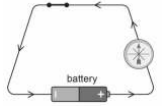
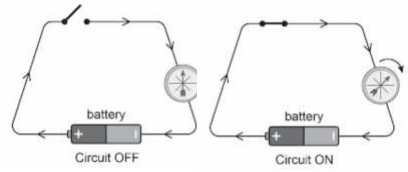
Reema placed a magnetic needle in an electric circuit.
She noticed a delection of the needle when the circuit is turned ON.

Image
3. Reema placed a second battery in the circuit and turned the circuit ON.
What change in the needle will she observe now?
A. The needle will keep spinning.
B. The delection of the needle will increase.
C. The delection of the needle will decrease.
D. There will be no change in the delection of the needle.
4. Reema reverses the direction of the battery in the circuit.
She turns the circuit ON.
Draw an arrow on the magnetic needle to show the correct delection.

Image

The teacher while conducting practicals in the laboratory divided the students into three groups and gave them various solutions to find out their pH and classify them into acidic, basic and neutral solutions.
Group A - Lemon juice, vinegar, colourless aerated drink
Group B - Tomato juice, coffee, ginger juice
Group C - Sodium hydroxide, sodium chloride, lime water
(a) For the solutions provided, which group is/are likely to have pH value (i) less than 7, and (ii) greater than 7?
(b) List two ways of determining pH of a solution.
OR
Explain, why the sour substances such as lemon juice are effective in cleaning the tarnished copper vessels.
Refer to the given table regarding results of $\mathrm{F}_{2}$ generation of Mendelian cross.
Plants with round and yellow coloured seeds (P)315
Plants with round and green coloured seeds (Q)108
Plants with wrinkled and yellow coloured seeds (R)101
Plants with wrinkled and green coloured seeds (S)32

i. What would be the phenotype of $F_{1}$ generation regarding given data of $F_{2}$ generation?
ii. What would be the genotype of parental generation regarding the given result of $\mathrm{F}_{2}$ generation?
iii. If a plant with wrinkled and green coloured seeds $(\mathrm{S})$ is crossed with the plant having wrinkled and yellow coloured seeds (R), what will be the probable phenotype of offspring?
OR
What will result when plant YyRr is self-pollinated?
Question numbers i - iv are based on the table given below. Study the table and answer the following questions.

S. No.GenerationPhenotypic ratio
1.F_(1) generation23 pairs
2.F_(2) generation22 pairs

(i) State the law of dominance.

(ii) What is the dominant allele?

(iii) Define the term phenotype.

(iv) What is the meaning of genotype ?

Corrosion is the phenomenon of deterioration of surface of metal in presence of air and moisture. It is a natural process and in the presence of a moist atmosphere, chemically active metals get corroded. This is oxidation reaction. Rusting is the process where iron corrodes due to exposure to the atmosphere. The main circumstance of corrosion occurs with iron because it is a structural material in construction, bridges, buildings, rail transport, ships, etc. Aluminium is also an important structural metal, but even aluminium undergoes oxidation reactions. However, aluminium doesn't corrode or oxidize as rapidly as its reactivity suggests. An alloy of aluminium or any other metal like magnesium can make aluminium stronger and harder.
Copper $( Cu )$ corrodes and forms a basic green carbonate and lead corrodes to form a white lead oxide or carbonate.
(i) What is rusting?
(ii) Which two metals do not corrode easily?
(iii) List two properties of alloys.
or
(iv) What is the effect of corrosion on electrical conductivity?
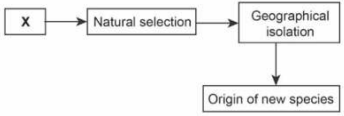
The two birds once belonged to the same species.
The following sequence of events is likely to have caused the origin of the two different species.

Image
9. What is the biological event X?
A. Evolution
B. Speciation
C. Changes in DNA
D. Sexual reproduction
10. Which of the following statements is correct?
Circle ‘Yes’ or ‘No’ to mark your responses.

Is this statement correct?

Yes or No

Natural selection provides an advantage to organisms.

Yes/No

Genes mix with each other to produce new traits

Yes/No

All chromosomes in human cells are found in pairs.

Yes/No


Read the following and answer any three questions from (i) to (iv).
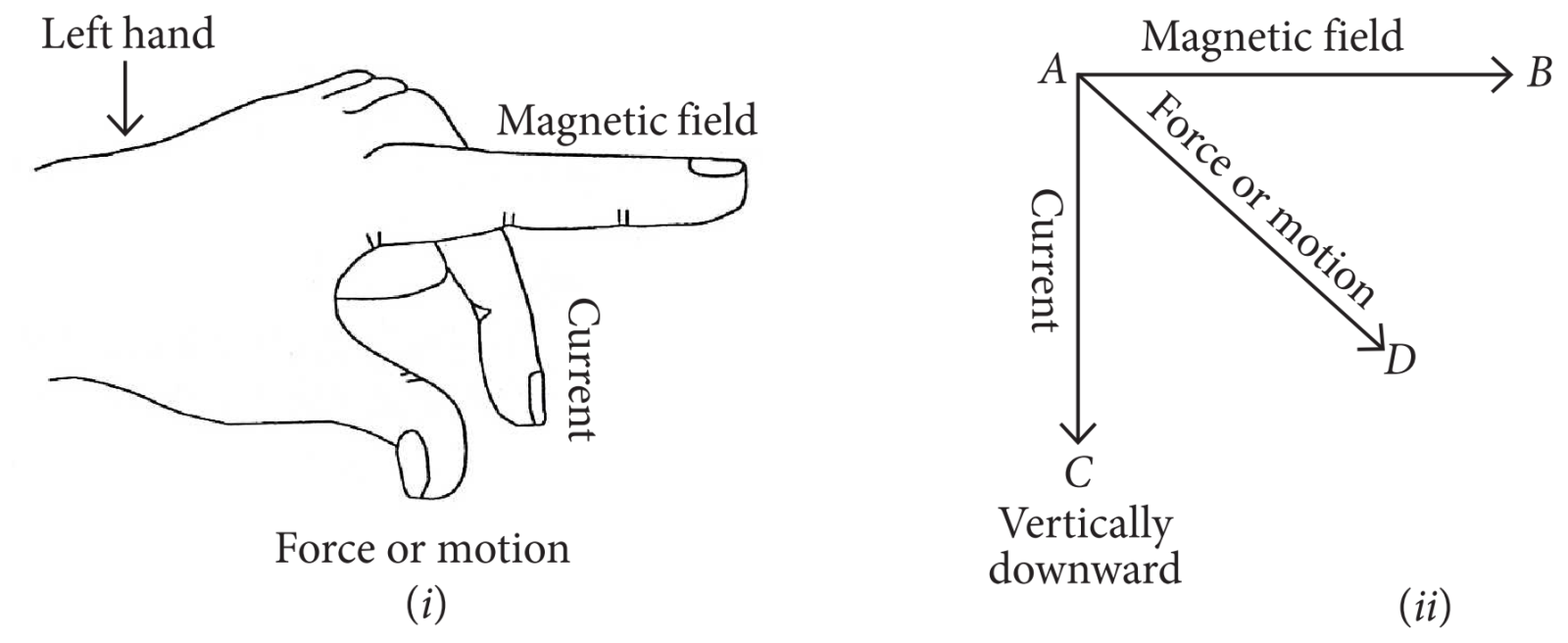
Andre Marie Ampere suggested that a magnet must exert an equal and opposite force on a current carrying conductor, which was experimentally found to be true. But we know that current is due to charges in motion. Thus, it is clear that a charge moving in a magnetic field experience a force, except when it is moving in a direction parallel to it. If the direction of motion is perpendicular to the direction of magnetic field, the magnitude of force experienced depends on the charge, velocity (v), strength of magnetic field (B), and sine of the angle between v and B. Direction of magnetic force is given by Fleming's left-hand rule.
  1. If an electron is travelling horizontally towards east. A magnetic field in vertically downward direction exerts a force on the electron along which side?
     
  2. If a charged particle is moving along a magnetic field line. The magnetic force on the particle will?
     
  3. a) A magnetic field exerts no force on?
    b) what Andre Marie Ampere suggested?
     
  4. What is fleming's left hand rule?
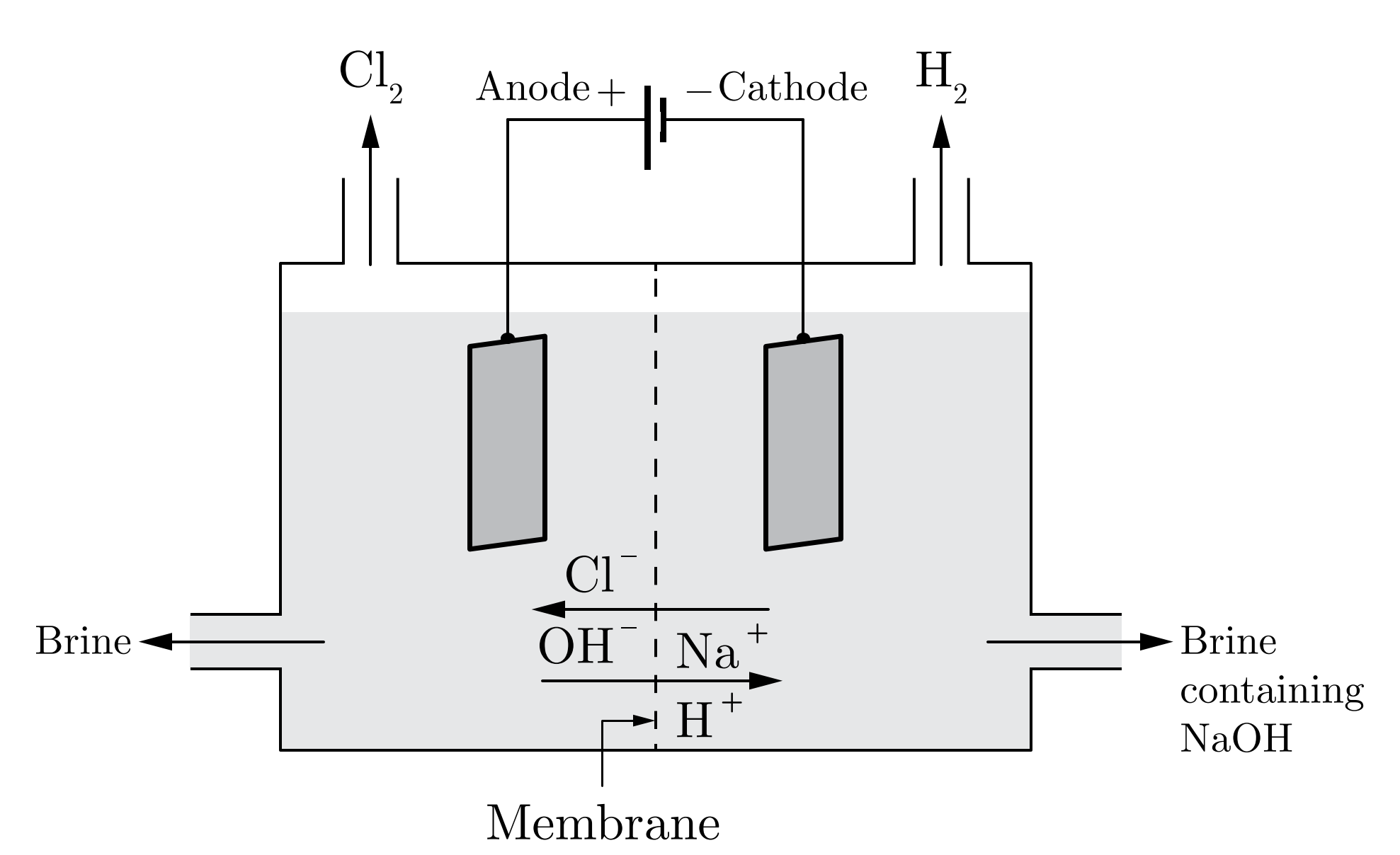
'Salts' refer to the compound formed when an acid reacts with a base. These reactions are known as neutralisation reactions. These reactions are often used in the laboratories to calculate the exact concentration of an acid or an alkali when the other is known. The familiar example of salt is sodium chloride (NaCl), which we use in our food on daily basis and is known as rock salt. It is prepared by the reaction of hydrochloric acid and sodium hydroxide solution. This salt is used to prepare various compounds. When electricity is pass through an aqueous solution of sodium chloride (called brine), it decomposes to form sodium hydroxide. The process is called the chlor-alkali process because of the products formed-chlor and alkali for sodium hydroxide.

(i) Write the chemical reaction of chlor-alkali process.
(ii) Name the gases formed at the anode and the cathode.
(iii) Write one use each of chlorine and hydrogen gas.
or
(iv) How will you prepare baking soda from sodium chloride?

Read the following and answer any four questions from (i) to (v).Our body needs to remove the wastes that build up from cell activities and from digestion. It these wastes are not removed, then our cells can stop working and we can get very sick. The organs of our excretory system help to release wastes from our body. The excretory system consists of a pair of kidney, a pair of ureters, a urinary bladder and a urethra. Each kidney is made up of nearly one million complex tubular structures called nephrons. The formation of urine involves various processes that takes place in the different parts of the nephron. Each nephron consists of a cup-shaped upper end called Bowman's capsule containing a bunch of capillaries called glomerulus. Bowman's capsule leads to tubular structure-proximal convoluted tubule, loop of Henle and distal convoluted tubule which ultimately joins the collecting tubule.
  1. The following substances are the excretory products in animals. Choose the least toxic form.
  1. Urea
  2. Uric acid
  3. Ammonia
  4. $CO^2$
  1. The outline of principal events of urination is given below in random manner.
  1. Stretch receptors on the wall of urinary bladder send signals to the CNS.
  2. The bladder fills with urine and becomes distended.
  3. Micturition.
  4. CNS passes on motor messages to initiate the contraction of smooth muscles of bladder and simultaneous relaxation of urethral sphincter.
The correct sequence of the events is:
  1. (I) → (II) → (Ill) → (IV)
  2. (IV) → (III) → (II) → (I)
  3. (II) → (I) → (IV) → (III)
  4. (Ill) →(II) → (I) → (IV).
  1. A person who is not taking food or beverages will have in urine.
  1. Little glucose.
  2. Less urea.
  3. Excess urea.
  4. Little fat.
  1. Glomerular filtrate is first collected by:
  1. Distal convoluted tubule.
  2. proximal convoluted tubule.
  3. Bowman's capsule.
  4. Loop of Henle.
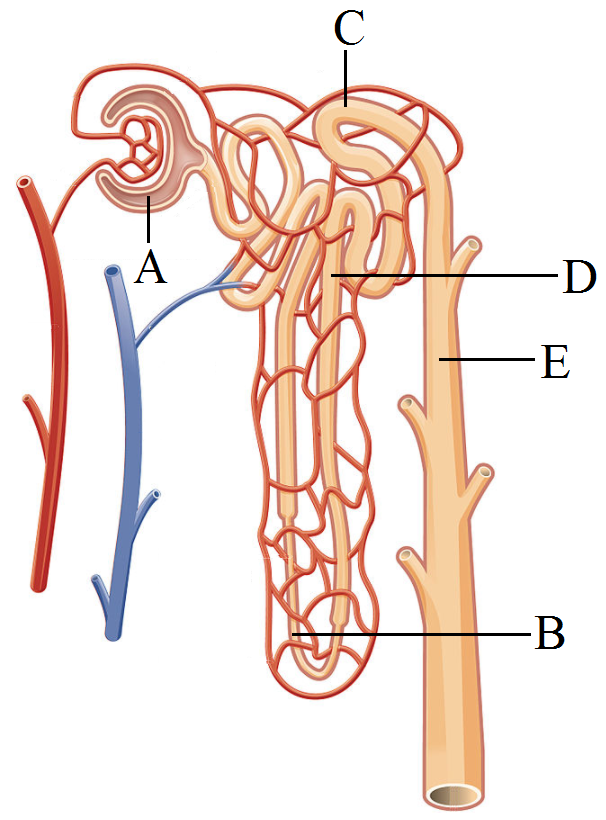
  1. The given figure represents a single nephron from a mammalian kidney. Identify the labelled parts, match them with the options (i-iv) and select the correct answer.
  1. The site of ultrafiltration
  2. Collect the urine and make it more concentrated
  3. The main site for the reabsorption of glucose and amino acids
  4. Largely responsible for the maintenance of blood $p_H$
  1. (I)-A, (II)-E, (III)-C, (IV)-D
  2. (I)-A, (II)-B, (III)-C, (IV)-D
  3. (I)-B, (II)-A, (III)-C, (IV)-E
  4. (I)-E, (II)-B, (III)-0, (IV)-A