A person observes two moving trains, '$A$' reaching the station and '$B$' leaving the station with equal speed of $30\,m / s$. If both trains emit sounds with frequency $300\,Hz$, (Speed of sound : $330\,m / s$ ) approximate difference of frequencies heard by the person will be $..........Hz$
JEE MAIN 2023, Medium
Download our app for free and get started
$f _1=300\left(\frac{330-0}{330-(-30)}\right)=275$
$f _2=300\left(\frac{330-0}{330-(30)}\right)=330$
$\Delta f =330-275=55\,Hz$

Download our appand get started for free
Experience the future of education. Simply download our apps or reach out to us for more information. Let's shape the future of learning together!No signup needed.*
Similar Questions
- 1Two trains $A$ and $B$ are moving with speeds $20 \mathrm{~m} / \mathrm{s}$ and $30 \mathrm{~m} / \mathrm{s}$ respectively in the same direction on the same straight track, with $B$ ahead of $A$. The engines are at the front ends. The engine of train $A$ blows a long whistle.View Solution
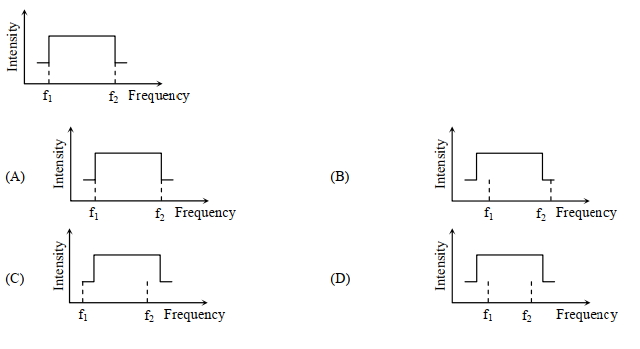
Assume that the sound of the whistle is composed of components varying in frequency from $f_1=800 \mathrm{~Hz}$ to $f_2=1120 \mathrm{~Hz}$, as shown in the figure. The spread in the frequency (highest frequency - lowest frequency) is thus $320 \mathrm{~Hz}$. The speed of sound in still air is $340 \mathrm{~m} / \mathrm{s}$.
$1.$ The speed of sound of the whistle is
$(A)$ $340 \mathrm{~m} / \mathrm{s}$ for passengers in $A$ and $310 \mathrm{~m} / \mathrm{s}$ for passengers in $B$
$(B)$ $360 \mathrm{~m} / \mathrm{s}$ for passengers in $A$ and $310 \mathrm{~m} / \mathrm{s}$ for passengers in $B$
$(C)$ $310 \mathrm{~m} / \mathrm{s}$ for passengers in $A$ and $360 \mathrm{~m} / \mathrm{s}$ for passengers in $B$
$(D)$ $340 \mathrm{~m} / \mathrm{s}$ for passengers in both the trains
$2.$ The distribution of the sound intensity of the whistle as observed by the passengers in train $\mathrm{A}$ is best represented by
$Image$
$3.$ The spread of frequency as observed by the passengers in train $B$ is
$(A)$ $310 \mathrm{~Hz}$ $(B)$ $330 \mathrm{~Hz}$ $(C)$ $350 \mathrm{~Hz}$ $(D)$ $290 \mathrm{~Hz}$
Give the answer question $1,2$ and $3.$
- 2A tuning fork $A$ produces $4$ beats/sec with another tuning fork $B$ of frequency $320 Hz$. On filing the fork $A$, $4$ beats/sec are again heard. The frequency of fork $A$, after filing is ....$Hz$View Solution
- 3Three waves of equal frequency having amplitudes $10 \,\mu \, m, 4 \, \mu \,m$ and $7 \mu m$ arrive at a given point with successive phase difference of $\frac{\pi }{2}$. The amplitude of the resulting wave in $\mu \,m$ is given byView Solution
- 4If the tension of sonometer’s wire increases four times then the fundamental frequency of the wire will increase by .... $ times$View Solution
- 5Two open organ pipes of length $60 \mathrm{~cm}$ and $90 \mathrm{~cm}$ resonate at $6^{\text {th }}$ and $5^{\text {th }}$ harmonics respectively. The difference of frequencies for the given modes is . . . . . $\mathrm{Hz}$.View Solution
(Velocity of sound in air $=333 \mathrm{~m} / \mathrm{s}$ )
- 6The path difference between the two waves ${y_1} = {a_1}\sin \,\left( {\omega t - \frac{{2\pi x}}{\lambda }} \right)$ and ${y_2} = {a_2}\cos \,\left( {\omega t - \frac{{2\pi x}}{\lambda } + \phi } \right)$ isView Solution
- 7A transverse wave propagating on the string can be described by the equation $y=2 \sin (10 x+300 t)$. where $x$ and $y$ are in metres and $t$ in second. If the vibrating string has linear density of $0.6 \times 10^{-3} \,g / cm$, then the tension in the string is .............. $N$View Solution
- 8View SolutionA tuning fork produces waves in a medium. If the temperature of the medium changes, then which of the following will change
- 9View SolutionMechanical waves on the surface of a liquid are
- 10When a car is approaching the observer, the frequency of horn is $100 Hz$. After passing the observer, it is $50\,Hz$. If the observer moves with the car, the frequency will be $\frac{ x }{3} Hz$ where $x =.....$View Solution