MCQ
A person travelling on a straight line moves with a uniform velocity $v_1$ for some time and with uniform velocity $v_2$ for the next equal time. The average velocity is given by:
  • $\text{v}=\frac{\text{v}_1+\text{v}_2}{2}$
  • B
    $\text{v}=\sqrt{\text{v}_1\text{v}_2}$
  • C
    $\frac{2}{\text{v}}=\frac{1}{\text{v}_1}+\frac{1}{\text{v}_2}$
  • D
    $\frac{1}{\text{v}}=\frac{1}{\text{v}_1}+\frac{1}{\text{v}_2}$
Answer

Correct option: A.
$\text{v}=\frac{\text{v}_1+\text{v}_2}{2}$
$a.\ \text{v}=\frac{\text{v}_1+\text{v}_2}{2}$
Explanation:
Velocity is uniform in both cases; that is, acceleration is zero.
We have:
$\text{d}_1=\text{v}_1\text{t}$ and $\text{d}_2=\text{v}_2\text{t}$
Total displacement, $\text{d = d}_1+\text{d}_2$
Total time, $\text{t = t + t = 2t}$
$\therefore$ Average velocity, $\text{v}=\frac{\text{d}_1+\text{d}_2}{2\text{t}}=\frac{\text{v}_1+\text{v}_2}{2}$

Need a full question paper?

Generate a complete, print-ready paper with questions like this in minutes — across 16+ boards, with answer keys.

Start Generating Free

Similar questions

If the potential energy of a spring is $V$ on stretching it by $2\, cm$, then its potential energy when it is stretched by $10 \,cm$ will be
$M{L^3}{T^{ - 1}}{Q^{ - 2}}$ is dimension of
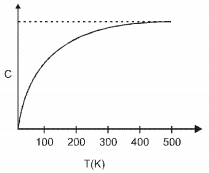
The figure below shows the variation of specific heat capacity $(C)$ of a solid as a function of temperature $(T)$. The temperature is increased continuously from $0$ to $500 \ K$ at a constant rate. Ignoring any volume change, the following statement$(s)$ is (are) correct to a reasonable approximation.$Image$

$(A)$ the rate at which heat is absorbed in the range $0-100 \ K$ varies linearly with temperature $T$.

$(B)$ heat absorbed in increasing the temperature from $0-100 \ K$ is less than the heat required for increasing the temperature from $400-500 \ K$.

$(C)$ there is no change in the rate of heat absorbtion in the range $400-500 \ K$.

$(D)$ the rate of heat absorption increases in the range $200-300 \ K$.

On the $x-$axis and a dsitance $x$ from the origin, the gravitational field due to a mass distribution is given by $\frac{A x}{\left(x^{2}+a^{2}\right)^{3 / 2}}$ in the $x-$direction. The magnitude of gravitational potential on the $x-$axis at a distance $x,$ taking its value to be zero at infinity, is
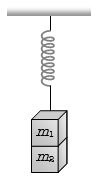
Two masses $m_1$ and $m_2$ are suspended together by a massless spring of constant $K$. When the masses are in equilibrium, $m_1$ is removed without disturbing the system. The amplitude of oscillations is
A player kicks a football of mass $0.5\, kg$ and the football begins to move with a velocity of 10 m/s. If the contact between the leg and the football lasts for $\frac{1}{{50}}$ sec, then the force acted on the football should be ........... $N$
Zeroth Law of Thermodynamics :
For proper ventilation of building, windows must be open near the bottom and top of the walls so as to let pass
A disc rotating about its axis from rest, acquires the angular speed $100 \,rev/s$ in $4$ second. The angle rotated by it during these four seconds (in radian) is ...... $\pi$
A body at rest explodes into two pieces of unequal mass. The parts will move