MCQ
A plane progressive wave is given by $y=2 \cos 2 \pi(330 t-x) m$. The frequency of the wave is:
  • A
    $165 \mathrm{~Hz}$
  • $330 \mathrm{~Hz}$
  • C
     $660 \mathrm{~Hz}$
  • D
    $340 \mathrm{~Hz}$

Answer

Correct option: B.
$330 \mathrm{~Hz}$
b
$y=2 \cos 2 \pi(330 t-x) m$

$y=A \cos (\omega t-k x)$

$\text { by comparing } \omega=2 \pi \times 330$

$2 \pi f=2 \pi \times 330$

$f=330$

Need a full question paper?

Generate a complete, print-ready paper with questions like this in minutes — across 16+ boards, with answer keys.
Start Generating Free

Similar questions

The time period of an artificial satellite in a circular orbit of radius $R$ is $2\, days$ and its  orbital velocity is $v_0$. If time period of another satellite in a circular orbit is $16 \,days$ then
If e is the electronic charge, $c$ is the speed of light in free space and $h$ is Planck's constant, the quantity $\frac{1}{4 \pi \varepsilon_{0}} \frac{| e |^{2}}{h c}$ has dimensions of .......
Three discs $A, B$ and $C$ having radii $2\; m, 4\;m,$ and $6 \;m$, respectively are coated with carbon black on their outer surfaces. The wavelengths corresponding to maximum intensity are $300\; nm, 400\; nm$ and $500\; nm$, respectively. The power radiated by them are $Q_A,Q_B$ and $Q_C$ respectively.
An ideal Carnot heat engine with an efficiency of $30\%$.It absorbs heat from a hot reservoir at  $727^o C$. The temperature of the cold reservoir is  .... $^oC$
A projectile of mass $M$ is fired so that the horizontal range is $4\, km$. At the highest point the projectile explodes in two parts of masses $M/4$ and $3M/4$ respectively and the heavier part starts falling down vertically with zero initial speed. The horizontal range (distance from point of firing) of the lighter part is .................. $\mathrm{km}$
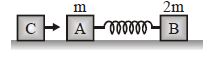
Two bodies $A$ and $B$ of masses $m$ and $2m$ respectively are placed on a smooth floor. They are connected by a spring. A third body $C$ of mass $m$ moves with velocity $V_0$ along the line joining $A$ and $B$ and collides elastically with $A$ as shown in fig. At a certain instant of time $t_0$ after collision, it is found that instantaneous velocities of $A$ and $B$ are the same. Further at this instant the compression of the spring is found to be $x_0$. Determine the spring constant
A vector $\vec A $ is rotated by a small angle $\Delta \theta$ radian $( \Delta \theta << 1)$ to get a new vector $\vec B$ In that case $\left| {\vec B - \vec A} \right|$ is
A ball is projected from the ground at an angle of $45^{\circ}$ with the horizontal surface. It reaches a maximum height of $120 m$ and returns to the ground. Upon hitting the ground for the first time, it loses half of its kinetic energy. Immediately after the bounce, the velocity of the ball makes an angle of $30^{\circ}$ with the horizontal surface. The maximum height it reaches after the bounce, in metres, is. . . . .
The unit of the coefficient of viscosity in $S.I.$ system is
A given system undergoes a change in which the work done by the system equals the decrease in its internal energy. The system must have undergone an