A plastic disc of radius $R$ has a charge $q$ uniformly distributed over its surface. If the disc is rotated at an angular frequency $\omega$ about it axis, the induction at the center of the disc is :-
Diffcult
Download our app for free and get started
$\frac{\mu_{0} \omega q}{2 \pi R}$ (Hint : Divide disc into rings, consider one such ring of radius $\mathrm{x}$, thickness $\mathrm{dx}.$ Then field at its center $\mathrm{dB}=\left(\mu_{0} \omega \mathrm{q} / 2\right)$ $\mathrm{dx}$ integrate to find $\mathrm{B}$ ).

Download our appand get started for free
Experience the future of education. Simply download our apps or reach out to us for more information. Let's shape the future of learning together!No signup needed.*
Similar Questions
- 1View SolutionThe ratio of the magnetic field at the cpentre of a current carrying circular wire and the magnetic field at the centre of a square coil made from the same length of wire will be
- 2$\alpha$ particle is revolving in radius $r$ with frequency $f$ then find value of magnetic dipole moment.View Solution
- 3A square loop of side $l$ is kept in a uniform magnetic field $B$ such that its plane makes an angle $\alpha$ with $\vec{B}$. The loop carries a current $i$. The torque experienced by the loop in this position isView Solution
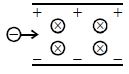
- 4An electron enters the space between the plates of a charged capacitor as shown. The charge density on the plate is $\sigma $. Electric intensity in the space between the plates is $E$. A uniform magnetic field $B$ also exists in that space perpendicular to the direction of $E$. The electron moves perpendicular to both $\vec E$ and $\vec B$ without any change in direction. The time taken by the electron to travel a distance $\ell $ is the space isView Solution
- 5A straight section $PQ$ of a circuit lies along the $X$-axis from $x = - \frac{a}{2}$ to $x = \frac{a}{2}$ and carries a steady current $i$. The magnetic field due to the section $PQ$ at a point $X = + a$ will beView Solution
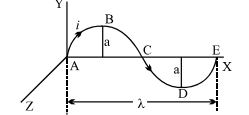
- 6A conductor $ABCDE$, shaped as shown, carries a current i. It is placed in the $xy$ plane with the ends $A$ and $E$ on the $x$-axis. $A$ uniform magnetic field of magnitude $B$ exists in the region. The force acting on it will beView Solution
- 7In a hydrogen atom, an electron moves in a circular orbit of radius $5.2 \times {10^{ - 11}}\,m$ and produces a magnetic induction of $12.56\, T$ at its nucleus. The current produced by the motion of the electron will be (Given ${\mu _0} = 4\pi \times {10^{ - 7}}\,Wb/A - m)$View Solution
- 8View SolutionThe current is flowing in south direction along a power line. The direction of magnetic field above the power line (neglecting earth's field) is
- 9View SolutionA current carrying circular loop is freely suspended by a long thread. The plane of the loop will point in the direction
- 10A charged particle of specific charge $\alpha$ is released from origin at time $t = 0$ with velocity $\vec V = {V_o}\hat i + {V_o}\hat j$ in magnetic field $\vec B = {B_o}\hat i$ . The coordinates of the particle at time $t = \frac{\pi }{{{B_o}\alpha }}$ are (specific charge $\alpha = \,q/m$)View Solution