A plate oscillated with time period $‘T’$. Suddenly, another plate put on the first plate, then time period
Easy


Download our appand get started for free
Experience the future of education. Simply download our apps or reach out to us for more information. Let's shape the future of learning together!No signup needed.*
Similar Questions
- 1A simple pendulum of length $l$ and mass $m$ of the bob is suspended in a car that is travelling with a constant speed $v$ around a circular path of radius $R$. If the pendulum undergoes oscillations with small amplitude about its equilibrium position, the frequency of its oscillations will beView Solution
- 2A block of mass $200\, g$ executing $SHM$ under the influence of a spring of spring constant $K=90\, N\,m^{-1}$ and a damping constant $b=40\, g\,s^{-1}$. The time elapsed for its amplitude to drop to half of its initial value is ...... $s$ (Given $ln\,\frac{1}{2} = -0.693$)View Solution
- 3A particle is executing $S.H.M.$ with total mechanical energy $90 \,J$ and amplitude $6 \,cm$. If its energy is somehow decreased to $40 \,J$ then its amplitude will become ........ $cm$View Solution
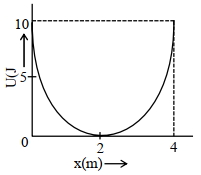
- 4A mass of $5\, {kg}$ is connected to a spring. The potential energy curve of the simple harmonic motion executed by the system is shown in the figure. A simple pendulum of length $4\, {m}$ has the same period of oscillation as the spring system. What is the value of acceleration due to gravity on the planet where these experiments are performed? (In ${m} / {s}^{2}$)View Solution
- 5An object of mass $0.2\ kg$ executes simple harmonic along $X-$ axis with frequency of $\frac{{25}}{\pi } Hz$ . At the position $x$ = $0.04\ m$ , the object has kinetic energy of $0.5\ J$ and potential energy of $0.4\ J$ amplitude of oscillation in meter is equal toView Solution
- 6In forced oscillation of a particle the amplitude is maximum for a frequency $\omega_{1}$ of the force, while the energy is maximum for a frequency $\omega_{2}$ of the force, thenView Solution
- 7The length of simple pendulum is increased by $44\%$. The percentage increase in its time period will be ..... $\%$View Solution
- 8An ideal spring with spring-constant $K$ is hung from the ceiling and a block of mass $M$ is attached to its lower end. The mass is released with the spring initially unstretched. Then the maximum extension in the spring isView Solution
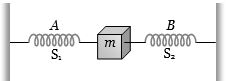
- 9In the figure, ${S_1}$ and ${S_2}$ are identical springs. The oscillation frequency of the mass $m$ is $f$. If one spring is removed, the frequency will becomeView Solution
- 10A ring is hung on a nail. It can oscillate, without slipping or sliding $(i)$ in its plane with a time period $T_{1}$ and, $(ii)$ back and forth in a direction perpendicular to its plane, with a period $T _{2}$. the ratio $\frac{ T _{1}}{ T _{2}}$ will beView Solution