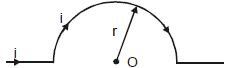
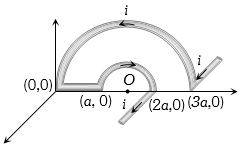
A portion of a conductive wire is bent in the form of a semicircle of radius $r$ as shown below in fig. At the centre of semicircle, the magnetic induction will be
Medium


Download our appand get started for free
Experience the future of education. Simply download our apps or reach out to us for more information. Let's shape the future of learning together!No signup needed.*
Similar Questions
- 1A tightly wound $100$ turns coil of radius $10 \mathrm{~cm}$ carries a current of $7 \mathrm{~A}$. The magnitude of the magnetic field at the centre of the coil is (Take permeability of free space as $4 \pi \times 10^{-7} \mathrm{SI}$ units):View Solution
- 2View SolutionThe magnetic field at the centre of current carrying coil is
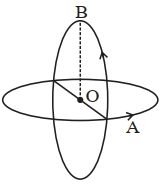
- 3Two insulated circular loop $A$ and $B$ radius ' $a$ ' carrying a current of ' $\mathrm{I}$ ' in the anti clockwise direction as shown in figure. The magnitude of the magnetic induction at the centre will be :View Solution
- 4A charge $q$ $coulomb$ moves in a circle at $n$ revolutions per second and the radius of the circle is $r$ $metre$. Then magnetic field at the centre of the circle isView Solution
- 5In a hydrogen atom, an electron of mass $m$ and charge $e$ revolves in an orbit of radius $r$ making $n$ revolutions per second. If the mass of hydrogen nucleus is $M$, the magnetic moment associated with the orbital motion of electron isView Solution
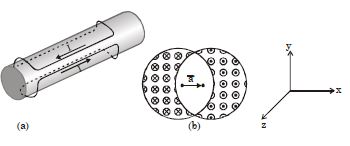
- 6To produce a uniform magnetic field directed parallel to a diameter of a cylindrical region, one can use the saddle coils illustrated in figure. The loops are wrapped over a somewhat flattened tube. Assume the straight sections of wire are very long. The end view of the tube shows how the windings are applied. The overall current distribution is the superposition of two overlapping,circular cylinders of uniformly distributed current, one toward you and one away from you. The current density $J$ is the same for each cylinder. The position of the axis of one cylinder is described by a position vector a relative to the other cylinder. The magnetic field inside the hollow tube is.View Solution
- 7There are $50$ $turns$ of a wire in every $cm$ length of a long solenoid. If $4\, ampere$ current is flowing in the solenoid, the approximate value of magnetic field along its axis at an internal point and at one end will be respectivelyView Solution
- 8View SolutionFrom Ampere's circuital law for a long straight wire of circular cross-section carrying a steady current, the variation of magnetic field in the inside and outside region of the wire is :
- 9In the given figure net magnetic field at $O$ will beView Solution
- 10A wire of magnetic moment $M$ is moulded according to figure, then magnetic moment becomesView Solution