In a hydrogen atom, an electron of mass $m$ and charge $e$ revolves in an orbit of radius $r$ making $n$ revolutions per second. If the mass of hydrogen nucleus is $M$, the magnetic moment associated with the orbital motion of electron is
Easy


Download our appand get started for free
Experience the future of education. Simply download our apps or reach out to us for more information. Let's shape the future of learning together!No signup needed.*
Similar Questions
- 1A proton with a kinetic energy of $2.0\,eV$ moves into a region of uniform magnetic field of magnitude $\frac{\pi}{2} \times 10^{-3}\,T$. The angle between the direction of magnetic field and velocity of proton is $60^{\circ}$. The pitch of the helical path taken by the proton is $..........cm$ (Take, mass of proton $=1.6 \times 10^{-27}\,kg$ and Charge on proton $=1.6 \times 10^{-19}\,kg)$View Solution
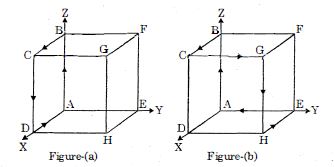
- 2Current $I$ is flowing along the path $ABCDA$ consisting of four edges of a cube (figure $-a$), produces a magnetic field $B_0$ at the centre of the cube. Find the magnetic field $B$ produced at the center of the cube by a current $I$ flowing along the path of the six edges $ABCGHEA$ (figure $b$)View Solution
- 3An electron having mass $m$ and kinetic energy $K$ enter in uniform magnetic field $B$ perpendicularly, then its frequency will beView Solution
- 4The electric current in a circular coil of $2$ turns produces a magnetic induction $B _{1}$ at its centre. The coil is unwound and is rewound into a circular coil of $5$ turns and the same current produces a magnetic induction $B _{2}$ at its centre.The ratio of $\frac{ B _{2}}{ B _{1}}$ is.View Solution
- 5Two coaxial solenoids $1$ and $2$ of the same length are set so that one is inside the other. The number of turns per unit length are ${n_1}$ and ${n_2}$. The currents ${i_1}$ and ${i_2}$ are flowing in opposite directions. The magnetic field inside the inner coil is zero. This is possible whenView Solution
- 6At what distance for a long straight wire carrying a current of $12\, A$ will the magnetic field be equal to $3 \times 10^{-5} Wb / m ^{2}$ ?View Solution
- 7A galvanometer $G$ deflects full scale when a potential difference of $0.50 $ $V$ is applied. The internal resistance of the galvanometer $r_g$ is $25$ $ohms$. An ammeter is constructed by incorporating the galvanometer and an additional resistance $R_S$. The ammeter deflects full scale when a measurement of $2.0$ $A$ is made. The resistance $R_S$ is closest to : ................. $\Omega$View Solution
- 8One proton beam enters a magnetic field of ${10^{ - 4}}$ $T$ normally, Specific charge = ${10^{11}}\,C/kg.$ velocity = ${10^7}\,m/s$. What is the radius of the circle described by it....$m$View Solution
- 9A electron experiences a force $\left( {4.0\,\hat i + 3.0\,\hat j} \right)\times 10^{-13} N$ in a uniform magnetic field when its velocity is $2.5\,\hat k \times \,{10^7} ms^{-1}$. When the velocity is redirected and becomes $\left( {1.5\,\hat i - 2.0\,\hat j} \right) \times {10^7}$, the magnetic force of the electron is zero. The magnetic field $\vec B$ is :View Solution
- 10View SolutionWhich of the following figures correctly depicts the direction of magnetic field of a current-carrying coil ?