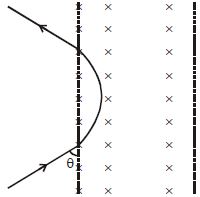
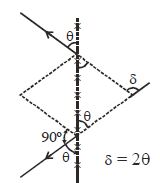
A positively charged particle enters in a region of uniform. Transverse magnetic field as shown in figure find net deviation in path of the particle.
Medium
Download our app for free and get started

Download our appand get started for free
Experience the future of education. Simply download our apps or reach out to us for more information. Let's shape the future of learning together!No signup needed.*
Similar Questions
- 1A horizontal overhead power line is at a height of $4\,m$ from the ground and carries a current of $100\,A$ from east to west. The magnetic field directly below it on the ground is $(\mu _0 = 4\pi \times 10^{-7}\,TmA^{-1})$View Solution
- 2In an ammeter, $5 \%$ of the main current passes through the galvanometer. If resistance of the galvanometer is G, the resistance of ammeter will be :View Solution
- 3In a moving coil galvanometer, the deflection of the coil $\theta $ is related to the electrical current $i$ by the relationView Solution
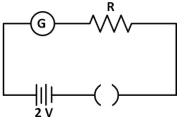
- 4A galvanometer has a $50$ $division$ scale. Battery has no internal resistance. It is found that there is deflection of $40$ $divisions$ when $R = 2400\,\Omega $. Deflection becomes $20$ $divisions$ when resistance taken from resistance box is $4900\,\Omega $ . Then we can concludeView Solution
- 5View SolutionThe direction of magnetic lines of force produced by passing a direct current in a conductor is given by
- 6A charge $q$ $coulomb$ moves in a circle at $n$ revolutions per second and the radius of the circle is $r$ $metre$. Then magnetic field at the centre of the circle isView Solution
- 7An electron is moving along the positive $X$-axis. You want to apply a magnetic field for a short time so that the electron may reverse its direction and move parallel to the negative $X$-axis. This can be done by applying the magnetic field alongView Solution
- 8If the angular momentum of an electron is $\overrightarrow {J\,} $ then the magnitude of the magnetic moment will beView Solution
- 9Two particles $x$ and $y$ have equal charges and possessing equal kinetic energy enter in a uniform magnetic field and describe circular path of radius of curvature $r_1$ and $r_2$ respectively. The ratio of their masses isView Solution
- 10Two mutually perpendicular conductors carrying currents $I_1$ and $I_2$ lie in one plane. Locus of the point at which the magnetic induction is zero, is aView Solution