The direction of magnetic lines of force produced by passing a direct current in a conductor is given by
Easy


Download our appand get started for free
Experience the future of education. Simply download our apps or reach out to us for more information. Let's shape the future of learning together!No signup needed.*
Similar Questions
- 1The resistance of a galvanometer is $25\, ohm$ and it requires $50\,\mu A$ for full deflection. The value of the shunt resistance required to convert it into an ammeter of $5\, amp$ isView Solution
- 2A uniform beam of positively charged particles is moving with a constant velocity parallel to another beam of negatively charged particles moving with the same velocity in opposite direction separated by a distance $d.$ The variation of magnetic field $B$ along a perpendicular line draw between the two beams is best represented byView Solution
- 3View SolutionAssertion : Cyclotron does not accelerate electron.
Reason : Mass of the electrons is very small
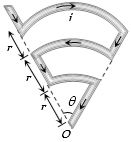
- 4Find magnetic field at $O$View Solution
- 5Two charged particles, having same kinetic energy, are allowed to pass through a uniform magnetic field perpendicular to the direction of motion. If the ratio of radii of their circular paths is $6: 5$ and their respective masses ratio is $9: 4$. Then, the ratio of their charges will be.View Solution
- 6A cylindrical conductor of radius $'R'$ carries a current $'i'$. The value of magnetic field at a point which is $R/4$ distance inside from the surface is $10\,T$. Find the value of magnetic field at point which is $4R$ distance outside from the surfaceView Solution
- 7View SolutionThe tangent galvanometer, when connected in series with a standard resistance can be used as
- 8View SolutionA uniform electric field and a uniform magnetic field are produced, pointed in the same direction. An electron is projected with its velocity pointing in the same direction
- 9The average dipole moment of $Fe$ atoms is $1.8 × 10^{-23}\ A-m^2$ . The magnetic moment of an iron rod of length $10\ cm$ and diameter $1\,cm$ is........$A-m^2$ : (density and at. wt. of $Fe$ are $7.87\ g/cm^3$ and $55.87$ )View Solution
- 10The flux density obtained at the centre of a circular coil of radius $R$ which carries a current $i$, is $B_0$. At a distance $‘pR’$ from the centre on the axis, the flux density will beView Solution